IMI STI UD derivative unit for exhaust amplification on pneumatic actuators
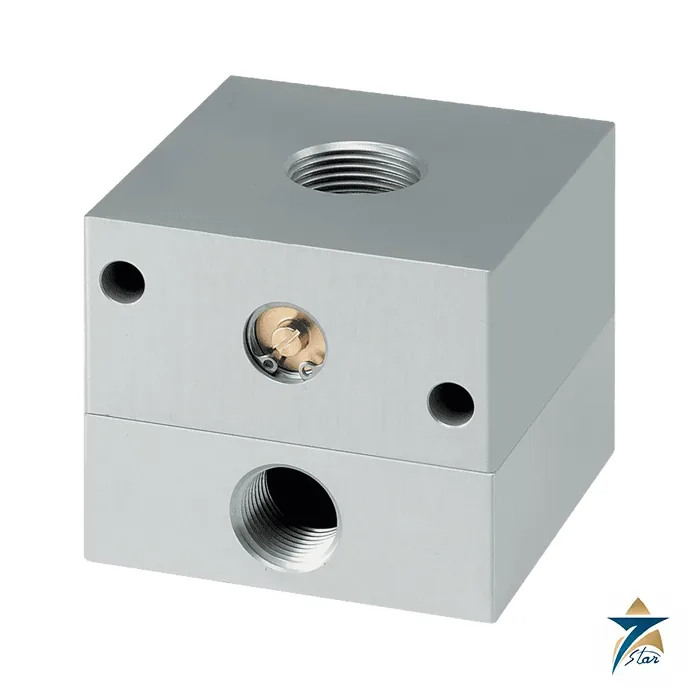
The IMI STI UD is a pneumatic derivative unit. Its job is to amplify the exhaust flow of a positioner or pilot circuit so that a pneumatic actuator can vent faster, while a built-in regulation screw lets the installer tune that speed against the stability of the loop. The UD is used on modulating control valves, where exhaust speed has to be balanced against overshoot, and also on on/off systems where quick venting is wanted. Seven Star LLC supplies the IMI STI UD in Oman and the GCC as an independent supplier in Muscat.
The UD has no suffix-based ordering code in the brochure. It is defined by housing material (anodised aluminium or stainless steel 316), a temperature option, the pilot activation version and the connection set, all of which are covered in the sections below so that an enquiry can be written without guesswork.
Technical specifications of the UD derivative unit
| Parameter |
Specification |
| Manufacturer / part number |
IMI STI (Process Automation) / UD derivative unit |
| Function |
Exhaust amplification for modulating and on/off pneumatic circuits |
| Housing materials |
Anodised aluminium or stainless steel 316 |
| Operating pressure |
3 bar minimum, 7 bar maximum; design pressure 10 bar |
| Pilot signal connection |
1/2″ NPT |
| Actuator connections |
Manifold mounting, 1/2″ NPT |
| Exhaust connections |
3/4″ NPT |
| Exhaust Cv (max) |
3.8, adjustable from 0 to 3.8 with the regulation screw |
| Operating temperature options |
-20°C to 70°C, -40°C to 70°C or -20°C to 85°C; other ranges on request |
| Weight |
Aluminium 1 kg; stainless steel 316 2.7 kg |
| Actuator types |
Single and double acting |
| Ambient conditions |
Standard, offshore, sandstorm and copper-free |
The product page for the UD additionally lists ATEX and IECEx under certification. If your project requires certificates or a specific marking, state that in the enquiry so the applicable documents can be confirmed before an order is placed.
How the UD derivative unit works
In a conventional positioner-actuator loop the exhaust path is limited by the small passages inside the positioner. When the actuator has a large air volume, venting through those passages is slow and the valve is sluggish in the closing or opening direction that depends on exhaust. The UD adds a larger exhaust path in parallel with the positioner output, so air leaves the actuator chamber through a port rated for a Cv of up to 3.8 instead of through the positioner alone.
Because a faster exhaust can make a loop unstable, the UD is not simply a quick-exhaust valve. It is built for modulation. A regulation screw sets how far the exhaust path opens, so the commissioning engineer can raise exhaust speed step by step until the valve is fast enough without hunting. The screw is designed so that internal air pressure cannot eject it, which removes a failure mode that can be a hazard on a pressurised unit. The brochure also notes full tight, zero-leakage behaviour when the unit is not exhausting, so it does not bleed air in steady state.
Two activation versions are offered for the pilot side. The brochure describes flow ranges of 0.1 to 0.8 Cv and 0.8 to 2.5 Cv for these versions. The smaller range suits fine modulating duty on smaller actuators, while the larger one suits bigger volumes or on/off use. Confirm the version against the actuator volume and the required stroking time.
Manifold mounting and connections on the UD
IMI STI uses a manifold mounting system for its accessories. Instead of connecting fittings and nipples between a positioner, booster and actuator, machined connection faces with an O-ring seal bolt directly together. For the UD this means the 1/2″ NPT actuator connection is made on the manifold face, and the 3/4″ NPT exhaust connection is available for collecting the exhaust to a safe location.
- Fewer fittings means fewer leak points and a shorter pneumatic path.
- The shortened dimensions save space on crowded actuator yokes.
- The actuator connection can be adjusted every 90°, so the unit can be oriented to suit the tubing layout.
- Fewer loose parts also reduces the spares inventory a plant has to hold.
Where the UD fits in the IMI STI accessory range
The UD sits between a positioner and the actuator, typically beside an IMI STI volume booster. Within the same instrument-valve family the IMI STI AV volume booster increases supply flow to the actuator, while the SL exhaust protection system is a flange-mounted silencer with check valve for the exhaust side. A common arrangement for a fast, large actuator is a positioner such as the FasTrak FTC or SR/CCK, an AV booster to feed air, and the UD to open the exhaust path under control. Each part solves a different half of the speed problem, so they are specified together and not as alternatives.
Selection and ordering checklist for the UD
- Housing material: anodised aluminium for general plant air, or stainless steel 316 for offshore, coastal and corrosive atmospheres.
- Temperature range: pick the option that covers the lowest and highest ambient at the valve, including solar heating of skid equipment.
- Actuator: single or double acting, and the total air volume to be exhausted.
- Supply pressure: must stay within 3 to 7 bar, design pressure 10 bar.
- Pilot activation version and the required speed of response.
- Whether the exhaust is to be collected to a pipe or vented locally.
Installation, tuning and maintenance of the UD
Install the UD on the manifold face with the O-ring in place and fasteners tightened evenly. Make sure the supply is filtered and dry; instrument air quality matters more for a unit with small calibrated passages than for a plain tubing fitting. Start with the regulation screw closed, stroke the valve in the exhaust direction and open the screw gradually while watching the valve travel on a recorder or the positioner display. Stop when the stroking time is acceptable and no overshoot appears on small setpoint steps. Lock the setting once tuned.
In service, inspect for exhaust-port blockage, especially if a collected exhaust line is fitted, and confirm there is no leakage at the manifold O-ring. Because the unit has no electrical parts, maintenance is limited to cleaning, seal replacement and re-checking the screw setting after any actuator or positioner change.
Typical UD applications in Oman and the GCC
In Oman and across the GCC, pneumatic accessories work in some of the harshest conditions for instrumentation: coastal humidity and salt on oil and gas platforms, fine dust and sand at inland gas plants and power stations, and high ambient temperatures in summer. The UD is offered in housing options and temperature ranges intended for standard, offshore and sandstorm conditions, which is why it is specified for control valves on gas processing trains, desalination plants and petrochemical units where valve speed is a process requirement. Large anti-surge, depressurisation and fast-stroking control valves are typical candidates because their actuator volume makes exhaust speed the limiting factor.
IMI STI UD variants at a glance
| Version |
Housing |
Weight |
Typical use |
| Aluminium, manifold mounted |
Anodised aluminium |
1 kg |
General industrial use; lower weight |
| Stainless steel 316, manifold mounted |
316 stainless |
2.7 kg |
Offshore, coastal, corrosive atmospheres |
Information to send with a UD request
- Part name UD and quantity, with the housing material.
- Temperature option or the minimum and maximum ambient temperature.
- Actuator type, size and supply pressure.
- Positioner and booster model used in the same circuit.
- Exhaust arrangement: collected line or local vent.
- Hazardous-area requirement and any certificate needed.
Documents and quotation
A brochure for the IMI STI UD is attached on this page. It shows the specifications and dimensional drawing summarised above.
Send the part number, quantity and required options to Seven Star LLC and we will confirm lead time and any additional documents available for the UD derivative unit.




















Reviews
There are no reviews yet.