A compact rotary table with a low profile
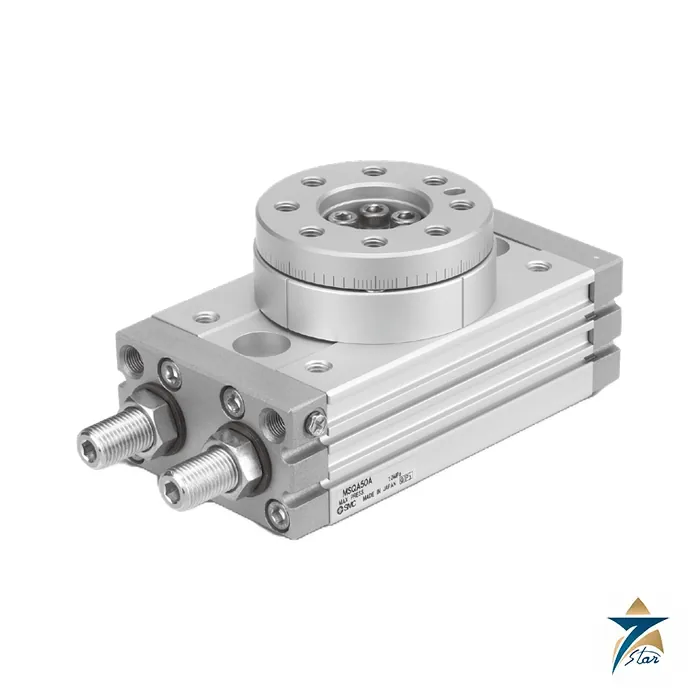
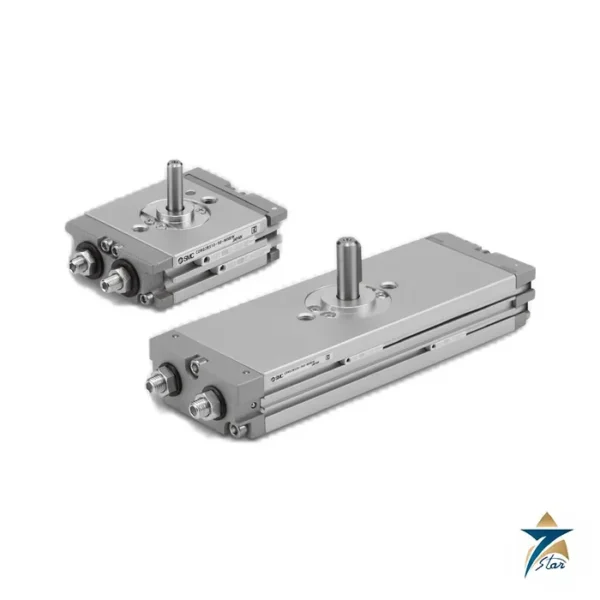
MSQB7A is a basic-type rotary table of the rack and pinion kind from the SMC MSQ series. Instead of a shaft, it has a round table on a large rolling-element bearing, so a plate, a gripper or a workpiece can be fixed straight on the table and swung through an angle. The low table height saves space in assembly machines, and the table inside and outside diameters are held to tolerances that make fitting easy.
The code reads MSQ (series), B (basic type; A is the high-precision type), 7 (size 7, cylinder bore 12 mm) and A (with angle adjustment bolts). No port-location letter is added, so the ports are on the end face; E would move them to the front. The catalogue states that the port location cannot be changed after delivery.
Technical specifications
| Parameter |
Specification |
| Series / type |
MSQ rotary table, rack and pinion, basic type (MSQB) |
| Size / cylinder bore |
7 / 12 mm |
| Fluid |
Air (non-lube) |
| Maximum operating pressure |
0.7 MPa |
| Minimum operating pressure |
0.1 MPa |
| Ambient and fluid temperature |
0 to 60 deg C (no freezing) |
| Angle adjustment range |
0 to 190 deg |
| Maximum rotation |
190 deg |
| Port size |
M5 x 0.8 |
| Allowable kinetic energy |
0.006 J |
| Rotation time adjustment range |
0.2 to 1.0 s per 90 deg for size 7 |
| Weight |
250 g (basic type, excluding auto switch) |
Basic type or high-precision type
The basic type MSQB suits general turning duties, while the MSQA is the high-precision type, which weighs slightly more (265 g for size 7 against 250 g). The choice depends on how accurately the table must repeat its position; the precision figures are in the catalogue. A catalogue Clean Series is also described, with a vacuum port that draws away particles generated inside the unit, but that is a different code with the prefix 11.
With the adjustment bolt option A fitted, the angle can be set anywhere between 0 and 190 degrees, which is more flexible than a fixed 90 or 180 degree stop.
Application notes
The kinetic energy limit of 0.006 J is small; a plate with a heavy tool at the end of an arm will exceed it, so use speed controllers on both ports to slow the movement and check the inertia of the load against the catalogue. Fit the speed controllers on the exhaust side and try the 0.2 to 1.0 second per 90 degrees range first.
Use a mounting position away from magnetic material when auto switches are used: the catalogue notes that magnetic substances within about 10 mm can affect the sensor.
Mount the unit on a flat surface so that the body is not twisted by the fixing bolts, and keep the table clear of side pushes during the swing. If the work attached to the table is off-centre, check the moment as well as the kinetic energy, and consider a separate stopper outside the actuator for heavy tools.
Sizing the load before choosing size 7
Size 7 is the light end of a rotary table selection, so the load check deserves more care than the stroke angle. Work out the mass of everything that turns with the table, including the fixture plate, gripper, fittings and the part itself, then estimate its moment of inertia about the table axis. Combine that with the rotation time you need and compare the resulting kinetic energy with the 0.006 J limit. If the load only fits by making the swing very slow, and the cycle time cannot accept that, the application is asking for a larger actuator rather than tighter speed control.
Keep the turning mass close to the centre where possible. A short, compact gripper mounted directly on the table is far kinder to the bearing and the rack than the same gripper at the end of a long arm, even though the mass is the same.
Installation and first run
- Blow out the supply lines before connecting them to the M5 x 0.8 ports, as chips and sealing tape fragments can jam the small passages of a size 7 unit.
- Supply clean, dry, non-lubricated air within the 0.1 to 0.7 MPa range, and use the lowest pressure that turns the load reliably.
- Fit the speed controllers fully closed, then open them gradually while cycling the table so that the first movements are slow.
- Set the angle adjustment bolts with the air off, cycle the unit, and fine-tune the end positions in small steps before locking the bolts.
- If auto switches are fitted, set their positions after the end positions are final and check that each switch changes state at both ends.
Maintenance and troubleshooting
A table that bounces or knocks at the end of the swing is usually running too fast for its load; slow it with the speed controllers before it damages the rack and pinion. If the end position drifts over time, check whether the adjustment bolt lock nuts have loosened. Jerky or slow motion often points to low supply pressure, a partly blocked fitting or water in the line. Air leaking from the body or ports at rest suggests worn seals, and the unit should be inspected or replaced rather than run with a leak.
Notes for automation in Oman and the GCC
Compressed air in hot, humid coastal plants carries a lot of moisture, and condensate in the line is one of the main causes of corrosion and sticking in small pneumatic actuators. Fit a suitable dryer or at least an effective filter and drain upstream of the valve that serves the table. The upper ambient limit of 60 deg C is easy to exceed inside an unventilated machine enclosure in summer, so check temperatures near the actuator during the hottest months. On packaging and assembly lines that handle dusty products, keep the area around the table clean so that fine dust does not build up on the bearing gap.
Documents and quotation
The SMC MSQ catalogue PDF below has the how-to-order page, specification tables and dimension drawings. Please confirm size, type, port position and auto-switch needs before ordering. More actuators are listed under Pneumatic Cylinders. Seven Star LLC is an independent supplier and quotes the exact code on request.















Reviews
There are no reviews yet.