A Zone 1 fixed monitor for benzene at 0.02 to 20 ppm
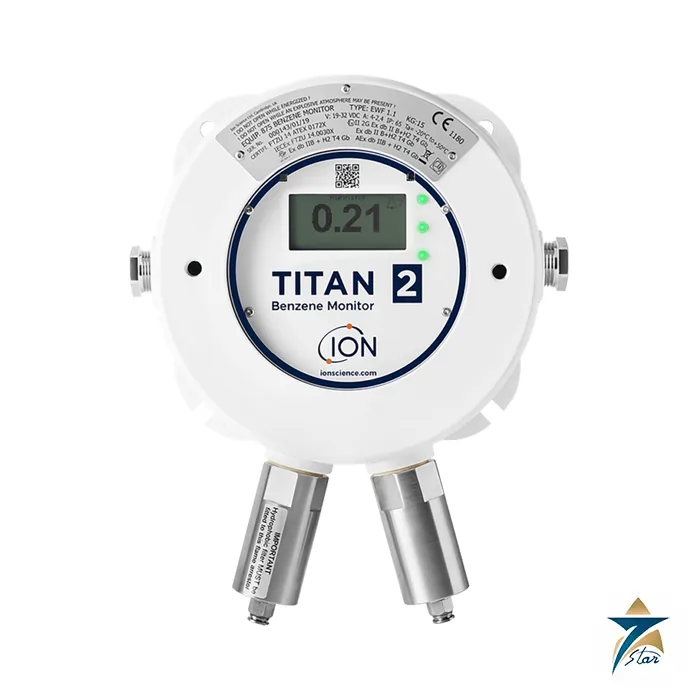
The ION Science Titan 2 is a fixed benzene monitor certified for Zone 1 hazardous areas. It samples ambient air once per minute, separates benzene from other VOCs with an AirSep filter, and measures it with a MiniPID T2 10.0 eV sensor, reporting both the current concentration and the 15-minute STEL. Readings appear on the backlit LCD and on an isolated 4-20 mA channel, with RS485 Modbus and USB for data, and two programmable relays handle alarms. It is aimed at petrochemical sites where benzene exposure must be monitored continuously at the fence line or in process areas.
Technical specifications
| Parameter |
Specification |
| Sensor |
MiniPID T2 10.0 eV; benzene specific within a typical petrochemical matrix |
| Detectable range |
0.02 to 20 ppm; limit of detection 0.02 ppm (20 ppb), 10 ppb resolution |
| Accuracy |
+/-50 ppb or +/-10%, whichever is greater (+/-10 ppb for readings of 0.1 ppm or below); +/-20% at +55 C |
| Measurement frequency |
One sample per minute; STEL calculated over previous 15 minutes |
| Sample flow and line |
Flow 100 ml/min or more; PTFE sample line up to 10 m, 6 mm OD, 4 mm ID |
| Display |
Graphic black-and-white LCD 64 x 128 with backlight; bright LEDs for normal, fault and alarm; two magnetic switches |
| Outputs |
Isolated 4-20 mA; isolated RS485 Modbus (ASCII or RTU); micro USB; two voltage-free relays 24 VDC at 1.25 A |
| Default alarms |
Alarm 1 5.0 ppm live; Alarm 2 0.5 ppm STEL; relays N/O, both programmable |
| Power |
24 VDC nominal at 3.2 A; 19 VDC at 4.0 A minimum; 32 VDC at 2.4 A maximum; 4-20 mA loop needs its own 24 to 32 VDC |
| Data storage |
Onboard MMC, six months minimum (2 GB) |
| Operating temperature |
Recommended -20 to 50 C; do not install where ambient exceeds 55 C |
| Ingress protection and humidity |
IP65; 0 to 99% RH |
| Cable entries |
Two 3/4 in NPT gland threads |
| Size and weight |
219 x 219 x 172 mm (approx.); 15 kg |
| Approvals as printed |
ATEX 4FTZU 14 ATEX 0172X, II 2G Ex db IIB+H2 T4 Gb; IECEx FTZU 14.0030X Ex db IIB+H2 T4 Gb; QPS LR1621-1 Ex db IIB+H2 T4 Gb / AEx db IIB+H2 T4 Gb; Tamb -20 to +55 C |
The manual states the relay rating as 1.25 A in the specification table and 1.5 A in the alarm chapter; use the lower figure for design.
Maintenance and installation
Titan 2 is built from a permanently installed Housing Module and a removable Detection Module that holds all operating and calibration data, so a module calibrated off-site can be swapped in without recalibrating the installed unit. Service intervals in the manual are six months for the PID lamp, electrode stack, inline filter, VRV restrictor and hydrophobic and carbon filters, and twelve months where the AirSep filter is also replaced. There is no forced cooling, so keep ambient below 55 C and protect the sample line from condensation. Position sampling points to represent the exposure area, and confirm the zone, gas group (IIB+H2) and sample-line routing before ordering.
How the ION Science Titan 2 works
The Titan 2 draws a sample of air once every minute through a PTFE line. An AirSep filter removes other volatile compounds, so that benzene is the main compound that reaches the detector. A MiniPID T2 photoionisation sensor with a 10.0 eV lamp ionises the benzene, and the current is turned into a reading in parts per million. The monitor shows the live value and a 15-minute short-term exposure value, sends them on a 4-20 mA signal and Modbus, and trips relays at the alarm levels.
Where the ION Science Titan 2 is used
- Petrochemical plants and refineries
- Fence-line benzene monitoring
- Storage terminals and loading areas
- Process areas in Zone 1
- Sites that must log benzene exposure over time
Selection checklist for the Titan 2
- Detectable range of 0.02 to 20 ppm benzene
- Zone 1 approval, ATEX and IECEx marking
- Sample line length of up to 10 m
- Outputs: 4-20 mA, RS485 Modbus, USB and two relays
- Supply of 24 VDC
- Ambient temperature, up to 55 degrees C
- Protection rating of IP65
- Cable entries of two 3/4 inch NPT glands
Installation, commissioning and maintenance notes
Mount the monitor where a sample of the area can reach it by a short line, and keep the line as straight and short as the layout allows. Wire the 24 VDC supply, the 4-20 mA loop and the alarm relays through certified glands. Set the alarm levels to the site limits, run a calibration check with a benzene test gas, and check the pump, filter and lamp at planned intervals.
Requesting a quotation for the ION Science Titan 2
Please send the site, the alarm levels, the output signals and the sample line length needed. Seven Star LLC serves industrial customers in Oman and the GCC and replies with a quotation based on the information provided.
Titan 2 accuracy
The accuracy is 50 ppb or 10 percent, whichever is greater, and the resolution is 10 ppb.
Titan 2 alarms
The default alarms are 5.0 ppm for the live reading and 0.5 ppm for the 15-minute value, and both relays can be programmed.
Titan 2 display and data
A backlit LCD shows the readings, and bright LEDs show normal, fault and alarm. An onboard memory keeps at least six months of data.
Titan 2 size and weight
The monitor measures about 219 x 219 x 172 mm and weighs 15 kg.
Gas monitor records for Titan 2
Keep the calibration gas certificate, the alarm settings and the filter change dates with the monitor file.
Choosing the right Titan 2 configuration
Define the benzene limit, the number of sample points, the distance to the monitor and the signals the control room needs before ordering. This avoids rework on site.
Titan 2 site planning
Plan power, cable routes and a protected position for the monitor, and keep the sample line short, clean and free of kinks so the response stays quick.
Documents and quotation
The attached file is the Titan 2 instrument user manual (V1.0, 66 pages); no separate datasheet is linked from the product page. For a handheld VOC survey instrument see the
ION Science Tiger XT.
and
gas analyzer systems. Send the number of monitoring points, sample line length, power and relay needs for a quotation.










Reviews
There are no reviews yet.