- Automation & ControlView all 1,676 products
- AC Drives
- Industrial Communications
- PLC & I/O Cards
- Vibration Monitoring
- Automation Accessories
- Controllers & Data Acquisition
- CCTV & Security
- Safety Switches & Guard Locking
- Encoders
- Isolator & Barrier
- Industrial Computers
- Servo Drives
- Motor Soft Starters
- HMI Displays
- Pneumatic Cylinders
- Automation Software
- Machine Vision
- Robotics
















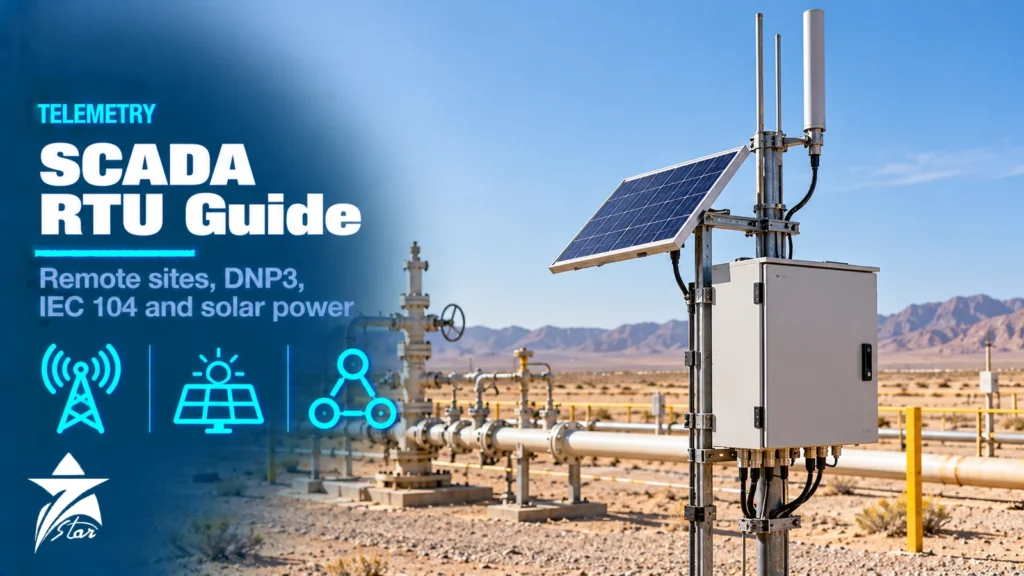
A wellhead 80 km from the nearest camp, a borehole pump station on the edge of the desert, a pipeline block valve with no grid power: these sites still need to report pressure, flow and alarms every few seconds and accept commands from a control room. A SCADA RTU (remote terminal unit) is the field device that makes this possible, collecting I/O, time-stamping events and pushing data over radio, cellular or satellite links that are slow, expensive or intermittent. This guide covers how RTUs differ from PLCs, the telemetry options, how DNP3, IEC 60870-5-104, Modbus and MQTT behave on poor links, how to power a site from solar, and the specification data an engineer should prepare.
What an RTU Does in a SCADA System
A SCADA system has three layers: the control centre (SCADA servers, historian, operator stations), the communication network, and the field devices. The RTU sits at the field end. Its job is not only to read and write I/O but to make a weak link look reliable to the control centre.
- Acquire: analog inputs from transmitters, digital inputs from switches and breakers, pulse inputs from meters, and serial data from flow computers, VFDs and analyzers.
- Time-stamp at source: record each change of state with the RTU’s own clock, so the sequence of events is correct even if the data arrives minutes later.
- Buffer and report by exception: store events locally and send only changes, rather than having the master poll every point continuously.
- Control: execute select-before-operate commands such as start pump, close valve or change set point, often with local interlocks that work even when communications are lost.
- Run local logic: pump alternation, tank fill control, well shutdown sequences and sometimes flow calculations, programmed in IEC 61131-3 languages.
RTU vs PLC: Where the Line Really Is
Modern PLCs can speak DNP3 and many RTUs run IEC 61131-3 logic, so the two have converged. The difference is in what each is optimised for.
| Feature | Typical RTU | Typical PLC |
|---|---|---|
| Primary design goal | Reliable data over long-distance, low-bandwidth links | Fast, deterministic local machine or process control |
| Power consumption | Low, designed for solar and battery sites | Higher, assumes mains power and a cabinet supply |
| Operating temperature | Often wide range, for unconditioned outdoor enclosures | Often narrower; extended-temperature variants available |
| Telemetry protocols | DNP3, IEC 60870-5-101/104 native, with event buffering | Usually via add-on modules or gateways |
| Event time-stamping | Built in, typically with GPS or network time sync | Possible but often needs extra configuration |
| Scan speed and I/O count | Moderate; small to medium I/O count | Fast scan; scales to large I/O counts |
| Typical sites | Wellheads, pipeline valves, water wells, reservoirs, substations | Process units, packaged skids, machines |
On larger remote installations, such as a gas compression station or a water treatment plant, a common pattern is a PLC for local control with an RTU or a communication gateway handling the link to the central SCADA. On small wellheads and water wells, a single RTU does both. See our range of controllers and data acquisition products for RTU and logger hardware.
Telemetry Options for Remote Sites
The communication link usually decides the project more than the RTU itself. Most networks use a mix, with a backup path for critical sites.
| Link | Strengths | Limitations | Typical use |
|---|---|---|---|
| Licensed UHF/VHF radio | Owned by the operator, no per-message cost, long range with line of sight | Low bandwidth, needs licensing, masts and path studies | Water networks, pipeline valves, wellhead clusters |
| Cellular (4G/LTE, private LTE) | Higher bandwidth, quick to deploy, supports IP protocols | Coverage gaps in remote desert areas, depends on carrier | Water wells near towns, distribution reservoirs |
| Satellite (VSAT or L-band services) | Coverage almost anywhere | Latency, per-data cost on some services, weather and dish alignment | Isolated wells and pipeline sites beyond radio range |
| Fibre or microwave backbone | High bandwidth, low latency | Expensive to install; justified for major stations | Compression and pump stations, substations |
Whatever the medium, design for the link failing. The RTU should keep logging and controlling locally, buffer events, and back-fill the historian when the link returns.
Protocols: DNP3, IEC 60870-5-104, Modbus and MQTT
DNP3 (IEEE 1815)
DNP3 was developed for utility and telemetry use and is common in water, oil and gas and power distribution. It supports event classes so that important changes are reported first, unsolicited responses so the outstation can report without waiting for a poll, time synchronisation, and time-stamped event buffers. Over IP networks it commonly uses TCP or UDP port 20000. Secure Authentication adds challenge-response protection for critical commands, but it does not encrypt traffic, so it is usually combined with TLS or a VPN.
IEC 60870-5-101 and -104
IEC 60870-5-101 is the serial telecontrol profile; IEC 60870-5-104 carries the same application data over TCP/IP, typically on TCP port 2404. It is widely used by electricity utilities and grid operators and therefore appears in substations, solar plants and some water utilities that align with power-sector practice. Like DNP3 it supports spontaneous transmission and time-tagged events. IEC 62351 defines security extensions for these protocols.
Modbus RTU and Modbus TCP
Modbus is simple and almost universal, which is why flow computers, analyzers and drives at the site often expose their data this way. It is a poll-response protocol with no native time-stamps or event buffering, so over slow links it wastes bandwidth polling unchanged values. A common design is to use Modbus locally between devices and the RTU, and DNP3 or IEC 104 from the RTU to the control centre.
MQTT with Sparkplug
MQTT is a publish-subscribe protocol from the IT world. With the Sparkplug specification it gains defined topics, state awareness and report-by-exception behaviour, which makes it efficient on cellular and satellite links. It suits new IIoT-style networks and cloud historians, while DNP3 and IEC 104 remain dominant where utilities or established SCADA platforms set the standard. For a wider comparison of field protocols, see our article on industrial communication protocols.
Powering Remote RTUs: Solar, Batteries and Power Budgets
Many remote wellheads and water wells have no grid connection, or the pump has power but the instrumentation must survive outages. A solar-battery system sized from an honest power budget is the usual answer.
- List every load with its average and peak current: RTU, radio or modem (transmit and idle), transmitters, solenoids, heaters or cooling fans, cathodic protection monitoring.
- Estimate duty cycles. A radio that transmits for a few seconds every minute draws far less on average than its transmit rating suggests; a cellular modem that stays connected draws continuously.
- Choose days of autonomy. Decide how many days the site must run without useful sun, considering dust storms and how quickly a technician can reach it.
- Size the battery for that autonomy, then derate for temperature and the allowed depth of discharge for the chemistry selected.
- Size the panel to recharge the battery while carrying the daily load, allowing for soiling, panel temperature losses and charge controller efficiency.
In the Gulf the solar resource is strong, but heat and dust work against both panels and batteries. Panels lose output as cell temperature rises, sand deposits cut production until cleaned, and battery life falls sharply at high temperature. Shading the battery enclosure, ventilating it, and selecting batteries rated for high-temperature service often matter more than adding panel capacity. Components for these systems are available in our solar power range.
Enclosures and Environmental Design for Desert Sites
- Heat: unconditioned outdoor cabinets in direct sun run far hotter than ambient. Use sunshields, double-skin roofs, light-coloured or stainless enclosures and equipment rated for the real internal temperature.
- Dust: IP65 or IP66 enclosures with filtered breathers; avoid fan-cooled designs whose filters clog between visits.
- H2S and sour gas: at oil and gas sites, corrosive gas attacks copper and silver on circuit boards. Conformal-coated electronics and sealed enclosures extend life.
- Hazardous areas: wellheads and manifolds are often classified. The RTU enclosure may need to be outside the zone, or the equipment certified for the zone with intrinsically safe field circuits.
- Lightning and surges: long cable runs to masts and remote transmitters need surge protection on antenna feeders, power and signal lines, with a proper earthing system.
Cybersecurity for Remote Telemetry
Remote RTUs are physically exposed and their links cross public networks, so security has to be designed in from the start rather than added later. The IEC 62443 series provides the overall framework for industrial automation security. Practical measures include private APNs or VPNs for cellular links, no direct internet exposure of RTU ports, DNP3 Secure Authentication or TLS where the master supports it, unique credentials per device, disabled unused services, signed firmware, and logging of configuration changes. Physical measures such as locked cabinets and door-open alarms are just as important at unmanned sites.
Typical SCADA RTU Applications in Oil, Gas and Water
- Wellhead monitoring: tubing and casing pressure, flowline temperature, ESP or rod-pump status, chemical injection rates and emergency shutdown valve position.
- Pipelines: block valve stations, pressure and leak detection inputs, cathodic protection readings and pig signallers.
- Gas metering: RTUs that read or host flow computer functions for allocation and custody points; our article on what a flow computer does explains how the two are related.
- Water supply: borehole pumps, reservoir levels, pressure zones, chlorine residual and flow totals for non-revenue water analysis.
- Wastewater: lift stations with level control, pump alternation, overflow alarms and energy monitoring.
Common Mistakes in Remote SCADA Projects
- Polling every point over a radio link instead of using report by exception, so the network saturates as sites are added.
- No time synchronisation, so the sequence of events after a trip cannot be reconstructed.
- Power budgets based on nameplate figures without duty cycle, temperature derating or dust, leading to flat batteries in summer or after a sandstorm.
- Mixing protocol variants without checking device profiles; DNP3 subset levels and IEC 104 information object addressing must match the master configuration.
- No local fallback logic, so a lost link stops a pump or leaves a tank to overflow.
- Spare RTU modules with different firmware than installed units, causing configuration mismatches during emergency replacement.
Specification Checklist for an RTU Enquiry
- Number and type of I/O: AI, AO, DI, DO, pulse, and any HART or serial devices.
- Required protocols to the control centre (DNP3, IEC 104, Modbus TCP, MQTT) and to field devices.
- Communication medium and any existing radio, modem or satellite equipment to interface with.
- Power source and available voltage; whether solar and battery sizing is needed.
- Operating temperature, enclosure rating and hazardous-area classification of the location.
- Local control logic requirements and programming environment preference.
- Data logging depth, time synchronisation source and event resolution required.
- Existing model numbers and firmware versions if expanding or replacing an installed system.
RTU and Telemetry Products We Supply
These products cover the controllers, gateways and communications used at remote sites.
| Product | Type | Where it fits |
|---|---|---|
| FloBoss 107 Flow Manager | Flow manager RTU | Wellsite gas measurement and control. |
| ROC800L Liquid Measurement Remote Operations Controller | Remote operations controller | Liquid measurement and remote control. |
| Moxa MGate 5109 Modbus to DNP3 Gateway | Modbus to DNP3 gateway | Connecting site devices to a DNP3 SCADA master. |
| Moxa MGate 5114 Modbus to IEC 60870-5-104 Gateway | Modbus to IEC 60870-5-104 gateway | Utility telemetry. |
| Winsonic NE22002-101111 Industrial Intelligent 4G LTE VPN Router | 4G LTE VPN router | Secure cellular links to remote sites. |
| Emerson 1410S Wireless Gateway with 781S Smart Antenna | Wireless gateway | Collecting WirelessHART data at the site. |
Send the number of signals, protocols, communication method and power source through our quote request form.
Sourcing SCADA RTUs and Telemetry Hardware Through Seven Star LLC
Seven Star LLC supplies RTUs, I/O modules, radios, modems, gateways and industrial communication hardware on request, including products from manufacturers such as Emerson, ABB, Schneider Electric and Honeywell. We help with selection, protocol compatibility questions and cross-checking part numbers against your installed base; availability and lead time are confirmed at quotation.
Planning a telemetry upgrade or replacing an RTU module? Send us the I/O list, the protocols your SCADA master uses, or a photo of the existing module nameplate, and we will prepare a quotation for matched hardware.
Frequently asked questions
What is the difference between an RTU and a PLC?
Both read I/O and run logic, but an RTU is optimised for remote sites with slow or intermittent communication. RTUs typically offer low power consumption, wide temperature ranges, built-in event buffering and native telemetry protocols such as DNP3 and IEC 60870-5-104. PLCs are optimised for fast local control and larger I/O counts with mains power available.
Should I use DNP3 or IEC 60870-5-104 for remote telemetry?
Both support event reporting, time-stamping and spontaneous transmission. DNP3 is common in North American-influenced water and oil and gas networks, while IEC 104 is widely used by electricity utilities and grid operators. The usual deciding factor is what the SCADA master and the client's standards already use.
What does report by exception mean?
Instead of the master polling every value on a fixed cycle, the RTU sends data only when a value changes beyond a deadband or a status changes. This greatly reduces traffic on radio and satellite links. Periodic integrity polls are still used to confirm that the master's database matches the RTU.
Which TCP ports do DNP3 and IEC 104 use?
DNP3 over IP commonly uses port 20000 and IEC 60870-5-104 commonly uses TCP port 2404. These ports should never be exposed directly to the internet. Use private networks, VPNs and firewall rules that allow only the SCADA master to connect.
How many days of battery autonomy should a solar RTU site have?
There is no single figure; it depends on how critical the site is, local weather, dust storm frequency and how quickly a technician can reach it. Designers commonly choose several days of autonomy and then derate the battery for temperature and allowable depth of discharge. A measured power budget with real duty cycles is the starting point.
Can Modbus be used for remote SCADA?
Yes, Modbus RTU and Modbus TCP are widely used, especially between field devices and the RTU. Over long, slow links it is less efficient because it has no native event buffering or time-stamps and relies on continuous polling. Many networks use Modbus locally and DNP3, IEC 104 or MQTT to the control centre.
Was this guide helpful?One click helps us write better guides for engineers.
Thank you! Glad it helped. Need this equipment for your project? Request a quotation
Thank you. We will use this to improve the guide.