- Automation & ControlView all 2,894 products
- Automation Accessories
- AC Drives
- PLC & I/O Cards
- Industrial Communications
- Vibration Monitoring
- Controllers & Data Acquisition
- Isolator & Barrier
- Safety Switches & Guard Locking
- Motor Soft Starters
- CCTV & Security
- Encoders
- Pneumatic Cylinders
- HMI Displays
- Servo Drives
- Industrial Computers
- Machine Vision
- Automation Software
- Robotics
















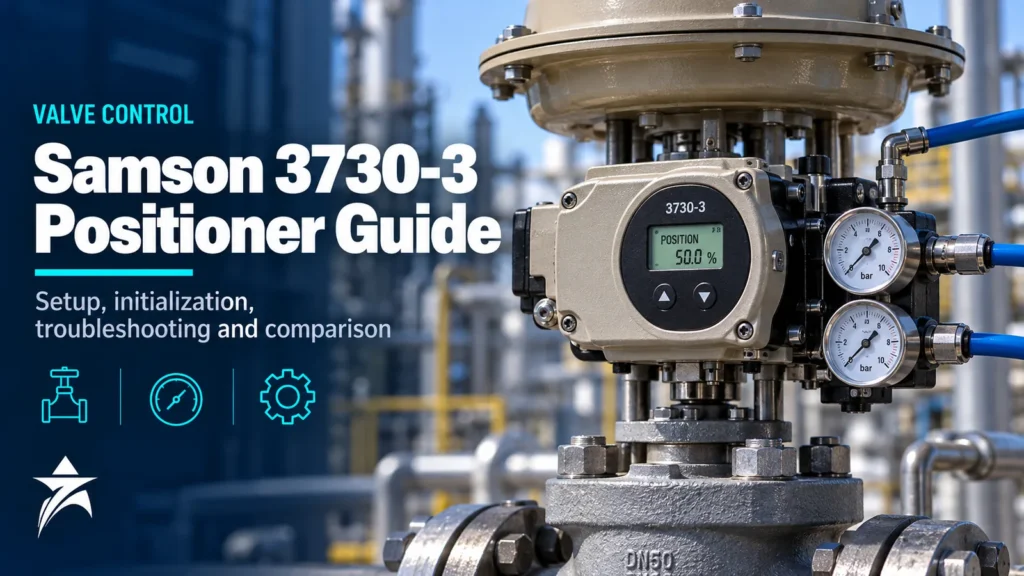
Control valves with Samson actuators are common in water treatment, desalination, power and process units across the GCC, and many of them carry a 3730 series positioner. When a valve hunts, will not close tightly or refuses to initialize, the technician at the valve needs to know how the positioner thinks: what it measures, what initialization does and which parameters change its behaviour. The Samson 3730-3 is a HART-communicating electropneumatic positioner with a local display and a single rotary pushbutton for configuration. This guide covers mounting, initialization, key settings, diagnostics and common faults, and compares it with other widely installed smart positioners. Limits such as supply pressure range, air consumption and temperature range vary by version, so take those from the current Samson datasheet for your exact model.
How the 3730-3 Works
The Samson 3730-3 positioner receives a 4–20 mA setpoint, which also powers the electronics, and compares it with the valve travel measured by a travel sensor driven by the lever and pin. A microcontroller runs the control algorithm and drives an i/p module and pneumatic amplifier that fill or vent the actuator. HART communication carries configuration, travel feedback and diagnostic data to a DCS, handheld or PC tool. Options vary by version and can include an analog position transmitter, inductive or software limit contacts, a forced-venting solenoid function and leakage sensing; confirm the fitted options from the order code on the nameplate.
Configuration is done locally through the rotary pushbutton and code-numbered parameters on the display, or remotely via HART using TROVIS-VIEW software or a handheld communicator with the correct device description.
Mounting Options
The 3730-3 can be attached in several ways, and the mounting determines lever choice, pin position and the travel sensing geometry:
- Direct attachment to Samson Type 3277 linear actuators, with internal air routing and no external tubing between positioner and actuator on many configurations.
- NAMUR attachment (IEC 60534-6-1) to linear actuators of other makes using a mounting kit on the yoke rib or columns.
- Rotary actuators via a VDI/VDE 3845 interface with a coupling and cam or bracket kit.
- Remote or special attachment kits for hot or vibrating valves.
Lever size and pin position must correspond to the rated travel of the valve. Samson’s mounting instructions give a table matching travel ranges to lever and pin position. A wrong pin position is one of the most common causes of initialization errors and poor resolution, because the positioner sees either too little or too much sensor rotation for the actual stroke.
Initialization Modes
Initialization lets the positioner learn the valve: it strokes the valve, determines the travel range and end positions, checks the direction of action and tunes the control parameters to the actuator volume and friction. Samson provides several modes:
| Mode | What it does | When to use |
|---|---|---|
| MAX (maximum range) | Strokes to the mechanical end stops and uses the full available travel | Simple installations, valves where full mechanical travel equals rated travel |
| NOM (nominal range) | Uses the entered nominal travel and checks it against measured travel | Linear valves where rated travel is known and should be controlled accurately |
| MAN (manually selected range) | Uses a travel range defined manually by moving the valve to the end positions | Valves where only part of the mechanical travel should be used |
| SUb (substitute calibration) | Estimates parameters without a full stroke, for replacing a positioner while the process runs | Emergency replacement on a valve that cannot be stroked; repeat a full initialization at the next opportunity |
Before initializing, set the fail-safe position (actuator stem extends or retracts on air failure), the pin position and the nominal travel. The valve will stroke fully during MAX, NOM and MAN initialization, so the loop must be in manual with operations aware, and the process must tolerate a full stroke. If the valve cannot be stroked, SUb is a stopgap only.
Key Parameters After Initialization
- Travel range and set point range: split-range operation is set by restricting the input range, for example 4–12 mA and 12–20 mA on two valves.
- Characteristic: linear, equal percentage or user-defined characteristics can be applied in the positioner, but most valves already have an inherent characteristic in the trim. Applying a second characteristic in the positioner should be a deliberate decision.
- Tight-closing (end position) function: forces the actuator fully vented or fully pressurized when the setpoint is below or above set thresholds, so the seat sees full actuator force. Without it, a valve controlled to 0 % may sit just off the seat and leak.
- Travel limits and rate limits, and the direction of action relative to the input signal.
- Alarm and limit contact settings, if options are fitted.
Diagnostics
The 3730-3 offers EXPERTplus valve diagnostics, with the scope depending on firmware and version. Typical functions include monitoring of travel deviation, friction changes, end position drift, supply pressure and leakage indicators, plus test functions such as step response and valve signature tests with the valve offline, and partial stroke testing where configured. Diagnostic results are classified and reported locally and via HART. A signature taken at commissioning gives the baseline against which later tests are compared, so record one on every critical valve. TROVIS-VIEW or an asset management system with the device DTM is needed to view the detail.
Air Supply Quality
Instrument air quality causes more positioner failures than electronics. Specify and maintain dry, oil-free, filtered air in line with ISA-7.0.01 and ISO 8573-1 classes stated on the Samson datasheet. A practical rule is a pressure dew point at least 10 K below the lowest ambient temperature the tubing will see. Supply pressure must be within the positioner’s range and high enough for the actuator spring range, but below the actuator’s maximum rated pressure. A Fisher 67C instrument supply regulator with filter is a common choice at each valve.
Common Faults and Causes
| Symptom | Likely causes | Checks |
|---|---|---|
| Initialization aborts | Wrong pin position or lever, travel too small, insufficient supply pressure, valve sticking | Compare pin with travel table, check supply at the positioner, stroke manually |
| Valve hunts or oscillates | High friction (packing), oversized actuator volume, wrong tuning after maintenance | Re-initialize, check packing, review step response |
| Valve does not close tightly | Tight-closing function off, travel range wrong, seat damage | Check end position function and zero; inspect trim |
| Slow response in one direction | Supply restriction, blocked filter, undersized tubing, leaking actuator diaphragm | Check air path and actuator for leaks |
| Travel drifts with constant signal | Leakage at actuator or fittings, worn coupling, loose lever | Leak test and check mechanical linkage |
| Display blank or HART lost | Loop current below minimum, wiring polarity, barrier voltage drop | Measure loop current and terminal voltage |
How It Compares
The following is a qualitative comparison with other smart positioners commonly encountered on GCC sites. Each has its own configuration software and diagnostics; the right choice is often the one that matches the plant’s installed base and asset management system.
| Positioner | Feedback and mounting | Configuration and diagnostics | Typical fit |
|---|---|---|---|
| Samson 3730-3 | Lever and pin; direct attachment to Samson 3277, NAMUR and rotary kits | Local rotary pushbutton; TROVIS-VIEW, HART DD/DTM; EXPERTplus | Samson valves and general process valves |
| Fisher FIELDVUE DVC6200 | Linkage-less, non-contact magnetic feedback | ValveLink software, HART/fieldbus; performance diagnostics | Fisher valves, plants standardized on Emerson asset management |
| Masoneilan SVI3 | Non-contact feedback | ValVue software; HART diagnostics | Masoneilan valves and general process valves |
| Flowserve Logix 3800 | Digital HART positioner | DTM-based configuration; Flowserve diagnostics | Flowserve valves and general process valves |
| Neles ND9000 (now Valmet) | Rotary and linear mounting | DTM-based tools; valve diagnostics | Rotary control valves, Neles installed base |
The Fisher DVC6200 is widely used in the region, with the DVC6200-AD version offering advanced diagnostics, while the Fisher DVC2000 is a compact option for simpler valves. The Masoneilan SVI3, Flowserve Logix 3800 and Neles ND9000 are typically chosen to match their own valve brands. For rotary valves on older installations, the Fisher 3610J pneumatic positioner remains common.
Oman Site Considerations
Valves on desalination plants and coastal process units sit in salt-laden, humid air, while interior gas plants see dust and high temperatures. Positioner housings in direct sun can exceed ambient by a wide margin in summer; confirm the permissible ambient range for the specific version and fit sun shades where practical. Keep cable entries and vents sealed and oriented to shed water and dust. Hazardous-area valves need the correct Ex version (for example intrinsically safe), and the barrier or isolator must deliver enough voltage at 4 mA for the positioner to operate. Instrument air dryers that struggle in summer humidity cause water in the tubing; check drains and dew point regularly.
Setup and Procurement Checklist
- Record the full type number and order code, including Ex approval and options.
- Confirm the mounting kit for the actuator (direct 3277, NAMUR or rotary) and the lever size.
- Set pin position for the rated travel per Samson’s mounting table.
- Verify supply pressure, filter-regulator condition and air quality.
- Set fail-safe position, nominal travel and direction of action before initializing.
- Choose the initialization mode and coordinate the full stroke with operations.
- Configure tight-closing, travel limits and split range as required.
- Record a valve signature and save the configuration via TROVIS-VIEW or the DTM.
- Confirm HART DD/DTM availability in the DCS and asset management system.
Sourcing Samson Positioners Through Seven Star LLC
Seven Star LLC supplies the Samson 3730-3 and related valve equipment, including the Samson 3241 globe valve, mounting kits and alternative positioners for plants in Oman and the GCC. Browse the valve positioners category and send the nameplate data so the correct version and mounting kit can be matched. If you are weighing pneumatic against electric actuation, see the electric valve actuator selection guide.
Send your Samson 3730-3 nameplate data and actuator details to Seven Star LLC to source the correct positioner version and mounting kit.
Frequently asked questions
What is the Samson 3730-3?
The Samson 3730-3 is an electropneumatic positioner with HART communication for linear and rotary control valves. It takes a 4–20 mA setpoint, measures valve travel and adjusts actuator pressure to hold the valve at the required position, with local configuration through a rotary pushbutton and display.
What do MAX, NOM, MAN and SUb mean on a Samson 3730 positioner?
They are initialization modes. MAX uses the full mechanical travel, NOM uses the entered nominal travel, MAN uses a manually defined range, and SUb is a substitute calibration that allows a positioner to be replaced without stroking the valve, to be followed by a full initialization later.
Why does Samson 3730-3 initialization fail?
Common causes are a pin position or lever that does not match the valve travel, supply pressure too low for the actuator, a sticking valve or excessive packing friction, and leaks in the actuator or tubing. Check the mounting against Samson's travel table and verify supply pressure at the positioner before repeating initialization.
What software is used to configure the Samson 3730-3?
Samson's TROVIS-VIEW software is used to configure the positioner and view diagnostics over HART. It can also be configured with a HART handheld communicator or an asset management system using the device DD or DTM, as well as locally with the rotary pushbutton.
Can a Samson 3730-3 be mounted on a non-Samson actuator?
Yes. Besides direct attachment to Samson Type 3277 actuators, it can be fitted to other linear actuators using a NAMUR mounting kit per IEC 60534-6-1, and to rotary actuators via a VDI/VDE 3845 interface. The correct kit, lever and pin position must be selected for the actuator and travel.
What air quality does a valve positioner need?
Positioners need clean, dry, oil-free instrument air meeting ISA-7.0.01 and the ISO 8573-1 classes given on the manufacturer's datasheet. A pressure dew point at least 10 K below the lowest ambient temperature is a common practical requirement, and a filter-regulator should be fitted at each valve.
Was this guide helpful?One click helps us write better guides for engineers.
Thank you! Glad it helped. Need this equipment for your project? Request a quotation
Thank you. We will use this to improve the guide.