A simple diode module for 1+1 and N+1 power redundancy
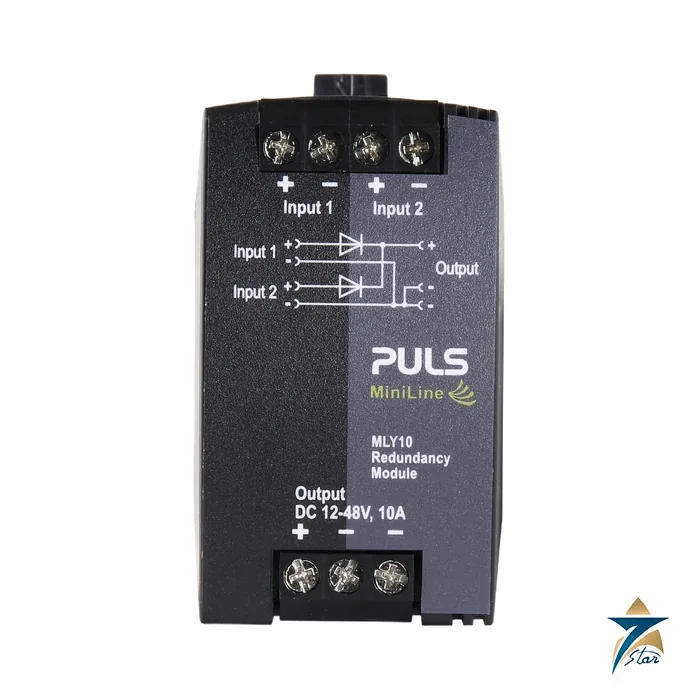
The PULS MLY10.241 is a dual-input redundancy module from the MiniLine-2 family. It decouples two DC power supplies with two diodes in common-cathode configuration, so that one failed supply cannot pull down the shared load, which is the basis of 1+1 and N+1 redundant systems. The datasheet lists two input channels that can each be connected to power supplies of up to 5 A output current and one output able to carry 10 A. The input range of 12 to 48 Vdc plus/minus 25 % (up to 12 to 120 Vdc with restrictions) means it works not only on 24 V rails but on 12 V and 48 V systems too.
PULS calls it a cost-effective solution; the trade-off against its MOSFET sibling, the YR40.242 on this site, is a higher voltage drop and more heat. The module is suitable for supplies with constant-current overload behaviour as well as any kind of hiccup behaviour.
Technical specification
| Parameter |
Specification |
| Order number |
MLY10.241 (redundancy module, MiniLine-2 family) |
| Input voltage |
DC 12-48 V plus/minus 25 % without restrictions; DC 12-120 V plus/minus 25 % with restrictions |
| Input voltage range |
9-60 Vdc without restrictions; 9-150 Vdc with restrictions |
| Input current |
2 x 0 to 5 A continuous; 2 x 0 to 8 A for 5 seconds |
| Output current |
0 to 10 A continuous; 10 to 16 A for 5 seconds; below 16 A at continuous overload or short circuit |
| Voltage drop, input to output |
typ. 0.8 V at 2 x 2.5 A; 0.9 V at 1 x 5 A; 0.9 V at 2 x 5 A |
| Power losses |
typ. 0 W at no load; 4.0 W at 2 x 2.5 A; 4.5 W at 1 x 5 A; 9.0 W at 2 x 5 A |
| Reverse current / voltage |
max. 0.6 mA per input; max. 200 Vdc continuously applied to the output |
| Protection |
Reverse input polarity protection included; no output over-current protection; no input fuse; IP20 |
| Isolation |
No galvanic separation between input and output (200 V epitaxial diode); class of protection III |
| Terminals |
Screw terminals 0.5-6 mm2 solid, 0.5-4 mm2 stranded, max. 2.8 mm wire diameter, 1 Nm, 7 mm stripping; negative distribution terminal included |
| Environment |
-40 C to +70 C operating, derating 0.25 A/C above +60 C; -40 C to +85 C storage; 5 to 95 % r.H.; altitude 0 to 2000 m, derating 0.7 A/1000 m above |
| Shock / vibration |
Shock 15 g 6 ms and 10 g 11 ms; vibration 2-17.8 Hz plus/minus 1.6 mm (IEC 60068-2-27 and -6) |
| Dimensions / weight |
45 x 75 x 91 mm (W x H x D); 140 g |
| MTBF / lifetime |
MTBF (SN 29500) 84 868 000 h at 24 V, 40 C; lifetime expectancy min. 25 years at 24 V and 40 C |
| Approvals as printed |
UL 508, UL 60950-1, IEC 60950-1, Class I Div 2, ATEX, IECEx, Marine (DNV GL and ABS), EAC; see chapter 13 |
How to size a diode redundancy module
The datasheet ratings give a simple way to size the module. Each input channel is rated 0 to 5 A continuously (8 A for 5 seconds) while the output is rated 10 A, so two supplies running together can share a 10 A load. If one supply fails, the remaining channel is rated for only 5 A continuous, so a strict 1+1 design should keep the load at or below 5 A (derived from the channel rating); a load of up to 10 A needs an N+1 arrangement with enough supplies connected, or a module with higher channel ratings. Expect about 0.9 V drop at 5 A, so the voltage after the module is lower than the supply setting; adjust the supplies slightly higher if the load needs the full 24 V.
Installation notes
- Mount on 35 mm DIN rail; wall brackets are listed in the datasheet accessory section.
- Set both supplies to the same output voltage; where possible use identical models.
- Power loss at 2 x 5 A is 9 W, so leave the clearances recommended in the datasheet and keep it away from heat sources.
- Because there is no output over-current protection, protect the load branches with fuses or electronic circuit breakers.
- There is no galvanic separation; keep input and output on the same SELV or PELV circuit.
GCC use cases
Redundant 24 V rails are common in oil and gas control panels, gas compressor packages and water utility PLC cabinets where a power supply failure must not stop the process. A diode module is a low-cost, simple choice for modest currents; the -40 to +70 C operating range covers outdoor kiosks in desert conditions. For higher currents and lower heat use the YR40.242 MOSFET module. See the Power Modules category.
Selection and installation notes
A redundancy or buffer module is selected from the load current, the output voltage and the way the supplies are arranged. Size each supply so one can carry the whole load, keep the wiring from each supply equal in length and cross-section, check the polarity and the module rating against the maximum load and test the changeover by switching one supply off. Allow the heat dissipation and the clearances on the data sheet.
Information needed for a quotation
Send the full model code, the quantity, the delivery location in Oman or the GCC, the intended use and any accessories needed, so that the complete package can be quoted together.
Documents and supply information
The manufacturer data sheet is attached to this page and should be read together with the project specification and the site risk assessment before a purchase is confirmed. Ratings, standards and dimensions are quoted as printed on that sheet. Lead time, stock position and certificates available with the shipment are confirmed in the quotation, and we supply to Oman and the wider GCC region for industrial, utility and building services projects.
Frequently asked questions
What does the MLY10.241 do?
It decouples two DC power supplies with diodes so they can back each other up in 1+1 or N+1 redundant systems.
What voltages can it handle?
12-48 Vdc plus/minus 25 % without restrictions, and up to 12-120 Vdc with restrictions according to the datasheet.
How much voltage is lost across the module?
Typically 0.8 V at 2 x 2.5 A and 0.9 V at 1 x 5 A or 2 x 5 A.
Is there an output fuse or current limiter inside?
No, the datasheet states output over-current protection is not included.
Who supplies the MLY10.241 in Oman?
Seven Star LLC is an independent supplier in Muscat, not the manufacturer; send us your supply ratings for a recommendation.







Reviews
There are no reviews yet.