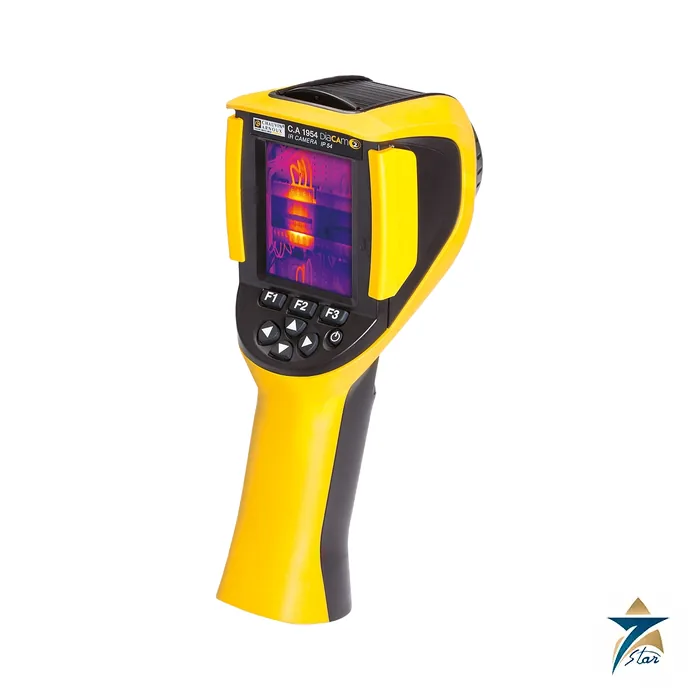
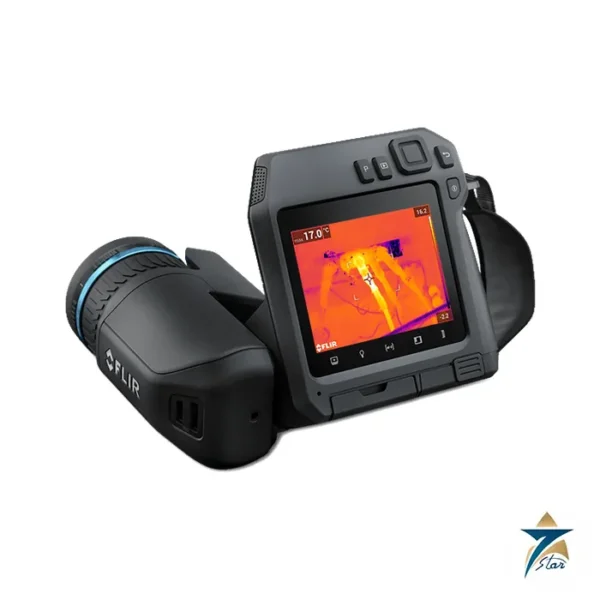
CA 1954 is a handheld thermal imaging camera from Chauvin Arnoux with a 160 x 120 uncooled microbolometer detector, a 2.8 inch colour screen, a built-in visible-light camera, a class 2 laser pointer and a measuring range of -20 to 250 °C, aimed at routine inspection of electrical and mechanical equipment.
Non-contact inspection without shutting equipment down
The manual introduces infrared thermography as a real-time, non-contact inspection method that does not require cutting power, stopping machines or interrupting production. It lists fields such as electric power, petroleum, natural gas, metallurgy and transportation, and named uses such as surveillance of electrical equipment and high-voltage transformers, locating leaks from thermal equipment and heat exchangers, analysing heat losses and finding latent fire sources.
The CA 1954 stores infrared and visible images, with optional voice remarks, on a micro SD card. Measurement tools include point and surface cursors, a temperature profile, min and max cursors and an isotherm function, and the colour palette can be frozen so that the same colour always means the same temperature from one image to the next.
Features from the manual and the technical appendix
- UFPA microbolometer, 8 to 14 µm spectral range, 160 x 120 pixels, 9 Hz frame rate.
- Fixed focus with a minimum focal distance of 0.3 m and 4.1 mrad IFOV.
- Built-in digital visible camera of 640 x 480 pixels; infrared, visible or both can be displayed.
- Analysis tools: point cursor, surface cursor, temperature profile, min/max cursor and isotherm.
- Correction for emissivity, distance, ambient temperature and relative humidity, in default or user mode.
- Voice remarks through a Bluetooth headset, and Bluetooth measurement peripherals.
- CAmReport software for report writing, and USB transfer of files from the SD card.
Technical specification
Detector and imaging
| Parameter |
Specification |
| Detector type |
UFPA microbolometer |
| Spectral range |
8 to 14 µm |
| Resolution |
120 x 160 pixels (as printed in the manual) |
| NETD |
Below 80 mK at 30 °C |
| Frame frequency |
9 Hz |
| Field of view |
28° x 38° (typical) |
| IFOV (spatial resolution) |
4.1 mrad |
| Minimum focal distance |
0.3 m; fixed focus |
| Visible camera |
640 x 480 digital, minimum focal distance 0.05 m, no illuminator |
| Display |
2.8 inch LCD, 240 x 320 |
| Video output |
None |
Measurement
| Parameter |
Specification |
| Temperature range |
-20 to 250 °C |
| Accuracy |
±2 °C or ±2 % |
| Palette |
Pseudo-colours, multiple palettes; automatic or manual (frozen) min/max |
| Corrections |
Emissivity, distance, ambient temperature, relative humidity |
| Reference settings |
Emissivity 1.00, distance 0.5 m, humidity 50 %, ambient 25 °C |
| Temperature alarm |
No |
| Storage |
Micro SD and SD HC card, FAT16 or FAT32 |
| Laser pointer |
Class 2, 645 to 655 nm, below 1 mW |
General specification
| Parameter |
Specification |
| Power |
Alkaline or Ni-MH AA cells; Ni-MH 1.2 V, 2500 mAh; typical life 9 h, minimum 7 h |
| Operating temperature |
-15 to 50 °C |
| Storage temperature |
-40 to 70 °C |
| Humidity |
10 to 95 % |
| Drop, impact, vibration |
2 m on all sides; 25 G; 2 G |
| Protection |
IP54 |
| Altitude, pollution degree |
Below 2000 m (10,000 m in storage), degree 2 |
| Dimensions |
225 x 125 x 83 mm |
| Weight |
700 g with batteries |
| Standards |
IEC/EN 61326-1; IEC 60825-1:2014; IEC/EN 61010-2-030 |
Getting accurate readings
The manual calls emissivity the most crucial setting. In default compensation, the camera assumes emissivity 1.00, distance 0.5 m, humidity 50 % and ambient 25 °C; it is suitable for thermal-bridge searches or simple temperature differences. For quantitative work, switch to user compensation and enter the real values, because wrong parameters can give a result worse than the defaults. Check that the 160 x 120 resolution and 4.1 mrad IFOV suit your target size and distance before ordering.
Good practice from the manual
Measure in the central zone of the screen, aim head on rather than at an angle, choose scenes large enough to avoid point-like targets and wait for the camera to stabilise after an ambient temperature change. Never aim the camera at the sun or other intense heat sources such as welding or cutting, which can disable the sensor for as long as several months; close the lens flap when not in use. Do not touch the lens, and keep the laser away from eyes.
Although rated IP54, the manual advises avoiding use in dusty environments with the lens flap open because dust on the lens disturbs measurements and sharpness. The micro SD card must be present for any image, audio or setup file to be saved.
Inspection work in Oman and the GCC
Maintenance teams can scan switchgear, busbar joints, motor terminations, transformer bushings and HVAC equipment for hot spots, and look for insulation gaps and heat-exchanger problems. Outdoors the manual notes that relative humidity, ambient temperature and distance vary more, so enter them as user compensation, and in strong sunlight avoid pointing the lens at the sun. Operation is specified from -15 to 50 °C, so allow the camera to cool before use if it has been left in a hot vehicle.
Software and accessories
The manual refers to the CAmReport software for reports, available from the Support section of the product page on the manufacturer site, Bluetooth headsets for voice remarks and Bluetooth peripherals that can provide influence values such as dew point. An external charger is needed for Ni-MH cells. See other instruments in the Portable Test & Measurement category.
Frequently asked questions
What is the detector resolution of the CA 1954?
The technical appendix lists a 160 x 120 pixel uncooled microbolometer detector (printed as 120 x 160) with a thermal sensitivity below 80 mK at 30 °C.
What temperature range can it measure?
-20 to 250 °C with an accuracy of ±2 °C or ±2 %.
Does it have a laser pointer?
Yes, a class 2 pointer at 645 to 655 nm and below 1 mW. The manual warns not to aim it at eyes.
Where are images stored?
On a micro SD card (FAT16 or FAT32) fitted on the left side of the head; without the card, an error message appears.
Does Seven Star LLC act as a Chauvin Arnoux distributor?
No. Seven Star LLC is an independent supplier in Muscat that sources Chauvin Arnoux products on request.
Documents and quotation
For quotation, send your required quantity and destination. The Chauvin Arnoux user manual for CA 1954 is provided below the description on this page. Seven Star LLC works as an independent supplier from Muscat. Please compare code, ratings and approvals with the document before you place an order; see also the category listing.





Reviews
There are no reviews yet.