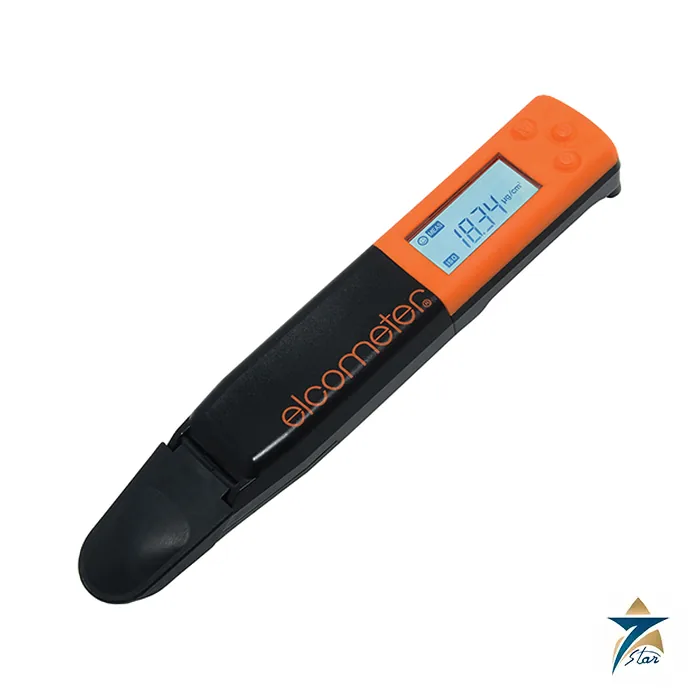
Pocket Bresle salt meter that reports salt density directly
The Elcometer 138 Bresle Salt Meter has a flat conductivity sensor. It measures the conductivity of a Bresle sample and converts it automatically to the surface density of salts, so the operator does not have to calculate it manually when working to ISO 8502-6 or ISO 8502-9. A sample can be placed on the flat sensor, or the sensor can be immersed directly in the solution under test. Highly precise measurements are possible from a very small sample, with out-of-range and low-battery alarms and a visual indication when the ambient temperature is outside the operating range. The manufacturer user guide describes it as designed primarily for use in accordance with ISO 8502-6 and 8502-9.
Technical specifications
| Parameter |
ISO mode |
IMO mode |
| Measurement mode |
ISO |
IMO |
| Measuring range |
0-2399 micrograms/cm2 |
0-2199 micrograms/cm2 |
| Conversion, microsiemens/cm to micrograms/cm2 |
0.12 |
0.11 |
| Conversion, microsiemens/cm to mg/m2 |
1.2 |
1.1 |
| Resolution |
0.1 microgram/cm2 up to 239.9; 1 microgram/cm2 from 240 to 2399 |
0.1 microgram/cm2 up to 219.9; 1 microgram/cm2 from 220 to 2199 |
| Accuracy |
+/-2% of full scale for each range |
+/-2% of full scale for each range |
The part number is E138-BSM. The measurement principle is a two-electrode bipolar AC cell and the minimum sample volume is 0.12 ml. Operating temperature is 5 to 40 deg C (41 to 104 deg F) with temperature compensation of 2% per degree Celsius, and operating humidity is 85% relative humidity or less without condensation. The meter uses two CR2032 lithium batteries giving about 200 hours of continuous use without backlight, weighs 50 g including sensor and batteries and measures 164 x 29 x 20 mm. It is supplied with a 14 ml bottle of conditioning solution, batteries and operating instructions.
Modes, calibration and care
The measurement button selects ISO mode, which applies the ISO Salt Mix conversion, or IMO mode, which applies the IMO PSPC equivalent NaCl conversion. A calibration routine is started with the CAL button, and a replacement sensor (T13833402) and a standard 84 microsiemens/cm calibration solution of 250 ml (T13830629-1) are listed as accessories. The user guide states that the meter measures aqueous solutions only; it is not designed to measure solids, organic solvents, surfactants, oil, adhesives, alcohol, strong acids or strong alkalis, and the sensor life will be extremely short if these are measured. The sensor is a consumable part and should not be forced, and the meter should not be subjected to high temperature or humidity.
Using it with a Bresle kit
The meter reads the extracted sample; the patch, syringe and extraction procedure come from a separate Bresle kit, whose user guide covers the ISO 8502-6 and 8502-9 method. A surface density limit is set by the coating specification or the paint manufacturer, and soluble salts left on blasted steel are a recognised cause of osmotic blistering. Other salt test instruments on this site include the DeFelsko PosiTector SST; see all portable test and measurement instruments, and the Elcometer 224 digital surface profile gauge for the blast profile check.
Documents and quotation
The attached Elcometer datasheet carries the specification and accessories. Please confirm before ordering whether you need a Bresle patch kit as well, the measurement mode your specification requires (ISO or IMO) and the spare sensor or calibration solution quantity, and send these with your enquiry so the part number can be checked against the manufacturer documentation.










Reviews
There are no reviews yet.