Tri-rotor positive displacement meters for refined fuels and bulk loading
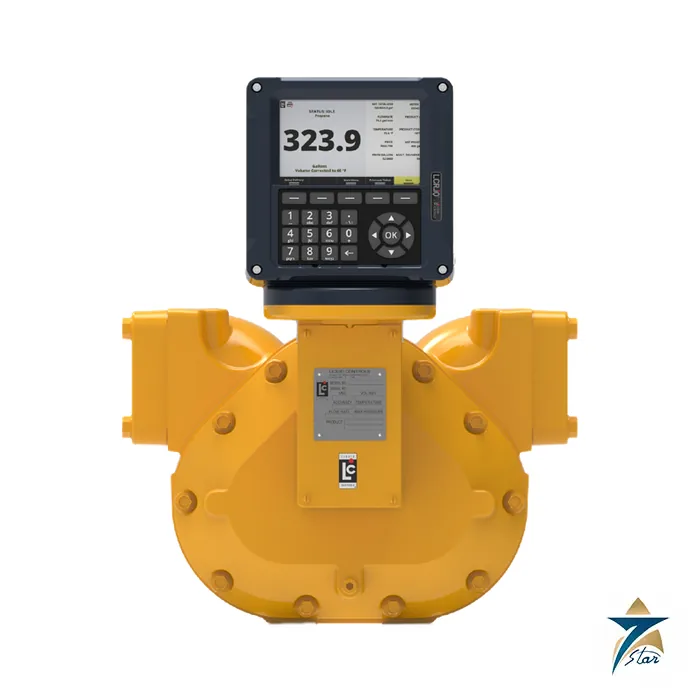
The Liquid Controls M-Series is a range of rotary positive displacement (PD) flow meters for custody transfer of refined and alternative fuels, aviation fuel and a wide range of industrial liquids. Inside the housing three cylindrical bores hold one blocking rotor and two displacement rotors that turn in synchronized relationship, so the liquid is divided into uniform volumes and displaced without metal-to-metal contact in the measuring chamber. The manufacturer states that the force of the fluid acts at right angles to the rotor faces, which avoids axial thrust and keeps wear, and therefore slippage, low over the life of the meter.
The same product page also covers the MSAA-Series, a spherical steel-case version for higher system pressure. Meters are built right-angle with stock or custom elbows and fittings, and take mechanical or electronic registration, such as the LCR.iQ, strainers, air eliminators, valves, printers and pulsers.
Technical specifications
| Parameter |
Specification |
| Manufacturer |
Liquid Controls (IDEX Energy, Advanced Flow Solutions) |
| Type |
Tri-rotor positive displacement meter, right-angle design |
| Models, M-Series |
M-5, M-7, M-10, M-15, M-25, M-30, M-40, M-40 AVI (aviation only), M-60, M-80 |
| Models, MSAA-Series |
MSAA-30, MSAA-40, MSAA-75, MSAA-120 |
| Rated pressure |
150 psi (10.3 bar, 1034 kPa) for M-Series; 285 psi (19.7 bar, 1965 kPa) for MSAA-Series |
| Repeatability |
0.02% or better at any flow rate over the entire range |
| Linearity, 5:1 range |
Mechanical register +/-0.125% or better; electronic register +/-0.10% or better |
| Linearity, 10:1 range |
Mechanical +/-0.22% or better; electronic +/-0.10% or better |
| Linearity, 40:1 range |
Mechanical +/-0.5% or better; electronic +/-0.15% or better |
| Temperature range |
-40 to 160 F (-40 to 71 C) in the brochure; the product page lists up to 185 F for some sizes |
| Viscosity range |
Less than 30 SSU (under 1 cP) to 1,500,000 SSU (325,000 cP) |
| Construction (examples) |
M-5, M-7 and M-15 in aluminium or stainless steel; M-10 and M-25 in aluminium; internals of aluminium, Ni-Resist and stainless steel on the M-25 |
| Seals |
Buna-N, Viton, PTFE (EPDM on some M-7 classes) |
| End fittings |
NPT or weld |
| Registration |
Mechanical or electronic; temperature compensation (TVC) available |
| Accessories |
Strainers, air eliminators, printers, valves, pulsers |
| Weights and measures |
Brochure states that LC meters meet NTEP (NIST Handbook 44), Measurement Canada, OIML and military weights and measures specifications |
Models and flow ranges
Nominal flow ranges and flange sizes as printed in the brochure and on the manufacturer product page:
| Model |
Flange |
Flow range (GPM) |
Flow range (LPM) |
| M-5 |
1.5 in |
6 to 60 |
22 to 227 |
| M-7 |
2 in |
10 to 100 |
20 to 378 |
| M-10 |
2 in |
15 to 150 |
56 to 567 |
| M-15 |
3 in |
20 to 200 |
75 to 756 |
| M-25 |
3 in |
30 to 300 |
110 to 1134 |
| M-30 |
4 in |
35 to 350 |
132 to 1323 |
| M-40 |
4 in |
45 to 450 |
170 to 1701 |
| M-60 |
4 in |
60 to 600 |
225 to 2268 |
| MSAA-30 |
3 in |
35 to 350 |
132 to 1325 |
| MSAA-40 |
3 in |
45 to 450 |
170 to 1703 |
| MSAA-75 |
4 in |
70 to 700 |
265 to 2650 |
| MSAA-120 |
6 in |
100 to 1000 |
378 to 3785 |
The M-40 AVI has a 45 to 600 GPM range for aviation use only (model M-40-2AVI), and the M-80 has a 6 in flange; its flow range is printed inconsistently in the sources, so confirm it before ordering.
Fluid classes and selection
The meter class defines materials and bearings for the product. Class 1 covers refined petroleum products such as gasoline, diesel, kerosene and ethylene glycol, class 2 aviation fuels, class 3 liquid sugars, sweeteners and vegetable oils, class 4 treated waters and solvents where no red metals are allowed, class 14 crude oil and heated or viscous liquids, and class 16 general solvents and alcohols. Class 8 for acidic liquids and class 18 for diesel exhaust fluid are listed on the M-7. Choose the size from the real minimum and maximum flow, then the class from the liquid, and check viscosity against the pressure loss at the intended flow rate.
Documents and quotation
State the liquid, specific gravity and viscosity at operating temperature, flow range, line pressure, flange or fitting type, seal material, direction of flow, register type and any weights and measures approval required. Because the manufacturer sheets give 160 F for some models and 185 F for others, confirm the temperature limit for the exact size and class. Specification sheets for individual sizes carry dimensions and the ordering form.
The attached Liquid Controls brochure covers the range tables, accuracy statements and classes, and the M-25 specification sheet shows the dimensions and ordering form of one size. Seven Star LLC, an independent supplier in Muscat, quotes the meter once the configuration above is known. Related items are listed under Flowmeters.














Reviews
There are no reviews yet.