
- Vibration Monitoring
- Industrial Communications
- PLC & I/O Cards
- Automation Accessories
- Controllers & Data Acquisition
- AC Drives
- Industrial Computers
- Encoders
- Safety Switches & Guard Locking
- Isolator & Barrier
- Automation Software
- HMI Displays
- Motor Soft Starters
- Servo Drives
- CCTV & Security
- Robotics
- Pneumatic Cylinders
- Machine Vision
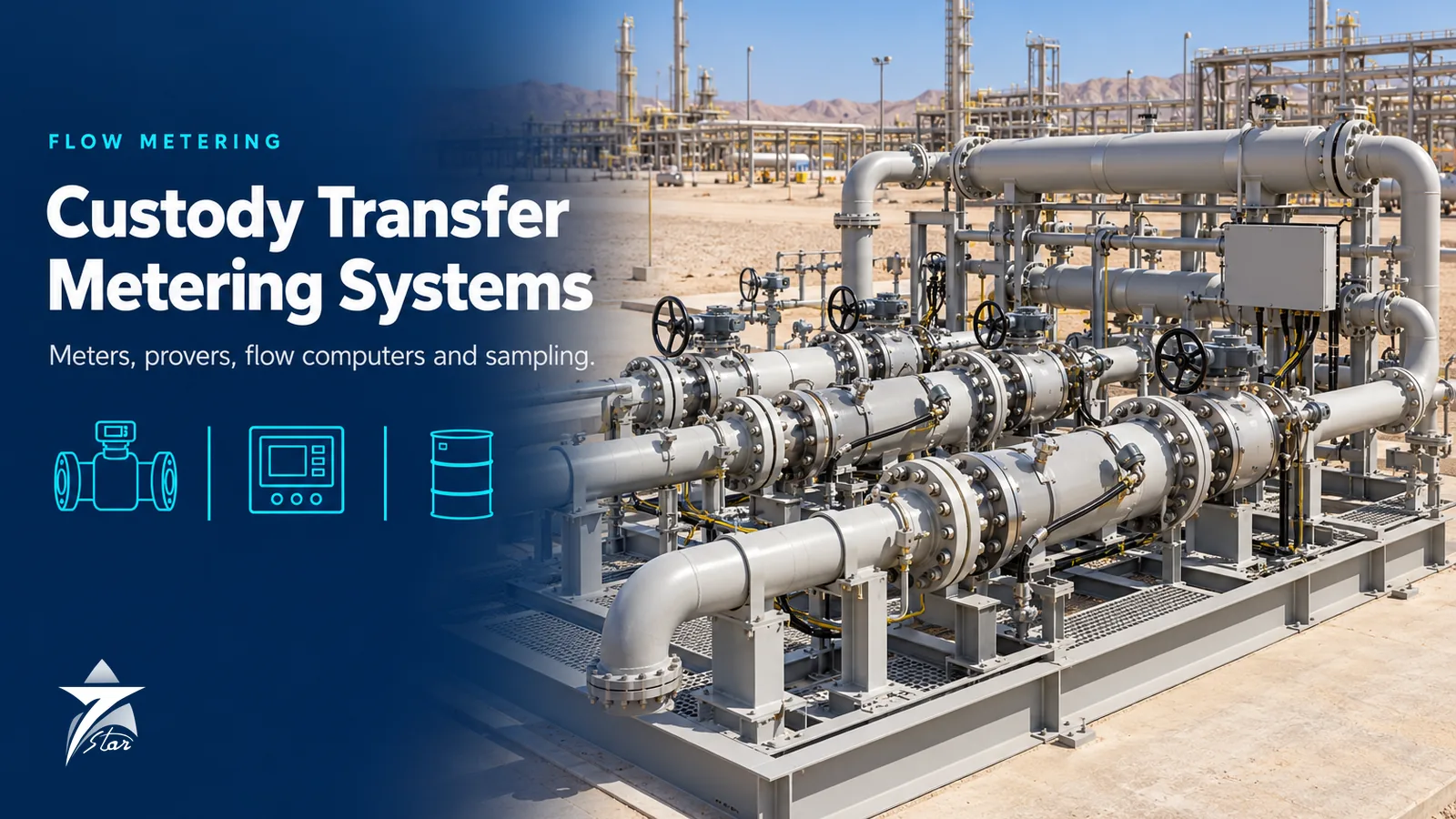
Custody Transfer Metering Systems: Meters, Provers, Flow Computers and Sampling for Oil and Gas Sales
In oil and gas sales, custody transfer metering is measurement where ownership of a hydrocarbon, and therefore money, changes hands. On a crude export line, a 0.1% systematic error is not a rounding issue: at large daily volumes it becomes a substantial sum every year, carried by one party or the other. That is why fiscal metering systems are designed, calibrated, proved, audited and witnessed to a level far beyond ordinary process measurement.
It helps to separate three levels. Custody transfer (fiscal) metering determines the quantity invoiced between seller and buyer, or the quantity on which royalties and taxes are paid. Allocation metering divides a commingled stream between fields, wells or equity owners, usually with a somewhat wider uncertainty. Check metering verifies another meter. This guide covers the first level, for both liquid and gas, and explains the components, standards and practices that make a metering station defensible in a dispute.
Anatomy of a Metering Station
A typical liquid or gas metering skid is a chain in which every element contributes to the final uncertainty.
| Component | Function | Key specification points |
|---|---|---|
| Inlet filtration or strainer | Protects meters and prover from debris | Differential pressure monitoring, mesh size suited to meter type |
| Flow conditioning | Produces a repeatable velocity profile | Conditioner type and straight lengths per the meter standard |
| Meter runs | Parallel streams, often n+1 or duty/standby | Each run sized so the meter stays in its calibrated range |
| Primary meter | Measures volume or mass | Turbine, ultrasonic, Coriolis, positive displacement or orifice |
| Pressure and temperature transmitters | Inputs for volume correction | High-accuracy units, 4-wire RTD, thermowell test points |
| Densitometer | Line density for liquids | Density meter in a fast loop, with its own calibration |
| Automatic sampler | Flow-proportional representative sample | Mixing upstream, sample probe position, receiver handling |
| Analyzers | Water content, gas composition, quality | Water-in-oil monitor for crude; gas chromatograph for gas |
| Prover or master meter | Determines meter factor in service | Pipe prover, compact prover or master meter |
| Double block and bleed valves | Prove that no flow bypasses the meter or prover | Seal integrity check through the bleed |
| Flow computer | Performs certified calculations per stream | Approved calculation standards, audit trail |
| Supervisory computer | Station control, reporting, prover sequencing | Batch and daily reports, alarm and event logs |
Double block and bleed valves deserve emphasis. A leaking divert valve during proving or a leaking crossover between runs creates an unmeasured flow that no calculation can recover. Valves with a bleed that proves seal integrity are standard on fiscal stations.
Choosing the Meter Technology
| Technology | Liquid custody transfer | Gas custody transfer | Main standard references | Strengths | Watch-outs |
|---|---|---|---|---|---|
| Turbine | Yes, light crude and products | Yes | API MPMS Ch. 5.3; AGA 7 | Proven, good repeatability, easy to prove | Bearing wear, viscosity effects, needs filtration |
| Multipath ultrasonic | Yes | Yes, very common | API MPMS Ch. 5.8; AGA 9 | No moving parts, low pressure loss, rich diagnostics | Profile sensitivity, conditioning, proving needs larger volumes |
| Coriolis | Yes | Yes | API MPMS Ch. 5.6; AGA 11 | Direct mass and density, no conditioning in most cases | Pressure drop, line size limits, zero stability |
| Positive displacement | Yes, viscous crude | Limited | API MPMS Ch. 5.2 | Handles high viscosity, low flow | Mechanical wear, pressure loss |
| Orifice | Rare | Yes | AGA 3; ISO 5167 | No flow calibration needed, simple, inspectable | Lower turndown, edge wear, higher uncertainty |
For high-value liquid streams, operators commonly use Coriolis meters such as the Micro Motion ELITE CMF or KROHNE OPTIMASS 6400, or turbine and multipath ultrasonic meters. For gas, multipath ultrasonic meters dominate large stations, while orifice runs with ABB FPD150 orifice plates remain widespread where simplicity and inspectability matter. Our flow meter selection guide compares these principles in more detail.
Proving and Meter Factors
Proving determines the meter factor: the ratio of the true volume, established by a prover with a traceable base volume, to the volume the meter indicated, both corrected to the same conditions. API MPMS Chapter 4 covers provers and proving.
- Pipe (ball) provers, unidirectional or bidirectional, have a calibrated volume between two detector switches. The meter needs to generate enough pulses per pass, commonly 10,000, unless pulse interpolation is used.
- Compact (small volume) provers use a precision piston and pulse interpolation to work with fewer meter pulses. They suit skid space limits and portable proving.
- Master meter proving compares the duty meter with a reference meter that is itself proved.
- The prover base volume is recalibrated, typically by water draw, at intervals set by the standard and contract.
Acceptance requires repeatability over consecutive runs, for example five runs within 0.05%, with alternative criteria given in the standard. Proving frequency is set by contract: at each batch or product change, after maintenance, at fixed intervals, and whenever flowrate, temperature or viscosity changes significantly. Plot meter factors on a control chart (API MPMS Chapter 13 gives the statistical basis). A sudden shift points to wear, debris or a prover problem; a slow trend points to bearing wear or deposits.
Gas meters are generally not proved in situ. They are flow-calibrated at an accredited laboratory, ideally at representative pressure, and then verified through diagnostics. For ultrasonic meters, the measured speed of sound compared with a value calculated from gas chromatograph composition (AGA 10) is a strong check on both the meter and the analyzer.
Sampling and Quality Measurement
Volume alone does not define value. For crude, water and sediment are deducted from the gross volume, so the sample decides how much is paid for. API MPMS Chapter 8.2 covers automatic sampling: the stream must be mixed so water is evenly distributed, the probe placed where the profile is representative, and grabs taken in proportion to flow. On-line water-in-oil analyzers support but do not usually replace the laboratory result from the composite sample. Density, measured by a line densitometer or in the laboratory, feeds the volume correction factors of API MPMS Chapter 11.
For gas, an on-line gas chromatograph provides composition for heating value (ISO 6976 or GPA methods) and for compressibility (AGA 8). Sales gas contracts usually also specify H2S, water dew point and hydrocarbon dew point limits, which need their own analyzers.
Flow Computers, Supervisory Systems and Audit Trail
The flow computer is the legal calculator of the station. Per stream it collects pulses, pressure, temperature and density, applies the selected standards, totalises gross and net quantities, controls proving, and stores batch reports, alarms and every parameter change with time and user. Established platforms include the FloBoss S600+, the OMNI 6000, the ABB SpiritIT Flow-X and the KROHNE SUMMIT 8800. A supervisory system such as Spirit IT eXLerate sits above the flow computers for station reporting, prover sequencing and sampler control.
Audit trail design matters as much as calculation accuracy. Define access levels, seal or lock calibration parameters, log every change, and make sure the duty/standby pair hold identical configurations. Our article on Elster gas metering and flow computers covers gas-side equipment further.
The Standards Framework
The contract and the relevant authority define which standards apply. Common references:
- API MPMS: Chapter 4 (proving), Chapter 5 (metering), Chapter 7 (temperature), Chapter 8 (sampling), Chapter 9 (density), Chapter 10 (sediment and water), Chapter 11 (physical properties and volume correction), Chapter 12 (calculations), Chapter 13 (statistics), Chapter 21 (electronic measurement).
- AGA Reports No. 3 (orifice), 7 (turbine), 8 (compressibility), 9 (ultrasonic), 10 (speed of sound) and 11 (Coriolis) for gas.
- ISO 5167 for differential pressure meters and ISO 6976 for calorific value.
- OIML R117 for dynamic measuring systems for liquids other than water, where legal metrology approval is required.
Uncertainty Budgets
An uncertainty budget combines the meter or prover, the pressure, temperature and density measurements, composition, and the calculation itself, following ISO 5168 or the GUM approach. Targets in the region of ±0.25% of volume for liquid hydrocarbons and around ±1% for gas energy or mass are often quoted, but the contract and authority set the actual figure.
Secondary instruments are significant. Light crude expands by very roughly 0.08–0.1% per °C, so a 0.5 °C temperature error moves the corrected volume by around 0.05%. That is why fiscal stations use 4-wire RTDs with high-performance transmitters such as the Rosemount 3144P, test thermowells beside the measuring well, and high-accuracy pressure transmitters such as the Rosemount 3051S, all on a short verification interval.
Oman and GCC Considerations
- Heat and solar gain affect skid instruments, electronics and prover temperature stability. Shade the skid, insulate the prover and meter runs where the standard and design allow, and check that temperature is stable during proving.
- Sand and produced solids in crude damage turbine bearings and prover sphere surfaces; filtration and strainer differential pressure monitoring are essential.
- Sour crude and gas require NACE MR0175/ISO 15156 materials for wetted parts, including sampler and analyzer systems.
- Remote stations depend on reliable telemetry for reports and alarms, with local storage in the flow computer so no data is lost during outages.
- Witness testing involves the seller, the buyer and often the authority; plan calibrations and proving schedules with them from the start.
Common Mistakes
- Treating temperature and pressure transmitters as ordinary instruments with ordinary calibration intervals.
- Ignoring double block and bleed integrity checks.
- Locating the sampler probe without a mixing study.
- Running duty and standby flow computers with different configuration versions.
- Changing meter factors or constants without documented approval in the audit trail.
Specification Checklist
- Contract and authority requirements, including standards, uncertainty and approvals.
- Fluid properties, flow range, pressure and temperature range, contaminants.
- Meter technology, number of runs and redundancy philosophy.
- Prover type and volume, or laboratory calibration strategy for gas.
- Sampler design, analyzers, and laboratory interface.
- Flow computer platform, stream count, redundancy, calculation standards, audit trail.
- Supervisory system scope: reports, prover control, communication to SCADA.
- Valve integrity verification, materials for sour service, hazardous area certification.
- Factory acceptance, site acceptance and witness test plans.
Sourcing Custody Transfer Metering Equipment Through Seven Star LLC
Seven Star LLC supplies and sources flow computers, meters, transmitters and spares for fiscal metering stations. Browse our flow computers category and flowmeters category, and share the station documentation so replacements match the certified configuration.
Send your metering station equipment list to Seven Star LLC and we will source the flow computers, meters and instruments your custody transfer system needs.
Was this guide helpful?One click helps us write better guides for engineers.
Thank you! Glad it helped. Need this equipment for your project? Request a quotation
Thank you. We will use this to improve the guide.
Need a Quotation for Your Project?
Seven Star LLC supplies the industrial equipment covered in this article to customers across Oman and the GCC. Send us the part numbers, models or a short description with quantities, and our sales team will reply with a formal quotation.
- Genuine OEM products
- Supply across Oman & the GCC
- Formal quotation from our sales team
Free, no-obligation quotation · takes about 1 minute
Other enquiries: [email protected] · WhatsApp
More Blog




Frequently Asked Questions
Custody transfer metering is the measurement of a fluid at the point where ownership changes hands, for example between a producer and a buyer or a pipeline operator. The measured quantity is the basis for invoicing, royalties or taxes. Because of this, it must meet contractual and regulatory standards for accuracy, proving and audit trail.
Custody transfer metering determines the quantity sold or transferred between parties and carries the tightest uncertainty requirements. Allocation metering divides a commingled flow between fields, wells or equity owners and is usually allowed a wider uncertainty. Both can involve money, but custody transfer is the legally binding sales measurement.
A meter factor is the ratio of the true volume measured by a prover to the volume indicated by the meter, both corrected to the same conditions. It is applied by the flow computer to correct the meter's output. Meter factors are tracked over time on control charts to detect wear or problems.
The proving frequency is set by the contract and applicable standards. Liquid meters are commonly proved at each batch or product change, after maintenance, at regular fixed intervals and whenever operating conditions change significantly. Gas meters are generally calibrated at a laboratory and verified in service with diagnostics.
Turbine, multipath ultrasonic, Coriolis and positive displacement meters are all used for liquid custody transfer. For gas, multipath ultrasonic, turbine, Coriolis and orifice meters are used, with ultrasonic meters common on large stations. The choice depends on fluid, flow range, line size and the governing standards.
The sample determines the water and sediment content that is deducted from the gross volume, and it supports density and quality measurements. A poorly mixed stream or badly placed sampler probe gives a non-representative sample and a direct financial error. API MPMS Chapter 8 covers the design and operation of automatic samplers.