
- Vibration Monitoring
- Industrial Communications
- PLC & I/O Cards
- Automation Accessories
- Controllers & Data Acquisition
- AC Drives
- Industrial Computers
- Encoders
- Safety Switches & Guard Locking
- Isolator & Barrier
- Automation Software
- HMI Displays
- Motor Soft Starters
- Servo Drives
- CCTV & Security
- Robotics
- Pneumatic Cylinders
- Machine Vision
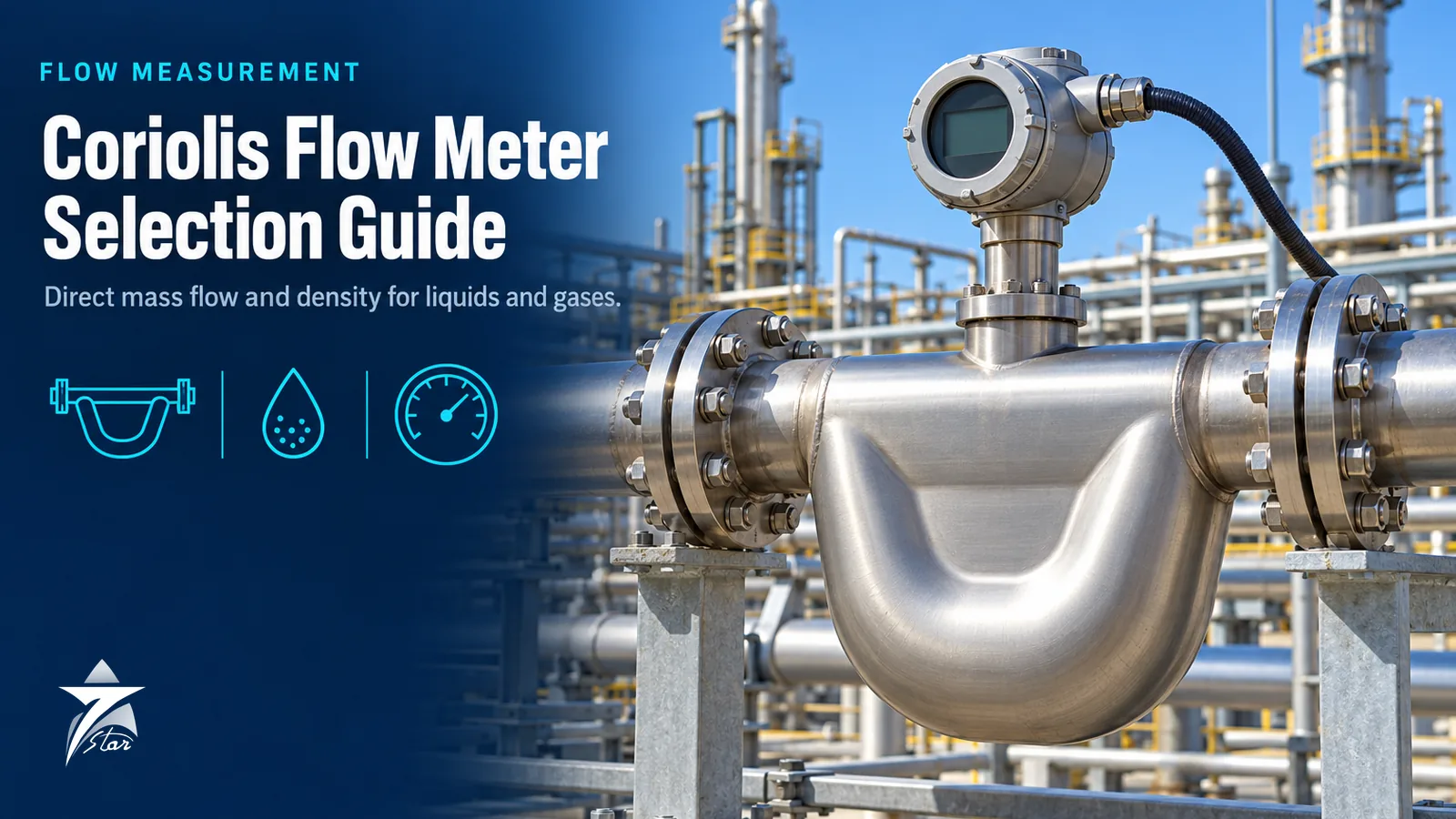
Coriolis Flow Meter Guide: Direct Mass Flow and Density, Accuracy, Installation and When They Are Worth the Cost
A Coriolis flow meter measures mass flow directly, without needing pressure, temperature or composition compensation, and measures density from the same sensor. That combination makes it the reference choice for custody transfer of liquid hydrocarbons, chemical dosing, blending and batching, and any application where mass rather than volume is what matters. It is also one of the most expensive meters per line size, heavy in larger sizes, and sensitive to installation details that are easy to get wrong.
This guide explains how Coriolis meters work, what accuracy to expect for liquids and gases, how zero stability limits low-flow performance, how to size for pressure drop, how entrained gas affects the measurement, and how to install and verify meters in the hot and remote conditions common in Oman.
Operating Principle
A Coriolis sensor contains one or two measuring tubes driven to oscillate at their resonant frequency by an electromagnetic driver. When fluid flows through the vibrating tubes, the Coriolis force twists them slightly, so the inlet and outlet sections oscillate out of phase. Pickoff coils at each end measure this phase shift, expressed as a time difference, which is directly proportional to mass flow rate. Because the measurement depends on the fluid’s inertia, it is independent of viscosity, flow profile and, to a large extent, of fluid properties.
The resonant frequency of the tubes depends on the total vibrating mass, which includes the fluid inside. As density rises, frequency falls, so the same sensor measures density. A temperature sensor on the tube compensates for changes in tube stiffness and reports process temperature. From mass flow and density, the transmitter derives volumetric flow, and with suitable models it can calculate concentration, such as degrees Brix, percent solids or net oil and water cut where conditions permit.
Accuracy, Zero Stability and Turndown
High-end Coriolis meters on liquids typically achieve mass flow accuracy in the order of ±0.05% to ±0.1% of reading, and density accuracy for high-end models can be in the order of ±0.0005 g/cm³ or better. Gas mass flow accuracy is typically around ±0.25% to ±0.5% of reading. Lower-cost and compact models are less accurate, so confirm the figures on the datasheet for the specific sensor and transmitter combination.
These figures apply above a certain flow rate. Below it, accuracy is governed by zero stability, a fixed value in mass flow units stated on the datasheet. Error as a percentage of reading equals zero stability divided by flow rate, so it grows as flow falls. For example, if a meter has a zero stability of 0.5 kg/h and operates at 100 kg/h, the zero contributes ±0.5% of reading; at 1,000 kg/h it contributes only ±0.05%. This is why a meter that is oversized to minimise pressure drop may perform poorly at the normal flow rate. Turndown with acceptable accuracy is often quoted as high as 100:1 or more, but the useful range depends on the accuracy required at minimum flow.
Zero stability is also affected by installation stress, temperature differences between the tubes and the case, and vibration. Performing a zero adjustment at operating temperature and pressure, with the meter full and flow positively stopped, is essential.
Coriolis Compared With Other Meter Types
| Criterion | Coriolis | Ultrasonic (multi-path) | Turbine | Electromagnetic |
|---|---|---|---|---|
| Measured variable | Mass flow, density, temperature | Volumetric flow (velocity) | Volumetric flow | Volumetric flow |
| Liquid accuracy (high-end) | Typically ±0.05–0.1% of reading | Typically ±0.1–0.2% in custody versions | Typically ±0.15–0.25% with proving | Typically ±0.2–0.5% |
| Straight run required | Generally none | Yes, or flow conditioner | Yes, with flow conditioner | Short |
| Conductive fluid needed | No | No | No | Yes |
| Pressure drop | Moderate to high | Negligible | Moderate | Negligible |
| Viscosity effect | Minimal | Small with profile correction | Significant | None |
| Sensitivity to entrained gas | High | High | Moderate | Moderate |
| Moving parts | None | None | Rotor and bearings | None |
| Practical line sizes | Small to medium; large sizes are heavy and costly | Medium to very large | Small to large | All sizes |
| Typical applications | Custody transfer, dosing, density, batching | Large pipelines, gas custody transfer | Refined products, clean liquids | Water, slurries, wastewater |
For broader selection logic across all meter types, see our guide to choosing a flow meter.
Sizing and Pressure Drop
Coriolis sizing is a trade-off. A smaller sensor gives higher tube velocity, better signal and lower zero-related error, but more pressure drop. A larger sensor reduces pressure drop but runs closer to its zero at normal flow. Size using the manufacturer’s tool at minimum, normal and maximum flow, and check pressure drop against the available head, accuracy at minimum flow, and the risk of flashing or cavitation when the pressure drop brings the liquid close to its vapour pressure. Volatile liquids such as LPG and condensate need enough back pressure downstream of the meter to keep them in single phase. On long transfer pipelines where pumping energy matters, pressure drop is often the deciding factor.
Entrained Gas and Two-Phase Flow
Gas bubbles in a liquid stream are the most common cause of poor Coriolis performance. Bubbles decouple from the liquid as the tubes oscillate, which disturbs both the mass flow and density measurements, increases drive gain and in severe cases stalls the tube oscillation. Modern transmitters include entrained gas handling and diagnostics that hold or flag readings, and some designs maintain a measurement through short slugs, but no Coriolis meter is an accurate two-phase meter in general. Remove the gas at source: avoid installing on the suction side of pumps where flashing occurs, keep the meter below a high point, maintain back pressure, and use air eliminators in loading systems. Drive gain trends are a useful early indicator of gas or coating problems.
Materials and Service Conditions
Measuring tubes are typically 316L stainless steel, with nickel alloys such as alloy C-22 used for chlorides and corrosive chemicals and other materials available for specific duties. For sour hydrocarbon service, wetted materials should comply with NACE MR0175 / ISO 15156, stated explicitly on the order. Check the secondary containment pressure rating of the sensor case, as it is relevant to safety if a tube fails. Erosion from sand in crude or produced water thins tube walls and changes calibration, so meter verification trends are important on such duties.
Installation Practice
- Orientation: for liquids, a commonly recommended orientation places the tubes below the flow path or the flow upward in a vertical line, so gas does not collect in the tubes. For gas, tubes up is commonly recommended so condensate drains. Follow the manufacturer’s guidance for the specific sensor geometry.
- Support and stress: support the piping on both sides; do not use the meter to align misaligned flanges. Pipe stress shifts the zero.
- Vibration: avoid installing close to reciprocating pumps or compressors and on poorly supported pipework. Modern designs reject most process noise, but strong vibration near the drive frequency can still affect performance.
- Valves: install an isolation valve downstream to allow zeroing with the meter full and flow stopped, and consider a bypass for maintenance.
- Straight run: generally none is required, which is a major advantage on compact skids.
- Hazardous area: confirm certification of both the sensor and the transmitter, and whether the transmitter is integral or remote.
Verification and Custody Transfer
Manufacturers offer in-situ verification tools that check the stiffness of the measuring tubes and the electronics against factory baseline, providing evidence that calibration has not shifted without removing the meter. Emerson calls its tool Smart Meter Verification, Endress+Hauser uses Heartbeat Technology, and other manufacturers have equivalent functions. These tools support longer calibration intervals but do not replace proving where custody transfer regulations require it.
For custody transfer, the relevant references include API MPMS Chapter 5.6 for Coriolis meters in liquid hydrocarbon service, AGA Report No. 11 for natural gas, and OIML R117 for dynamic measuring systems for liquids other than water. Check which approvals the project requires, and verify that the specific meter and transmitter combination holds them. Coriolis meters in fiscal service are typically proved with a compact prover or against a master meter, and connect to a flow computer for quantity calculations and audit trails.
Selected Models in the Market
| Model | Description | Notes |
|---|---|---|
| Micro Motion ELITE CMF | High-accuracy Coriolis sensor family | Widely used in custody transfer and high-accuracy duties; larger sizes such as the ELITE CMF400 |
| Micro Motion 5700 | Field-mount Coriolis transmitter | Pairs with Micro Motion sensors; supports advanced diagnostics |
| Micro Motion G-Series | Compact flow and density meters | General-purpose duties where full ELITE performance is not required |
| Endress+Hauser Promass F300 | Coriolis meter with compact transmitter | Broad process and custody transfer use; Heartbeat verification |
| KROHNE OPTIMASS 6400 | Coriolis meter for demanding process duties | Confirm tube geometry and approvals on the datasheet |
| Yokogawa ROTAMASS TI | Coriolis flow meter family | Range of sensor sizes; confirm configuration on the datasheet |
| ABB CoriolisMaster FCB430/450 | Coriolis mass flowmeter | General industrial and process use |
| ABB CoriolisMaster FCH430/450 | Coriolis mass flowmeter, hygienic design | Food, beverage and hygienic duties |
| Honeywell VersaFlow Coriolis | Coriolis flow meter | Confirm sizes and approvals on the datasheet |
This table is qualitative. Accuracy, pressure rating, materials and approvals vary between sizes and options, so compare datasheets for the specific configuration.
Considerations for Oman and the GCC
- Hot ambient and solar gain: a sensor in direct sun at 45–50 °C ambient with a cooler process fluid develops temperature gradients between tubes and case that shift the zero. Shade the meter, insulate where the manufacturer allows, and zero at operating conditions after temperatures have stabilised.
- Pump vibration: remote pumping stations often have meters close to the pumps on short skids. Provide proper pipe supports and, where possible, distance from reciprocating equipment.
- Long pipelines: pressure drop matters for pumping energy, so sizing toward a larger sensor may be justified, but check zero-related error at normal flow.
- Sand: erosion in crude and produced water service warrants regular verification and trending.
- Remote sites: meters with verification and diagnostics accessible over HART or a digital network reduce site visits.
Common Mistakes
- Oversizing to cut pressure drop and then operating near the zero stability limit.
- Zeroing the meter at ambient conditions or with flow not fully stopped.
- Installing with tubes up on liquid service, trapping gas.
- Using the meter to pull misaligned flanges together.
- Expecting accurate measurement with entrained gas or flashing liquids.
- Assuming custody transfer approval applies to every size and transmitter option.
Coriolis Meter Selection Checklist
- Fluid, phase, density, viscosity and gas content defined
- Minimum, normal and maximum flow with required accuracy at each
- Sizing completed for accuracy at minimum flow and pressure drop at maximum
- Back pressure adequate to prevent flashing or cavitation
- Tube material and NACE MR0175 / ISO 15156 compliance where needed
- Pressure rating and secondary containment confirmed
- Orientation and pipe support designed per manufacturer guidance
- Hazardous area certification for sensor and transmitter
- Outputs and protocols defined (4–20 mA with HART, pulse, Modbus or other)
- In-situ verification function included
- Custody transfer approvals and proving method confirmed where required
Sourcing Coriolis Meters Through Seven Star LLC
Seven Star LLC supplies and sources Coriolis flow meters, transmitters and spares for oil and gas, chemical and utility operators in Oman and the GCC. Browse the flowmeters category or the Emerson and KROHNE brand pages. Include the full model code or process data sheet with your enquiry so the correct sensor size and options can be confirmed.
Send your Coriolis meter process data or model code to Seven Star LLC through our contact page for a quotation.
Was this guide helpful?One click helps us write better guides for engineers.
Thank you! Glad it helped. Need this equipment for your project? Request a quotation
Thank you. We will use this to improve the guide.
Need a Quotation for Your Project?
Seven Star LLC supplies the industrial equipment covered in this article to customers across Oman and the GCC. Send us the part numbers, models or a short description with quantities, and our sales team will reply with a formal quotation.
- Genuine OEM products
- Supply across Oman & the GCC
- Formal quotation from our sales team
Free, no-obligation quotation · takes about 1 minute
Other enquiries: [email protected] · WhatsApp
More Blog



Frequently Asked Questions
Fluid flowing through vibrating tubes generates a Coriolis force that twists the tubes, creating a phase shift between the inlet and outlet sides. Pickoff coils measure this shift as a time difference, which is directly proportional to mass flow rate. The tube resonant frequency is used to measure density at the same time.
High-end Coriolis meters typically achieve around ±0.05% to ±0.1% of reading for liquid mass flow and around ±0.25% to ±0.5% for gas. Accuracy degrades at low flow, where zero stability dominates. Exact values depend on the model, size and transmitter, so they should be confirmed on the datasheet.
Coriolis meters generally do not need upstream or downstream straight runs because the measurement does not depend on the velocity profile. This makes them well suited to compact skids. Good pipe support and freedom from stress are more important than straight length.
Yes, Coriolis meters measure gas mass flow directly and are used for natural gas, hydrogen and other gases. Gas accuracy is lower than liquid accuracy and pressure drop can be significant, so careful sizing is required. AGA Report No. 11 covers Coriolis metering of natural gas.
Common causes are pipe stress, temperature differences between the tubes and the case, vibration, coating or erosion of the tubes, and changes in mounting. Zeroing at operating temperature and pressure with flow fully stopped corrects the offset. Persistent drift should be investigated with the meter's verification tools.
Gas bubbles move relative to the liquid as the tubes vibrate, which disturbs the mass flow and density measurements and increases drive power. In severe cases the tube oscillation can stall. Removing gas at source and maintaining adequate back pressure are the most effective solutions.