- Automation & ControlView all 1,920 products
- AC Drives
- PLC & I/O Cards
- Industrial Communications
- Vibration Monitoring
- Automation Accessories
- Controllers & Data Acquisition
- Isolator & Barrier
- CCTV & Security
- Safety Switches & Guard Locking
- Encoders
- HMI Displays
- Industrial Computers
- Motor Soft Starters
- Servo Drives
- Pneumatic Cylinders
- Machine Vision
- Automation Software
- Robotics
















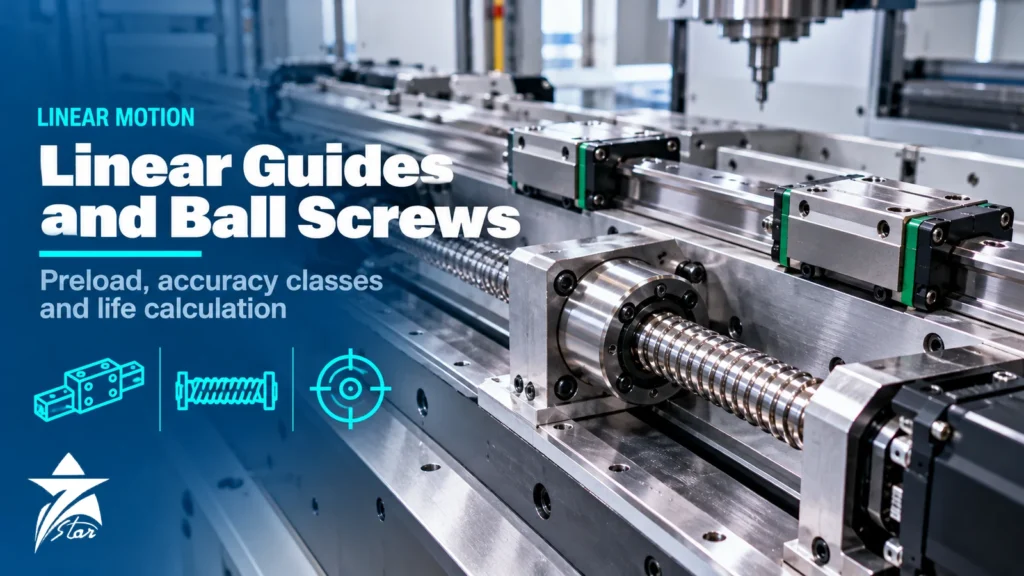
Profile rail guides and ball screws turn rotary motion and loads into accurate straight-line movement on machine tools, packaging lines, robots, gantries and test rigs. Choosing them by shaft size or by copying the previous design often leads to an axis that is either oversized and expensive or that loses accuracy and wears out early. This guide covers linear guide selection and ball screw sizing: the main types, load ratings and life, preload, accuracy classes, critical speed and buckling, mounting, lubrication and the data you need before ordering.
Profile Rail Guides: How They Work
A profile rail guide consists of a hardened steel rail with precision raceways and a carriage, or block, containing recirculating balls or rollers. The rolling elements run along the raceways, return through channels in the block and are guided by end caps that also carry seals and lubrication ports. Because the contact is rolling rather than sliding, friction is low and nearly independent of speed, and there is no stick-slip, which is why profile rails replaced box ways and dovetail slides on most modern machines. Typical arrangements use two parallel rails with two blocks each, so the system can take loads in all directions and moments about all three axes.
Types of Linear Guides Compared
| Type | Rolling element | Strengths | Typical uses |
|---|---|---|---|
| Four-row ball guide, standard block | Balls | Equal load in all directions, low friction, wide range | General automation, machine tool axes |
| Flange block | Balls or rollers | Mounting from above or below, high moment rigidity | Gantries, machine tools |
| Long or high block | Balls or rollers | Higher load and moment capacity | Heavy axes, vertical slides |
| Miniature guide | Balls | Compact, light | Instruments, semiconductor, medical devices |
| Wide rail | Balls | High roll moment on a single rail | Single-rail axes, robots |
| Roller guide | Cylindrical rollers | Very high rigidity and load capacity | Machining centres, grinding machines |
| Caged ball or roller | Balls or rollers in a retainer | Lower noise, longer lubrication intervals | High-speed and quiet axes |
Our linear motion category covers profile rails, blocks, ball screws and support units from established manufacturers.
Load Ratings and Nominal Life of Linear Guides
Each block has a static load rating C0, used with a static safety factor against permanent deformation, and a dynamic load rating C used to estimate life. Manufacturers define C for a reference travel of either 50 km or 100 km, so check which basis a catalogue uses before comparing products. For ball guides, the C value on a 50 km basis is about 1.26 times the value on a 100 km basis.
For a ball guide, the nominal life in km is L = (C/P)³ × 50 when C is given for 50 km, where P is the equivalent load on the block. Roller guides use an exponent of 10/3, and catalogues referenced to 100 km use 100 in place of 50. Life in hours follows from stroke length and cycles per minute. The equivalent load must combine radial, reverse radial and lateral loads and the moments from offset masses and acceleration forces, using the factors given by the manufacturer. Very short strokes, below about twice the block length, may need a correction because the same short section of raceway carries all the load cycles.
Preload and Rigidity
Preload removes the internal clearance and makes the block stiffer by loading the rolling elements against each other before any external load is applied. Manufacturers offer several classes, typically clearance or light, medium and heavy, set as a percentage of the dynamic load rating; commonly quoted values run from a few percent of C for light preload up to around 8 to 15% of C for the heaviest classes depending on the manufacturer and whether the guide uses balls or rollers.
- Light or zero preload: smooth, low friction, suits handling and transfer axes and where two rails cannot be perfectly parallel.
- Medium preload: common on machine tool and precision axes needing good rigidity.
- Heavy preload: highest rigidity and damping for heavy cutting and overhanging loads.
Preload adds to the internal load and friction, which reduces life, so it should be included in the life calculation. Heavier preloads also require more accurate mounting surfaces, as parallelism errors between rails add further internal load.
Accuracy Classes of Linear Guides
Linear guides are offered in accuracy classes such as normal, high, precision, super precision and ultra precision, with designations that differ between manufacturers. The class defines tolerances on the height and width of the block relative to the rail, the variation in these dimensions between blocks on the same rail, and the running parallelism of the block along the rail. The required class depends on the machine: transfer equipment works well with normal or high classes, while machine tools and measuring machines use precision classes. Remember that the accuracy of the mounting surfaces and the assembly method usually limit the final result more than the guide class.
Ball Screw Basics and Accuracy Grades
A ball screw converts rotation to linear motion through balls circulating between a threaded shaft and a nut, giving efficiencies typically above 90%, compared with much lower values for sliding lead screws. Ball screw accuracy follows ISO 3408 and JIS B 1192 grades. Precision grades C0 to C5 are defined by the travel deviation over the useful length, over each 300 mm and per revolution, and are generally ground. Transport grades C7 and C10 are defined by travel deviation in any 300 mm, about ±0.05 mm for C7 and ±0.21 mm for C10, and are usually rolled.
| Grade | Type | Typical use |
|---|---|---|
| C0 to C3 | Precision, ground | Measuring machines, precision grinding, semiconductor equipment |
| C5 | Precision, ground or high-grade rolled | CNC machine axes, precision positioning |
| C7 | Transport, rolled | General automation, packaging, axes with feedback |
| C10 | Transport, rolled | Simple transfer and adjustment movements |
Axial play is removed by preloading the nut, either with double nuts and a spacer, by a lead offset in a single nut, or by oversized balls. As with guides, preload improves rigidity at the cost of friction and heat.
Sizing a Ball Screw
Ball screw sizing checks several limits, not just life:
- Life: L = (Ca/Fa)³ × 10⁶ revolutions, using the mean axial load across the duty cycle and a load factor for vibration and shock.
- Static capacity: peak axial load against the static rating C0a with a suitable safety factor.
- Critical speed: the shaft’s whipping speed depends on root diameter, unsupported length and end fixing; keep the maximum speed well below it.
- Buckling: compressive axial loads on long screws must stay below the buckling load for the chosen end supports.
- Ball speed limit: the d·n value (nominal diameter times speed) must not exceed the manufacturer’s limit for the nut’s recirculation design.
- Lead: chosen to balance speed, resolution and motor torque; a larger lead allows higher linear speed for the same rotational speed.
- Drive torque and inertia, used to size the servo motor and drive.
End support arrangement strongly affects critical speed and buckling: a fixed-fixed or fixed-supported arrangement allows higher speeds and loads than a fixed-free screw of the same length.
Data to Collect for Linear Guide Selection
- Moving mass and its centre of gravity relative to the blocks.
- External forces, such as cutting, pressing or process loads, and their direction.
- Stroke, maximum speed, acceleration and duty cycle.
- Required positioning accuracy, repeatability and rigidity.
- Mounting orientation: horizontal, vertical, wall-mounted or inverted.
- Space available for rails, blocks, nut and end supports.
- Environment: chips, coolant, dust, temperature and washdown.
- Required life in hours or km.
- Existing part numbers of rails, blocks and screws, if replacing.
Mounting and Alignment
Mount the reference rail against a machined shoulder, tighten bolts in the sequence and to the torque in the manufacturer’s instructions, then align the second rail to it for parallelism and height. Blocks must never be removed from a rail without a dummy rail, or the balls will fall out. The ball screw must be aligned to the guides in both planes, as any offset forces the nut sideways, adding radial load that the screw is not designed to carry. Position feedback from encoders or linear scales completes the axis, and on precision machines a linear scale compensates for thermal growth of the screw.
Lubrication and Contamination Protection
Linear guides and ball screws are lubricated with grease or oil, through the lubrication ports in the block end caps and nut. Initial lubrication is often applied by the manufacturer, but relubrication intervals depend on travel distance, load, speed and environment, and are given in the catalogue. Many blocks have seals with oil-impregnated lubrication elements that extend the interval. Short-stroke movements need special care because the lubricant is not spread along the rail; regular full-length strokes can help. In dusty GCC sites, use double lip seals, scrapers, metal scrapers for hot chips, bellows or telescopic covers, and cap plugs for the rail bolt holes. In humid coastal areas, consider stainless or surface-treated rails.
Common Mistakes
- Comparing load ratings based on different travel references.
- Ignoring moments from overhanging loads and acceleration.
- Choosing a heavy preload for an axis with poorly machined mounting surfaces.
- Over-specifying ball screw accuracy where the axis has feedback from a linear scale.
- Checking only screw life and forgetting critical speed and buckling.
- Removing blocks from the rail without a dummy rail.
- Neglecting lubrication on short-stroke axes.
Linear Guide Selection Checklist
- Loads, moments and duty cycle defined.
- Life checked on a consistent rating basis.
- Preload and accuracy classes chosen to suit the machine.
- Ball screw grade, lead, critical speed and buckling checked.
- Mounting surfaces and alignment method specified.
- Seals and covers suited to the environment.
- Lubrication method and interval defined.
- Part numbers of existing components recorded.
Linear Guideways We Supply
These examples cover the block and rail types discussed above.
| Product | Type | Where it fits |
|---|---|---|
| HIWIN HGH-CA Heavy Load Linear Guideway Block and Rail | Heavy load linear guideway | Machine tools and heavy axes. |
| HIWIN EGH-CA Low Profile Linear Guideway Block and Rail | Low profile linear guideway | Compact axes. |
| HIWIN WEH-CA Wide Rail Linear Guideway Block and Rail | Wide rail linear guideway | Single-rail axes with moment loads. |
| HIWIN MGN-C Miniature Linear Guideway Block and Rail | Miniature linear guideway | Small equipment. |
| HIWIN QHH-CA Quiet Heavy Load Linear Guideway Block | Quiet heavy load linear guideway | Applications where noise matters. |
Send the load, stroke, speed and accuracy through our quote request form.
Sourcing Linear Guides Through Seven Star LLC
Seven Star LLC supplies profile rail guides, blocks, ball screws, nuts and support units from established manufacturers on request. We help with selection and with cross-checking rail and block part numbers between manufacturers, and availability and lead time are confirmed at quotation.
Send us the part numbers or drawings of your rails, blocks and screws, or your load and stroke data in an RFQ, and we will respond with matching options in our quotation.
Frequently asked questions
What is the difference between ball and roller linear guides?
Ball guides use balls in gothic arch or circular arc grooves and offer low friction, smooth motion and good accuracy for most automation and machine tool axes. Roller guides use cylindrical rollers with line contact, giving much higher rigidity and load capacity for the same size. Roller guides are chosen for heavy machining centres and grinding machines where stiffness under cutting loads matters.
Why do linear guide catalogues quote load ratings for 50 km or 100 km?
The dynamic load rating C is defined for a reference travel distance, and manufacturers use either 50 km or 100 km depending on their convention. The same block therefore shows a higher C on a 50 km basis than on a 100 km basis. For ball guides, C at 50 km is about 1.26 times C at 100 km, so always compare ratings on the same basis.
How much preload should a linear guide have?
Light or zero preload suits smooth, low-friction motion where rigidity is less important, such as handling and pick-and-place axes. Medium preload is common on machine tools and precision axes, and heavy preload is used where high stiffness and vibration damping are needed. Higher preload increases friction and shortens life, so use the lowest class that meets the stiffness requirement.
What do ball screw accuracy grades C3, C5 and C7 mean?
The grades define the permitted lead deviation of the screw, following ISO 3408 and JIS B 1192. C0 to C5 are precision grades controlled over the useful travel and over each 300 mm, used for positioning axes. C7 and C10 are transport grades defined by the travel deviation over any 300 mm, roughly ±0.05 mm for C7, and are usually produced by rolling.
How do I calculate ball screw life?
The basic rating life in revolutions is (Ca/Fa)³ × 10⁶, where Ca is the dynamic load rating and Fa the axial load. Use the mean axial load over the duty cycle and include a load factor for vibration and shock. Convert revolutions to hours or kilometres using the lead and the motion profile.
How often should linear guides and ball screws be lubricated?
The interval depends on speed, stroke, load and contamination, and the manufacturer gives a starting value, often expressed as a travel distance. Many blocks have seals with lubricating elements that extend the interval, while automatic central lubrication is common on machine tools. Short-stroke oscillating motion needs particular attention because lubricant is not redistributed along the rail.
Was this guide helpful?One click helps us write better guides for engineers.
Thank you! Glad it helped. Need this equipment for your project? Request a quotation
Thank you. We will use this to improve the guide.