Rosemount 3051 Pressure Transmitter Explained: 3051C vs 3051T vs 3051L vs 3051S, Model Codes and Selection
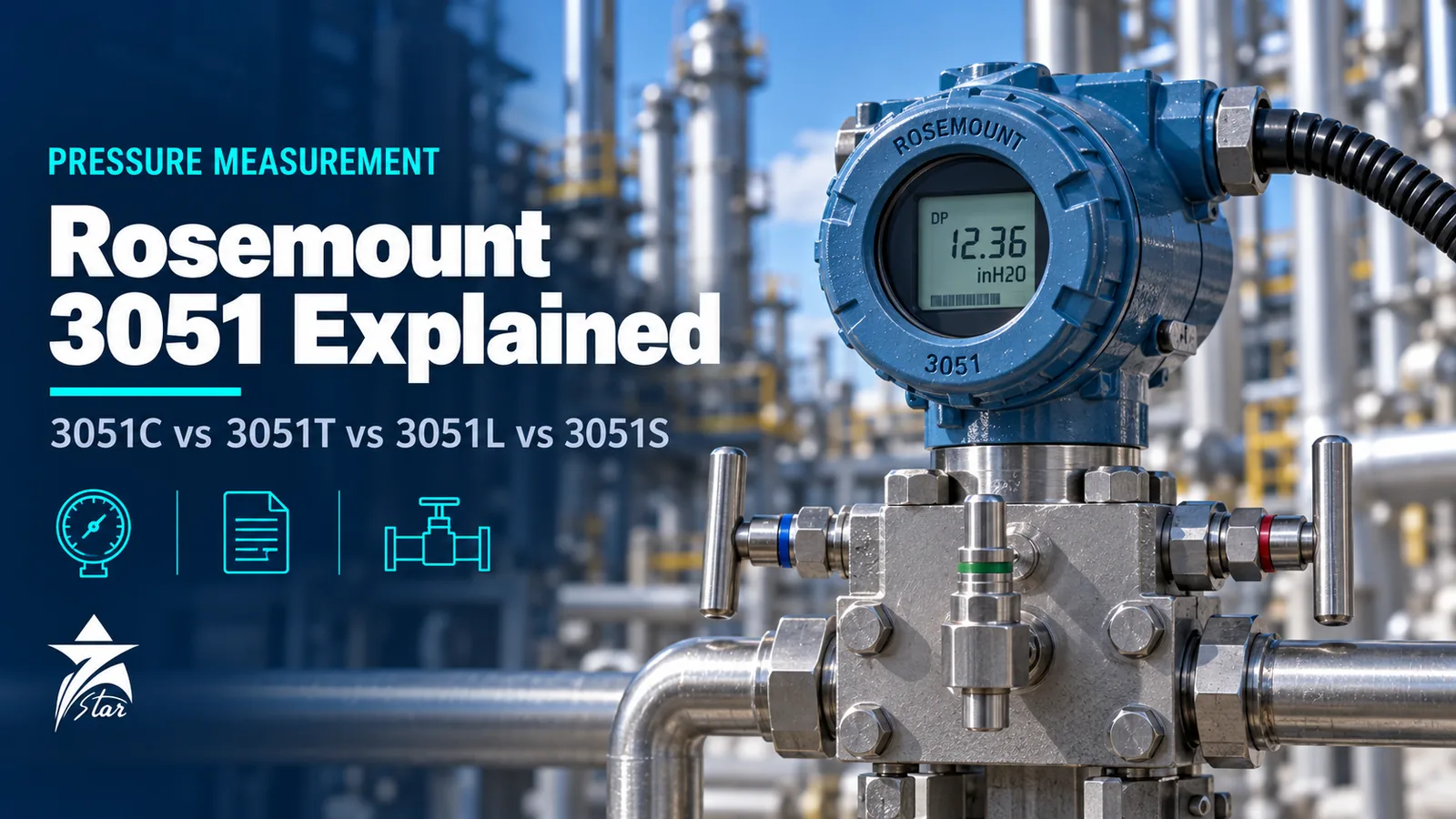
The Rosemount 3051 is one of the most widely installed pressure transmitter families in oil and gas, power and water plants, and many engineers know it simply by its model number. The family is broader than the name suggests: coplanar DP, gauge and absolute transmitters, in-line gauge and absolute units, flange-mounted level transmitters, integrated flowmeter assemblies and the separate 3051S scalable platform. Ordering the wrong variant, or misreading one field of the model code, produces a transmitter that does not fit the manifold, does not cover the range or does not carry the right approval. This guide explains the platforms, how model codes are structured, and how to choose between them and comparable instruments.
The Platforms at a Glance
The family divides by mechanical architecture first, then by measurement type.
| Platform | Measurement types | Process interface | Typical uses |
|---|---|---|---|
| 3051C coplanar | 3051CD differential, 3051CG gauge, 3051CA absolute | Coplanar flange with two process connections on one face; traditional flange and integral manifold options | DP flow across orifice plates, filter DP, level by DP, gauge and absolute pressure |
| 3051T in-line | 3051TG gauge, 3051TA absolute | Single in-line process connection | Line pressure, pump discharge, tank pressure where only one port is needed |
| 3051L level | DP level with flange-mounted high-pressure side | Flush or extended diaphragm flange on the tank nozzle | Level in tanks and vessels with viscous, dirty or crystallising liquids |
| 3051CF flowmeter series | DP flow | Transmitter integrated with a primary element such as an averaging pitot or an orifice assembly | Compact flow points delivered as a single assembly |
| 3051S scalable | Coplanar, in-line, level and flow variants | Modular sensor and electronics | Higher-performance and longer-stability applications, remote seal systems, advanced diagnostics |
| 3051SAL | DP or pressure level with seals | Remote or direct-mount diaphragm seals | Level on vessels needing seals, including high-temperature and corrosive services |
Product pages: the Rosemount 3051 pressure transmitter overview, the 3051 coplanar transmitter, the 3051S coplanar transmitter, the 3051S series of instrumentation and the 3051SAL liquid level transmitter.
The Coplanar Platform: 3051C
The coplanar design places both process isolating diaphragms on the same face of the sensor module. That single feature drives several practical advantages. A coplanar flange bolts to the sensor and presents the process connections; a traditional flange can be fitted instead where existing impulse-line spacing must be matched; and an integral manifold can bolt directly to the sensor, removing a set of fittings and leak points.
The 3051CD is the workhorse for DP flow and DP level. The 3051CG and 3051CA use the same mechanical platform for gauge and absolute pressure, which keeps manifold and mounting hardware common across a plant. If a site standardises on coplanar hardware, it can hold one style of manifold and bracket for most pressure points.
When specifying a 3051C for DP service, also specify the manifold. A 3-valve manifold suits liquid and most gas DP service, while a 5-valve manifold adds vent or calibration ports. An integral manifold ordered with the transmitter is assembled and pressure-tested as a unit, which simplifies installation and avoids mismatched bolting.
In-Line Transmitters: 3051T
The 3051T has a single isolating diaphragm and an in-line process connection, so it threads or flanges directly onto the process or onto a single valve. It measures gauge (3051TG) or absolute (3051TA) pressure only. It is lighter and simpler than a coplanar transmitter and is often the economical choice for straightforward line pressure on pumps, compressors and vessels.
Choose absolute pressure where the measurement must be independent of atmospheric pressure, for example vacuum service, vapour pressure-related control or gas density compensation. Gauge pressure is normal for most process and utility pressure points.
Level and Flow Variants: 3051L, 3051CF and 3051SAL
The 3051L bolts its high-pressure side directly to a tank nozzle with a flush or extended diaphragm. It eliminates the high-pressure impulse line, which is where plugging occurs with viscous or crystallising liquids. The low-pressure side can be a dry leg on an atmospheric tank, or a seal and capillary on a pressurised vessel.
The 3051CF flowmeter series supplies a transmitter already mounted on a primary element. It reduces field fabrication and impulse lines and is supplied and documented as one assembly.
The 3051SAL applies the 3051S platform to level with diaphragm seals. Seal systems introduce their own errors: fill fluid expansion with temperature, capillary head effects and slower response. Keep capillaries as short as practical, run both capillaries together so they see the same temperature, and choose a fill fluid rated for the process and ambient temperature range.
The 3051S Scalable Platform
The 3051S is a separate platform, not an upgraded 3051 with the same internals. It is modular, with sensor modules and electronics combined to suit the application, and it is offered in performance tiers. Higher tiers, such as the 3051S Ultra versions, offer tighter reference accuracy and longer stability specifications than the standard 3051. Confirm the exact figures in the current product data sheet, because performance statements depend on range, tier and options.
Choose the 3051S when:
- The measurement is fiscal, allocation or high-value, and total probable error over time matters.
- Longer calibration intervals are part of the maintenance strategy and need to be justified.
- Remote seal systems or more advanced diagnostics are required.
- The plant already standardises on 3051S and wants common spares.
For general process and utility pressure points, the standard 3051 is usually sufficient.
Reading a Model Code
A 3051 model code is a string of fields read from left to right. The general structure is:
- Model: for example 3051C, 3051T or 3051L.
- Measurement type: for the coplanar platform, D for differential, G for gauge and A for absolute, giving 3051CD, 3051CG and 3051CA.
- Range code: a digit that sets the sensor’s span limits.
- Transmitter output: 4–20 mA with HART, FOUNDATION Fieldbus, PROFIBUS PA or WirelessHART, depending on what the platform offers.
- Materials of construction: isolating diaphragm, process flange and adapters, and fill fluid.
- Process connection and flange style.
- Option codes: housing material and conduit entry, hazardous area approvals, display, mounting bracket, integral manifold, calibration certificates, safety certification and special cleaning or material certification.
Do not decode individual letters from memory. Option letters differ between platforms and have changed over the product’s life. Take the full code from the nameplate and decode it against the current product data sheet.
Range codes deserve particular attention. Lower range codes cover low DP such as draft or filter service, mid range codes cover typical orifice DP, and higher codes cover high pressure. Each has a maximum span and a minimum span, and performance is best when the calibrated span is not heavily turned down. When replacing a transmitter, match the range code first, then set the calibrated range to the loop’s required span. Verify span limits against the range table in the product data sheet.
Outputs, Diagnostics and Safety Certification
Most installed units are 4–20 mA with HART. HART gives remote configuration, diagnostics and device information to asset management systems and handheld communicators such as the Emerson 475 field communicator or the AMS Trex device communicator. When replacing an older unit, check the HART revision of the new transmitter against the device descriptions loaded in the DCS and asset management system; a missing DD often looks like a faulty transmitter.
FOUNDATION Fieldbus and WirelessHART versions exist for plants using those networks. WirelessHART suits monitoring points on remote wellheads and tank farms where cabling is expensive, provided update rate and battery life suit the application.
For safety instrumented functions, 3051 transmitters are available with IEC 61508 safety certification. Use the safety manual for proof-test procedures and failure rate data, and confirm the SIL capability on the certificate rather than on a sales summary. For sour service, select wetted materials that comply with NACE MR0175/ISO 15156 through the appropriate material options.
3051 Compared With 3051S and Competitors
| Transmitter | Positioning | Strengths | Points to check |
|---|---|---|---|
| Rosemount 3051 | General-purpose workhorse | Coplanar platform, very large installed base, broad option range | Correct range code and output; DD revision |
| Rosemount 3051S | Higher-performance scalable platform | Performance tiers, seal systems, diagnostics | Cost justification for the tier selected |
| ABB 266 series | Broad DP, gauge and absolute range | Wide range of seals and versions | Different flange and option structure |
| Endress+Hauser Cerabar and Deltabar | Gauge, absolute and DP families | Current Cerabar and Deltabar B generation, such as the Cerabar PMC71B, alongside legacy units like the Deltabar PMD75 | Generation differences when replacing |
| Yokogawa EJA series | DP, gauge and absolute | Established family with a large installed base | Match the existing DCS integration |
Most plants choose by standardisation rather than by marginal specification differences. If spares, manifolds, configuration tools and technician familiarity are built around one family, staying with it reduces lifecycle cost.
Replacing Legacy Units
Older Rosemount 1151 and early 3051 installations are still common. When replacing them:
- Check the process connection spacing and bolt pattern. A 3051 with a traditional flange option is often used to match existing impulse-line connections.
- Check the electrical entry size and thread type, and the hazardous area certification required for the location.
- Confirm the mounting bracket and orientation, especially where impulse lines are rigidly tubed.
- Configure range, units, damping and failure mode alarm direction to match the DCS expectations.
- Perform a zero trim at operating static pressure for DP units after installation.
Oman Site Considerations
Transmitters on exposed racks in the interior see direct sun, with housing temperatures well above the 45 to 50 °C ambient. Fit sunshades, use correctly rated cable glands and seal unused entries against fine dust. For remote seal systems, temperature effects on fill fluid are amplified by solar heating, so shade capillaries and keep both sides equally exposed. Coastal plants should specify housing materials and coatings suitable for salt-laden humidity. Our pressure transmitter selection guide covers these effects in more depth.
Selection Checklist
- Measurement type: differential, gauge or absolute.
- Platform: coplanar, in-line, flange level, flow assembly or 3051S.
- Range code covering the required span with adequate margin.
- Output: HART version, fieldbus or WirelessHART.
- Wetted materials and fill fluid, including NACE requirements.
- Process connection, flange style and manifold.
- Hazardous area approval and conduit entry.
- Display, bracket and housing material.
- Safety certification if used in a SIF.
- Calibration certificate and configuration data.
- DD availability in the host and asset management system.
Sourcing Rosemount 3051 Transmitters Through Seven Star LLC
Seven Star LLC supplies Rosemount 3051 and 3051S transmitters, as well as comparable transmitters from other manufacturers, for plants across Oman. Send us the full model code from the existing nameplate and the process conditions, and we will match the variant and options before quoting. Browse the Rosemount brand page or our pressure instrumentation category.
Send Seven Star LLC your Rosemount 3051 model code and process data, and we will help you source the correct transmitter.
Need a Quotation for Your Project?
- Genuine OEM products
- Supply across Oman & the GCC
- Formal quotation from our sales team
Free, no-obligation quotation · takes about 1 minute
Other enquiries: [email protected] · WhatsApp
More Blog