- Automation & ControlView all 2,925 products
- Automation Accessories
- AC Drives
- PLC & I/O Cards
- Industrial Communications
- Vibration Monitoring
- Controllers & Data Acquisition
- Isolator & Barrier
- Safety Switches & Guard Locking
- Motor Soft Starters
- CCTV & Security
- Encoders
- Pneumatic Cylinders
- HMI Displays
- Servo Drives
- Industrial Computers
- Machine Vision
- Automation Software
- Robotics
Brand: Panametrics
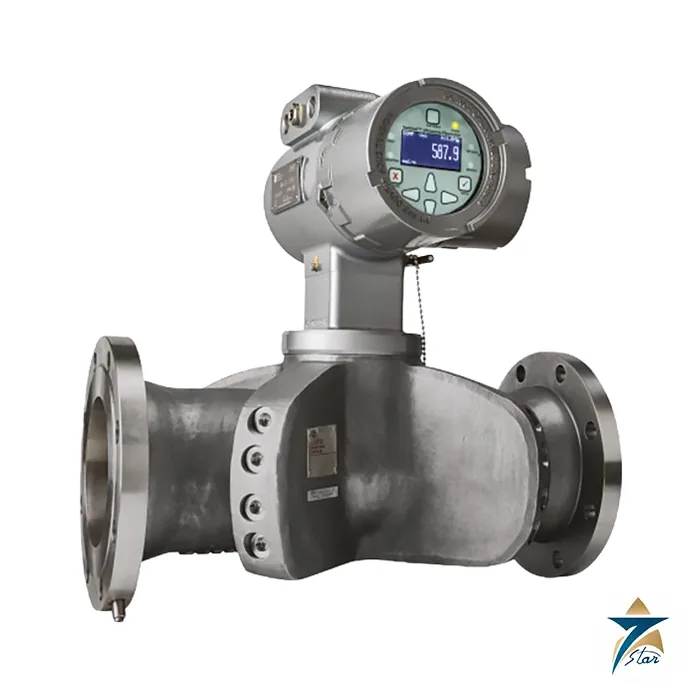
Panametrics Sentinel LCT8 Eight-Path Ultrasonic Flowmeter
Description
LCT8: the eight-path member of the Sentinel family
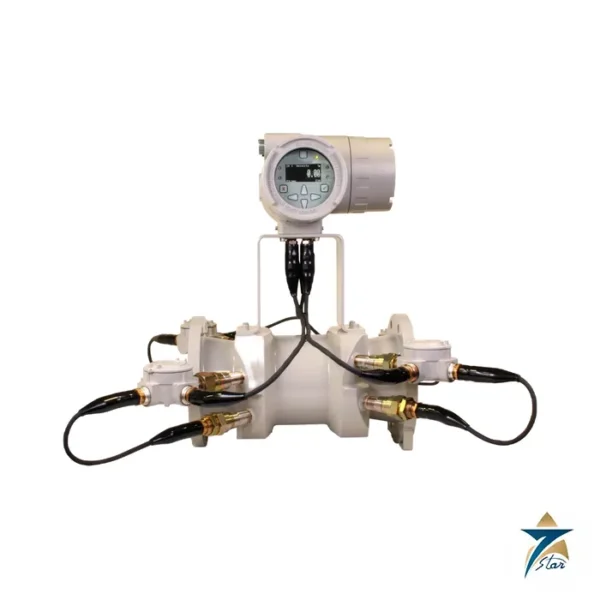
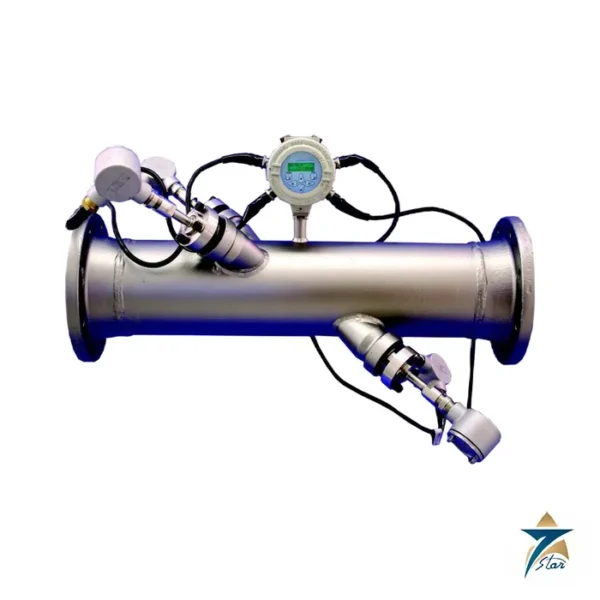
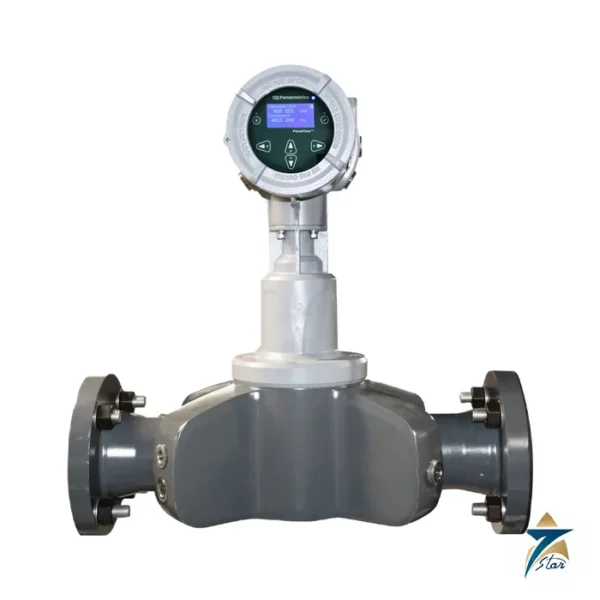
Where the Panametrics Sentinel LCT and LCT4 use four ultrasonic paths, the Sentinel LCT8 uses eight chordal paths arranged to create a stratified measurement field. The company says this arrangement cancels the effect of swirl and of flow disturbances caused by changing fluid properties or installation effects, which is why the LCT8 is aimed at hydrocarbon liquids and critical-use water where operating conditions are unstable. It reuses the groundbreaking LCT4 body concept, with integral electronics, magnetic-induction programming and no junction boxes, but trades path count for much shorter straight-run requirements and a slimmer installation footprint, a notable benefit on congested skids.
LCT8 selling points
- Eight chordal paths for high immunity to swirl and profile distortion.
- Linearity within plus or minus 0.12% of measured volume between 1 and 33 ft/s (0.3 and 10 m/s), tighter than the 0.15% of the four-path models.
- Recommended installation with a minimum of only 5 pipe diameters upstream and 3 downstream.
- Uncertainty under plus or minus 0.027% according to API MPMS 5.8.
- Viscosity independence with one calibration curve across the full viscosity range, and no prover run when viscosity changes.
- Pipe sizes 6 in to 24 in in 150, 300 and 600 lb flanges.
LCT8 specification sheet
| Parameter | LCT8 |
|---|---|
| Fluids | Liquid hydrocarbons, crude and refined products, other liquids including water |
| Viscosity, Reynolds | 0 to 660 cSt; Reynolds above 10,000 |
| Process / ambient | -40 to 140 C; ambient -40 to 60 C; storage -40 to 85 C |
| Meter body | SA216 WCB, SA352 LCB, SA351 CF8 (304) or CF8M (316); others on request |
| Schedules | Standard 40/40S, 80/80S and 10S; optional STD, XS and others |
| Electronics | Epoxy-coated aluminum, optional A351 316/316L stainless; IP66; 7 W |
| Supply | 100 to 240 VAC or 12 to 32 VDC |
| Outputs and inputs | Two isolated frequency/pulse outputs; two alarm relays; one 4-20 mA; optional two 4-20 mA plus RTD or three 4-20 mA inputs |
| Interfaces | PanaLink over RS232/485/USB; Modbus RTU over RS232/485 |
| Flow computer | Integrated, with P and T volume corrections to API 11.1 |
| Hazardous area | Class I Div 1 B, C, D; ATEX II 2 G Ex d IIB+H2; IECEx |
| Weights, 150 lb | 6 in 239 lb (108 kg); 12 in 582 lb (264 kg); 24 in 2112 lb (958 kg) |
How LCT8 differs from LCT4 and LCT
Path count is the headline: eight versus four. That gives the LCT8 its tighter 0.12 percent linearity and its 5D upstream and 3D downstream recommendation, compared with LCT4 at 0.15 percent and at least 10D upstream with a conditioner, and LCT at 0.15 percent with 20D upstream. Size range narrows from 3 to 24 in on LCT4 to 6 to 24 in on LCT8. Another difference is certification status: the datasheet notes that NMi testing for OIML approval of replacement-without-recalibration is pending for the LCT8, and that approvals are available country by country on request, whereas the LCT4 lists OIML R117-1 class 0.3 with certificate TC7595.
Why multiple paths matter is easy to see from the application list. In a short, congested piece of piping a single chord or a pair of chords sees a different part of the velocity profile every time an upstream valve moves, a pump starts or fluid properties change. Eight paths sample the profile at several heights and angles, so the meter integrates over the whole cross-section and the effect of swirl averages out, which is the reason the manufacturer can recommend only 5 diameters upstream and 3 downstream. A shorter spool also lowers installation cost, saves steel and shortens the outage when an old meter run is replaced. The same mechanical body is used for hydrocarbon liquids and for water, and the datasheet notes that no filters or strainers are required, there is no pressure drop and there are no moving parts to wear.
For buyers comparing options, the decision usually comes down to straight-run budget and the accuracy class demanded by the contract. If the skid can accommodate a longer upstream pipe with a flow conditioner, an LCT4 or the original LCT may be enough; if space is the constraint, or if the line sees a lot of disturbance, the eight-path model is the logical choice. Remember that the datasheet describes approvals as available on request by country, so the contract should name the metrology authority that will witness verification.
Applications in Oman and the Gulf
Pipeline leak detection, liquid custody transfer, allocation and any critical liquid process fit the LCT8. A short-run meter is attractive on jetty manifolds, refinery pump discharge headers and offshore or onshore skids where long straight pipes are expensive. Treated-water exports and other critical water lines can also use the eight-path design.
Sizing information
The velocity range quoted for product capability is 1 to 40 ft/s (0.3 to 12.2 m/s). Typical flow limits from the datasheet are 20 to 818 m3/h for 6 in, 56 to 2233 m3/h for 10 in, 129 to 5172 m3/h for 16 in and 301 to 12,022 m3/h for 24 in, based on nominal schedule 40S or STD bore. In barrels per hour the 24 in meter spans 1891 to 75,639. OIML applications are limited to the ranges on the certificate.
Installation and diagnostics
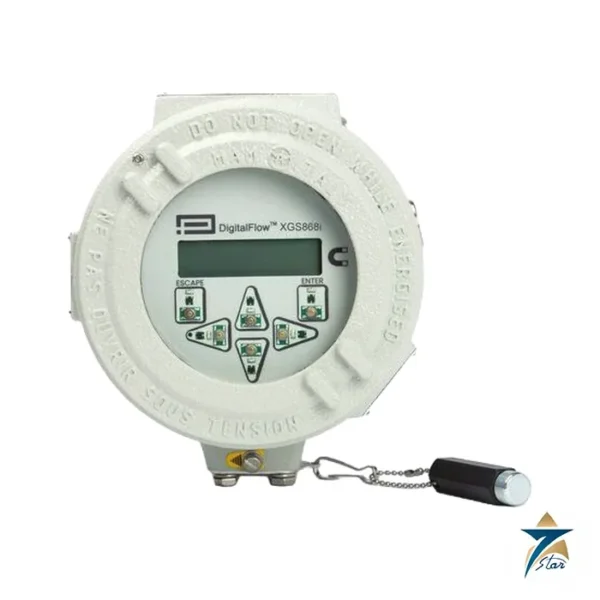
Bolt the flanged flowcell inline, then wire power, outputs and the optional temperature, pressure and density inputs. Local programming uses magnetic induction so the explosion-proof enclosure stays closed, and a remote-mount adapter with cable is available. PanaView records historical diagnostics and a configuration audit trail. Laboratory calibration uses single or multiple fluids according to the application.
Supplier note
Seven Star LLC is an independent supplier serving Oman and the GCC and is not affiliated with the manufacturer. We can help compare four-path and eight-path options for a particular skid layout.
Documents and quotation
A manufacturer datasheet for LCT8 comes with this listing. In an RFQ state LCT8, line size, flange class, body material, calibration fluid, approvals and quantity.
Other Models in the Panametrics Sentinel Range
Seven Star LLC supplies models from the Panametrics Sentinel range in Oman and the GCC. Compare the related models below and request a quote for the one that matches your application.
| Model | Category | |
|---|---|---|
| Panametrics Sentinel LCT Custody Transfer Ultrasonic Flowmeter | Ultrasonic Flowmeters | View details |
| Panametrics Sentinel LCT8 Eight-Path Ultrasonic Flowmeter | Ultrasonic Flowmeters | You are viewing this model |
Datasheets & Documents
- Datasheet Panametrics Sentinel LCT8 Eight-Path Ultrasonic Flowmeter Datasheet Download
Reviews (0)
How would you rate this product? Cancel reply
About brand
Panametrics is an American maker of ultrasonic flowmeters and moisture, oxygen and gas analysers. It was founded in 1960 and was based in Waltham, Massachusetts, when GE bought it in 2002. It later became a Baker Hughes business, and since 1 January 2026 it has belonged to Crane Company. Its long-running site in Shannon, Ireland, opened in 1973.
Seven Star LLC lists Panametrics flowmeters and analyzers for buyers in Oman: DigitalFlow gas and flare meters, clamp-on and portable liquid meters, and trace moisture analyzers for natural gas and process gases. We are an independent supplier, so each inquiry is checked against the manufacturer's order string before a quotation goes out.
Panametrics company profile
| Founded | 1960, Massachusetts, USA |
|---|---|
| Main sites | Billerica, Massachusetts, and Shannon, Ireland (since 1973) |
| Ownership | Crane Company since 1 January 2026; previously GE (from 2002) and Baker Hughes |
| Key technology | Transit-time ultrasonic flow measurement and aluminium oxide moisture sensing |
| Product families | TransPort PT900 portable and DigitalFlow fixed ultrasonic flowmeters for liquid, gas and flare gas, aluminium oxide moisture probes and hygrometers, Aurora laser moisture analysers, XMO2 oxygen and XMTC thermal conductivity transmitters |
Milestones
- 1960: Panametrics is founded.
- 1973: The Shannon, Ireland, site is established.
- 2002: GE acquires Panametrics.
- 2026: Crane Company completes its purchase of Baker Hughes' Precision Sensors & Instrumentation, including Panametrics.
Panametrics product families on this page
The listed items follow the manufacturer's own grouping:
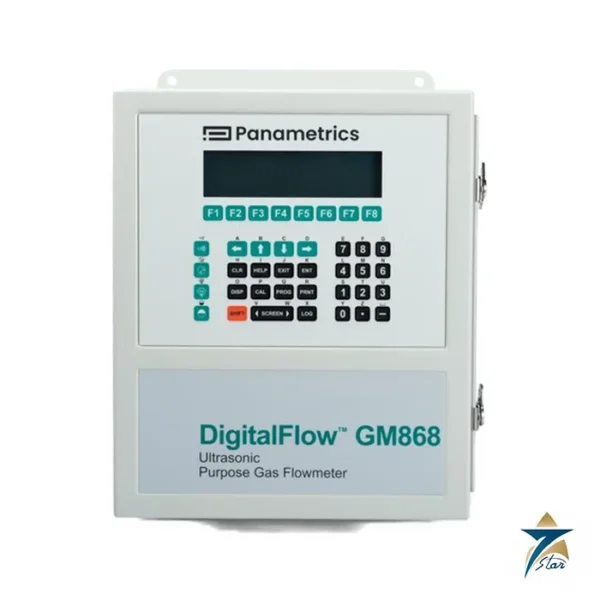
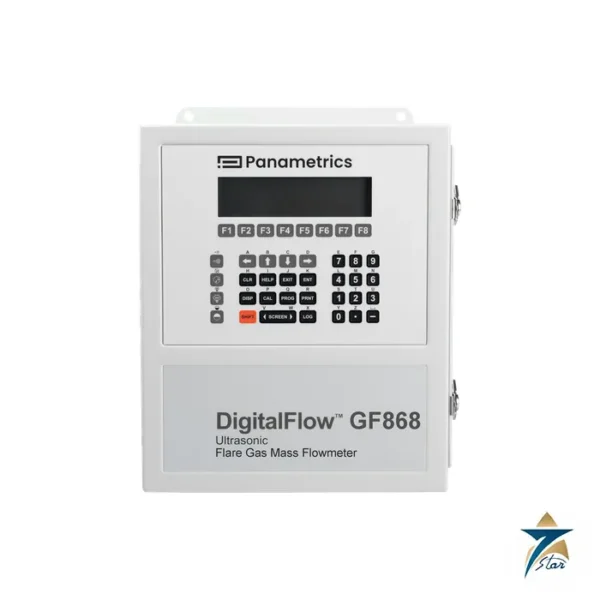
- Gas and flare flow: DigitalFlow GF868 flare gas meter, GM868 and XGM868i gas flow transmitters
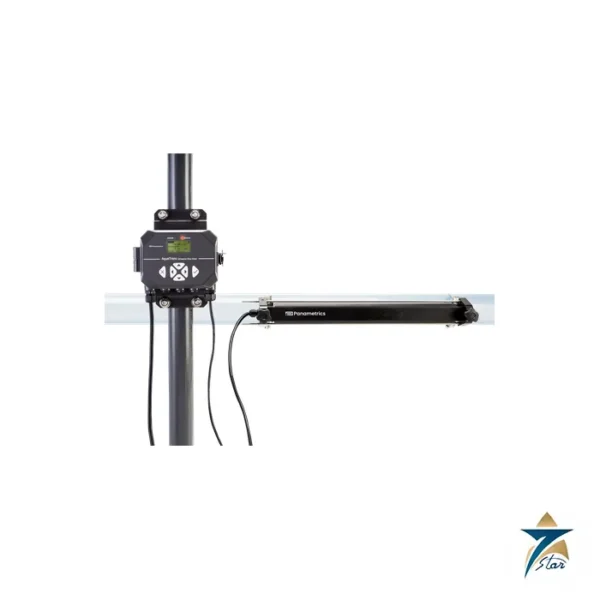
- Liquid flow: XMT1000 transmitter, AT600 AquaTrans clamp-on meter, TransPort PT900 portable meter
- Moisture: moisture.IQ multichannel analyzer, HygroPro II aluminum oxide transmitter, Aurora TDLAS analyzer for natural gas
Older units may carry GE Panametrics or GE Sensing on the nameplate. They belong to the same product lines, and the model string is read the same way.
Where Panametrics flowmeters and moisture analyzers are used
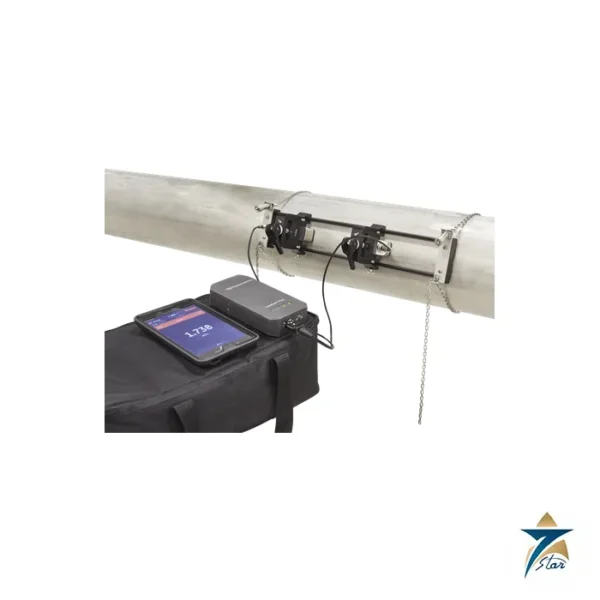
Flare meters report flared volumes on production sites, refineries and LNG plants. Clamp-on and portable ultrasonic meters check water, hydrocarbon liquid and utility lines without cutting the pipe. Aluminum oxide and TDLAS moisture analyzers watch dehydration units, gas pipelines, hydrogen and industrial gas streams. The manufacturer also names chemical processing, energy and water and wastewater among its markets, which matches what GCC operators ask us for.
Panametrics products we list
Ordering Panametrics equipment: what we need
A Panametrics model is a long configuration string, and the transducers or probes are ordered separately. Please send the full model and serial number of the electronics, the transducer or moisture probe part number, pipe size, schedule and material, fluid, pressure and temperature, flow range, hazardous area approval and output or protocol. For a flare meter add the flare gas composition range and velocity range. For moisture, give the dew point range and whether sample system components are required.
Facts checked against GE's 2002 acquisition release, Crane Company's January 2026 completion release and Irish press, October 2026.
FAQ
Questions about the Panametrics Sentinel LCT8 Eight-Path Ultrasonic
Answers from our engineering team on installation, compatibility and integration.
01How many paths does the Sentinel LCT8 use?
Eight chordal paths forming a stratified field that cancels swirl and disturbance effects.
02What straight pipe run is recommended for LCT8?
A minimum of 5 pipe diameters upstream and 3 diameters downstream, much shorter than the four-path Sentinel meters.
03How accurate is the Sentinel LCT8?
Linearity within plus or minus 0.12 percent of measured volume between 1 and 33 ft/s, with API MPMS 5.8 uncertainty under 0.027 percent.
04What pipe sizes does LCT8 cover?
6 in to 24 in with 150, 300 and 600 lb flanges.
05What fluids is the LCT8 designed for?
Hydrocarbon liquids and water for critical use, including crude oil and refined products, with viscosity from 0 to 660 cSt.


Reviews
There are no reviews yet.