Brand:

Panametrics PT878GC TransPort Portable Gas Ultrasonic Flowmeter

Description

Panametrics PT878GC portable gas flowmeter at a glance

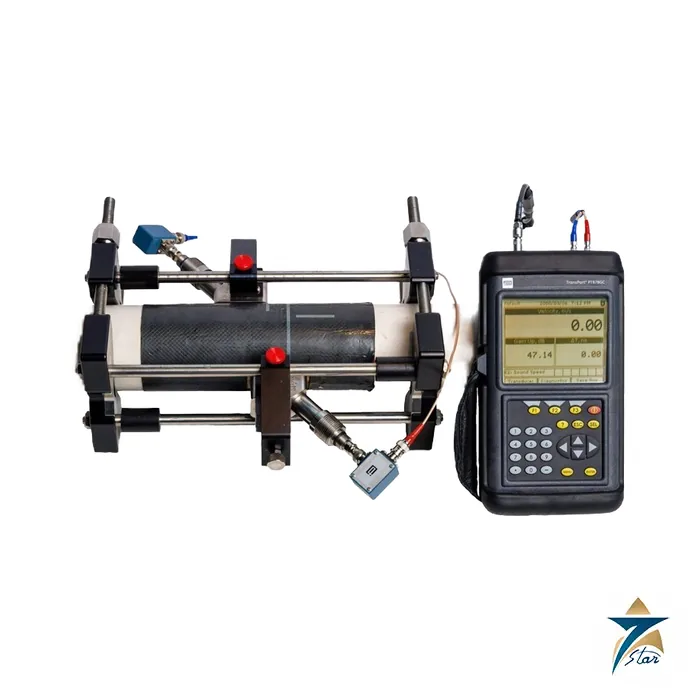
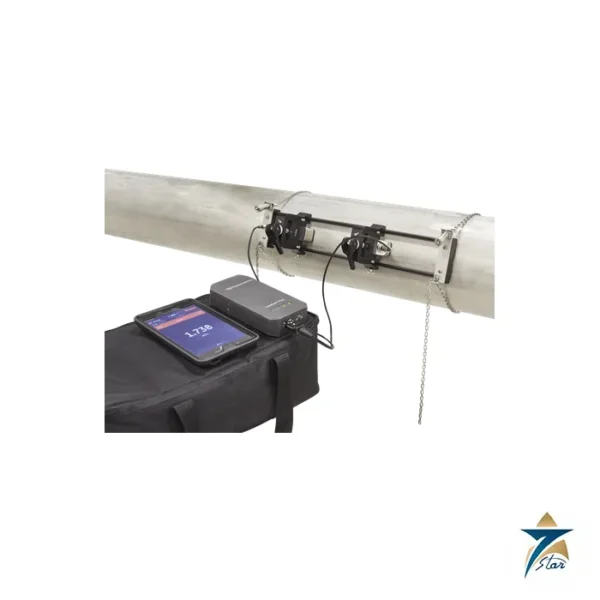
The Panametrics PT878GC, sold as the TransPort PT878GC, is a battery-powered handheld transit-time flowmeter built to measure gas without cutting the pipe. Two transducers are clamped to the outside of a metal or plastic line, the user keys in the site parameters, and flow appears on a 240 by 200 pixel backlit graphic display. The manufacturer designed it for natural gas, compressed air, fuel gases, erosive, corrosive and toxic gases, high-purity gases and air separation gases, which makes the PT878GC a common survey tool for plant engineers who need a number quickly and cannot shut a line down.

Nothing touches the process. The PT878GC has no wetted parts, no moving parts and causes no pressure drop, so the same instrument can be walked from a compressed-air header to a fuel gas branch in a single shift. The datasheet notes testing on metal pipes from 0.75 in (20 mm) to 24 in (600 mm), and the meter holds a rangeability of 150:1 when the flow profile is fully developed.

PT878GC key features

  • Patented correlation Transit-Time measurement with standard and actual volumetric flow, flow velocity and mass flow, plus a sound-speed output.
  • Rechargeable battery pack rated for 8 hours of continuous use, with a 100 to 250 VAC, 50/60 Hz charger.
  • Logging of more than 100,000 flow data points and storage for 32 site locations.
  • IP67 sealed housing in a rubber boot, tolerant of limited submersion up to 3 ft (1 m) of water.
  • One 0/4 to 20 mA output, one pulse or frequency output, and two 4 to 20 mA inputs with a switchable loop supply for a temperature or pressure transmitter.
  • Infrared port for a thermal printer or a PC through an RS232-to-infrared dongle.
  • Optional dual-element pipe-wall thickness gauge, because wall thickness is a key input to the clamp-on calculation.

PT878GC technical specifications

Parameter PT878GC value
Pipe size, PT878GC-01 electronics 0.75 in to 12 in (20 mm to 300 mm)
Pipe size, PT878GC-02 electronics 4 in to 24 in (100 mm to 610 mm) and larger
Velocity accuracy 2% to 5% of reading typical for pipes up to 6 in; 1% to 2% typical above 6 in
Repeatability 0.2% to 0.5% of reading
Straight run assumed About 20 diameters upstream, 10 downstream; velocity above 5 ft/s (1.5 m/s)
Pipe materials All metals and plastics, no lined pipes
Standard transducer temperature -40 to 266 F (-40 to 130 C); optional overall range to 446 F (230 C)
Electronics operating temperature -4 to 131 F (-20 to 55 C)
Enclosure and weight IP67; 3 lb (1.36 kg); 9.4 x 5.5 x 1.5 in
Keypad 25-key rubberized tactile membrane
Thickness gauge range 0.05 in to 3 in (1.3 mm to 76.2 mm), 1% typical accuracy
Area classification General purpose electronics

How the PT878GC reads gas through a pipe wall

Gas is a poor acoustic conductor, and the datasheet quantifies the problem: with traditional transducers only about 4.9 x 10 to the power of minus 7 percent of the transmitted sound energy reaches the receiver. The transducers supplied for the PT878GC generate coded signals five to ten times stronger, so the receiver can pick the burst out of background noise even in low-density gas. The meter then compares downstream and upstream transit times; the difference is proportional to flow velocity and, together with the programmed pipe data, gives rate and direction.

Because the signal has to cross the wall twice, there is a pressure floor. The installation requirements table gives, for example, a minimum of 60 psig (5.1 bar) in air for a 4 in pipe with wall up to 0.24 in (6.1 mm), but 300 psig (21.7 bar) in air when a 4 in wall is as thick as 0.68 in (17.3 mm). Natural gas on the same 4 in pipe needs 150, 400 and 800 psig for the three wall classes. Check these limits before travelling to site.

Applications in Oman and GCC industry

Portable clamp-on gas metering is useful where a permanent meter is absent or suspect. Typical uses around Oman and the Gulf include checking fuel gas to heaters and gas turbines, auditing compressed-air headers in manufacturing plants, spot-verifying a fixed meter in a gathering station, and surveying gas lift lines in oilfield service work. Utilities use it to verify nitrogen or instrument air consumption, and water-sector plants use it on blower air lines. The sound-speed output is also a quick sanity test of gas composition.

Selection and ordering notes for PT878GC

The order string for the system code PT878GC-SYS is built from base model, frequency code (1 for 500 kHz to 1 MHz, 2 for 200 to 500 kHz, 0 for no transmitter), power cord region, preamplifiers, transducer code, fixture code, damping material and accessories. Transducer codes range from a single C-RS at 1 MHz or 0.5 MHz rated -40 to 150 C, through C-RV and C-RW (0.2 MHz) pairs, to high-temperature C-RL versions rated to 230 C and a C-RW HT rated to 180 C. Fixture code 1 covers 3/4 in to 12 in pipe, code 2 covers 12 in to 24 in, and code 3 bundles both. Damping material DMP1 is for pipes below 150 F and DMP4 below 200 F. The example string in the datasheet is PT878GC-SYS 1 EU PRE A 1 DMP1 0.

Accessories listed include the thickness gauge DM5E, AIO input/output cable, spare battery, a battery case for AA cells, 25 ft and 100 ft extension cables and a hard case. Standard transducer cables are 25 ft (8 m) with LEMO coaxial connectors, and 500 ft (154 m) extension cables exist for most transducers.

Installing and commissioning the PT878GC

Start by choosing a straight section and confirming wall thickness, either from the pipe schedule or with the optional gauge. Enter the pipe, gas and transducer data in the menu-driven site setup, apply CPL-16 couplant, and mount the transducers in the supplied PCFG-1 fixture for pipes below 12 in or PCFG-2 above 12 in. Adjust spacing to the value the meter displays, check the signal diagnostics, and save the setup into one of the 32 site slots. Pipes of 2 in (50 mm) or smaller need at least 10 ft (3 m) of straight run without flanges, welds or couplings.

Care and maintenance of PT878GC

With no wetted parts, the maintenance routine is about the battery and the cables. Store the unit below 95 F (35 C) when it will sit for more than a month to preserve battery life, keep the LEMO connectors clean, and renew couplant as needed. Firmware lives in field-upgradeable FLASH memory, so updates do not require a return to the factory.

Related Panametrics instruments

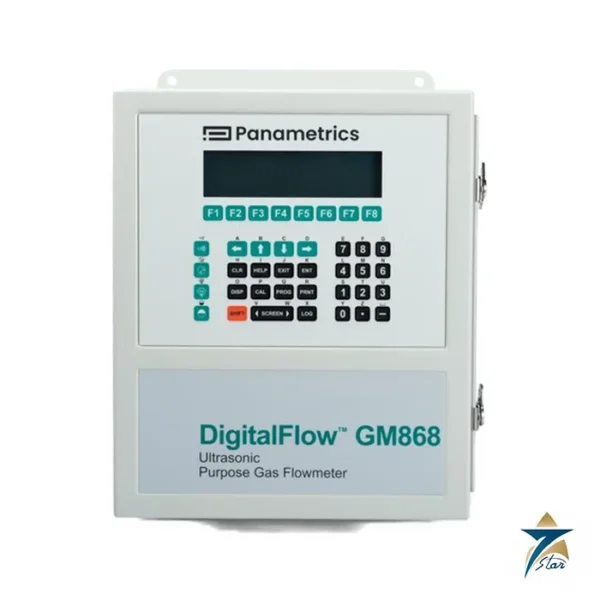
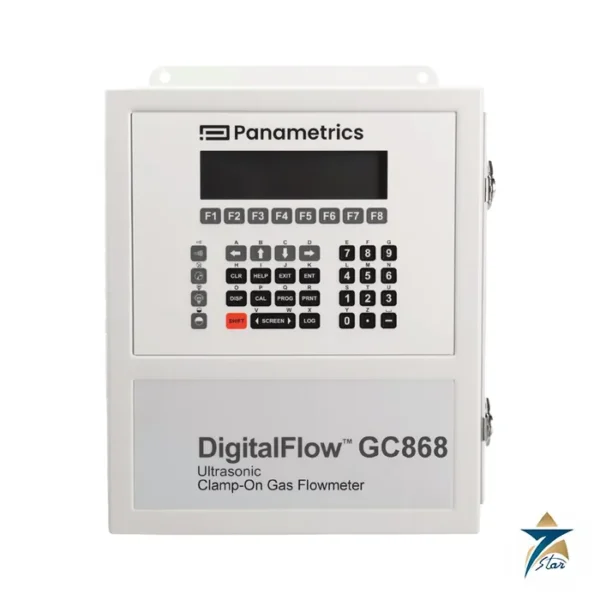
For a fixed installation using the same clamp-on gas principle, buyers often compare the DigitalFlow GC868. Liquid work calls for the clamp-on PT878 family or the DF868 instead. Seven Star LLC is an independent supplier serving Oman and the GCC and is not affiliated with the manufacturer; we can help confirm which transducer code and fixture suit your pipe.

Documents and quotation

The manufacturer datasheet for PT878GC is available on this page. To request a quotation, send your RFQ with the PT878GC part number or full order string, the pipe size, wall thickness, gas and pressure, and the quantity required, and we will reply with availability.

Datasheets & Documents
  • PDF Datasheet Panametrics PT878GC TransPort Portable Gas Ultrasonic Flowmeter Datasheet Download
Reviews (0)

Reviews

There are no reviews yet.

How would you rate this product?

It takes about 10 seconds — just tap a star. Your email is never published.

About brand

Panametrics is an American maker of ultrasonic flowmeters and moisture, oxygen and gas analysers. It was founded in 1960 and was based in Waltham, Massachusetts, when GE bought it in 2002. It later became a Baker Hughes business, and since 1 January 2026 it has belonged to Crane Company. Its long-running site in Shannon, Ireland, opened in 1973.

Seven Star LLC lists Panametrics flowmeters and analyzers for buyers in Oman: DigitalFlow gas and flare meters, clamp-on and portable liquid meters, and trace moisture analyzers for natural gas and process gases. We are an independent supplier, so each inquiry is checked against the manufacturer's order string before a quotation goes out.

Panametrics company profile

Founded 1960, Massachusetts, USA
Main sites Billerica, Massachusetts, and Shannon, Ireland (since 1973)
Ownership Crane Company since 1 January 2026; previously GE (from 2002) and Baker Hughes
Key technology Transit-time ultrasonic flow measurement and aluminium oxide moisture sensing
Product families TransPort PT900 portable and DigitalFlow fixed ultrasonic flowmeters for liquid, gas and flare gas, aluminium oxide moisture probes and hygrometers, Aurora laser moisture analysers, XMO2 oxygen and XMTC thermal conductivity transmitters

Milestones

  • 1960: Panametrics is founded.
  • 1973: The Shannon, Ireland, site is established.
  • 2002: GE acquires Panametrics.
  • 2026: Crane Company completes its purchase of Baker Hughes' Precision Sensors & Instrumentation, including Panametrics.

Panametrics product families on this page

The listed items follow the manufacturer's own grouping:

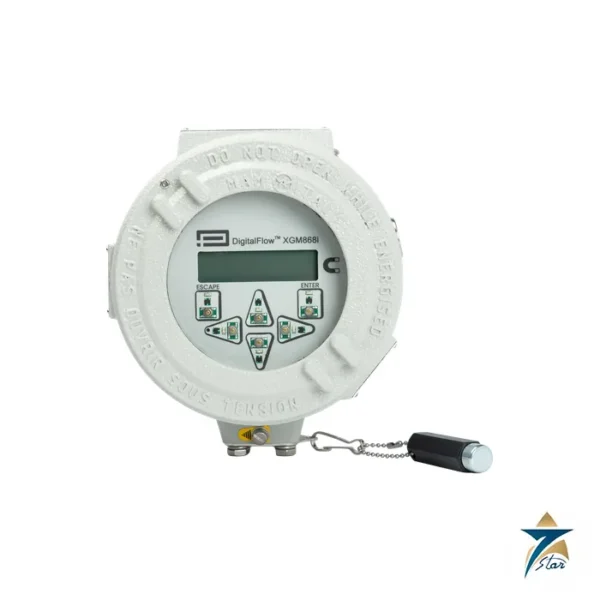
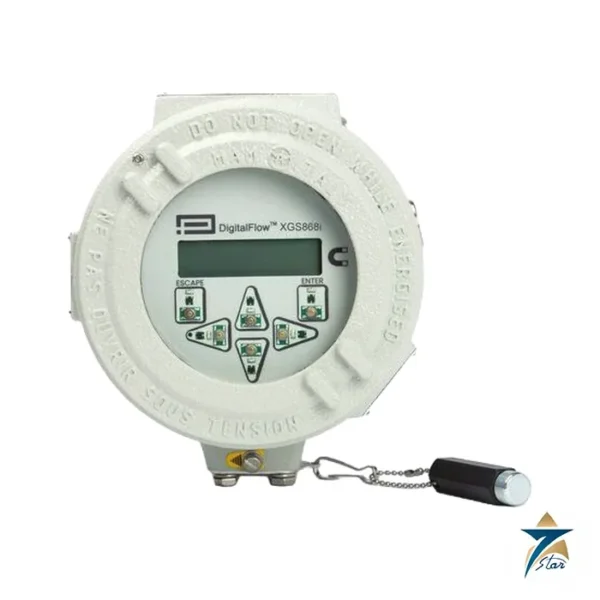
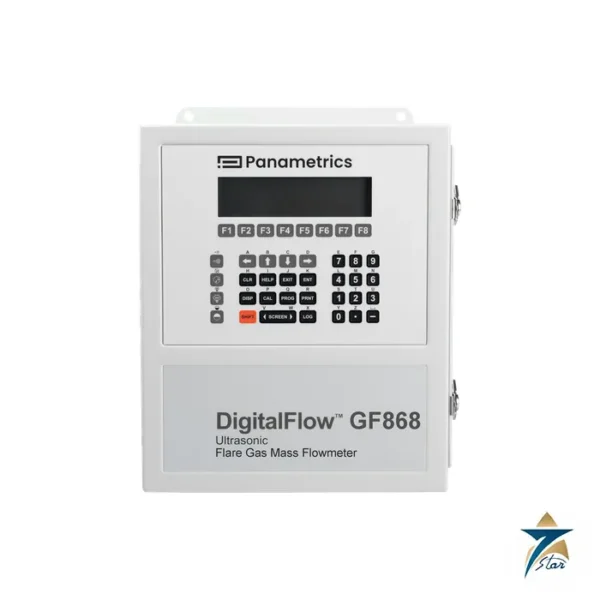
  • Gas and flare flow: DigitalFlow GF868 flare gas meter, GM868 and XGM868i gas flow transmitters
  • Liquid flow: XMT1000 transmitter, AT600 AquaTrans clamp-on meter, TransPort PT900 portable meter
  • Moisture: moisture.IQ multichannel analyzer, HygroPro II aluminum oxide transmitter, Aurora TDLAS analyzer for natural gas

Older units may carry GE Panametrics or GE Sensing on the nameplate. They belong to the same product lines, and the model string is read the same way.

Where Panametrics flowmeters and moisture analyzers are used

Flare meters report flared volumes on production sites, refineries and LNG plants. Clamp-on and portable ultrasonic meters check water, hydrocarbon liquid and utility lines without cutting the pipe. Aluminum oxide and TDLAS moisture analyzers watch dehydration units, gas pipelines, hydrogen and industrial gas streams. The manufacturer also names chemical processing, energy and water and wastewater among its markets, which matches what GCC operators ask us for.

Panametrics products we list

Family Examples
Flowmeters AT600 AquaTrans Clamp-On Ultrasonic Wate…, DigitalFlow GM868 General-Purpose Gas Ul…, GF868 DigitalFlow Flare Gas Ultrasonic F…, PT900 TransPort Portable Ultrasonic Flow…, XGM868i DigitalFlow Gas Ultrasonic Flow…, XMT1000 Liquid Flow Ultrasonic Transmitter
Gas Analyzer Systems Aurora TDLAS Moisture Analyzer for Natur…, HygroPro II Aluminum Oxide Moisture Tran…, moisture.IQ Multichannel Trace Moisture…

Ordering Panametrics equipment: what we need

A Panametrics model is a long configuration string, and the transducers or probes are ordered separately. Please send the full model and serial number of the electronics, the transducer or moisture probe part number, pipe size, schedule and material, fluid, pressure and temperature, flow range, hazardous area approval and output or protocol. For a flare meter add the flare gas composition range and velocity range. For moisture, give the dew point range and whether sample system components are required.

Facts checked against GE's 2002 acquisition release, Crane Company's January 2026 completion release and Irish press, October 2026.

FAQ

Questions about the Panametrics PT878GC TransPort Portable Gas

Answers from our engineering team on installation, compatibility and integration.

01What pipe sizes does the PT878GC-01 cover versus the PT878GC-02?
The datasheet gives 0.75 in to 12 in (20 to 300 mm) for the PT878GC-01 electronics and 4 in to 24 in (100 to 610 mm) and larger for the PT878GC-02.
02Does the PT878GC need a minimum gas pressure?
Yes. The installation requirements table lists minimum pressures that rise with wall thickness, for example 60 psig in air for a 4 in pipe with a thin wall and 300 psig for a 0.68 in wall.
03How long does the PT878GC battery last?
The rechargeable battery pack supports about 8 hours of continuous operation, and the charger accepts 100 to 250 VAC at 50/60 Hz.
04Can the PT878GC be used on lined pipe?
No. The datasheet says all metals and plastics are supported but lined pipes are not.
05What outputs does the PT878GC provide?
One 0/4 to 20 mA output, one pulse or frequency output, two 4 to 20 mA inputs for external temperature or pressure transmitters, and an infrared port.