- Automation & ControlView all 3,176 products
- Automation Accessories
- AC Drives
- PLC & I/O Cards
- Industrial Communications
- Vibration Monitoring
- Controllers & Data Acquisition
- Isolator & Barrier
- Safety Switches & Guard Locking
- Encoders
- Motor Soft Starters
- CCTV & Security
- Pneumatic Cylinders
- HMI Displays
- Servo Drives
- Industrial Computers
- Machine Vision
- Automation Software
- Robotics
















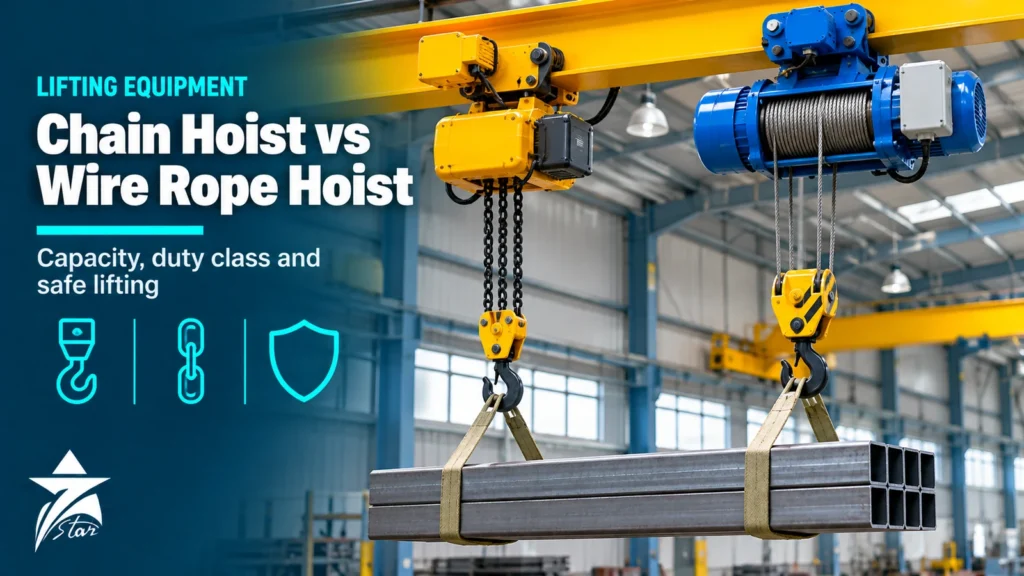
Hoists lift and lower loads in workshops, pump houses, compressor buildings, warehouses and process plants. The two main types are the chain hoist, which lifts with a load chain running over a pocketed wheel, and the wire rope hoist, which winds a steel rope onto a drum. Both can be electric, and chain hoists are also common as hand and lever operated units. Choosing the right type depends on the load, the lift height, how often the hoist works and the environment. This guide compares both types, explains duty classes, and sets out the inspection and safe lifting practice that keeps people and equipment safe.
How Each Hoist Type Works
In a chain hoist, a motor or hand chain drives a load sheave through a gearbox. The load chain, a calibrated and hardened link chain, passes over the sheave and collects in a chain bag or container. Capacity can be increased by reeving the chain in two or more falls. In a wire rope hoist, the motor drives a grooved drum through a gearbox, and the rope winds onto the drum and runs through a bottom block with sheaves. Wire rope hoists are commonly mounted on a trolley that runs along the bottom flange of a single girder beam, or on a crab between the rails of a double girder crane.
Chain Hoist vs Wire Rope Hoist Comparison
| Factor | Chain hoist | Wire rope hoist |
|---|---|---|
| Typical capacity | About 125 kg to 5 t electric, higher with multiple falls; manual up to 20 t and more | About 1 t to 80 t and above |
| Lift height | Usually up to 10 to 30 m, limited by chain weight and chain bag | Long lifts of 30 m and more without difficulty |
| Lifting speed | Low to moderate, often with two speeds or variable speed | Moderate to high, with smooth variable speed control |
| Hook path | Hook may drift sideways as chain falls change | True vertical lift possible with suitable reeving |
| Headroom | Compact for small capacities | Low headroom designs available for larger capacities |
| Duty | Light to medium duty in most applications | Medium to very heavy duty, frequent lifting |
| Cost | Lower initial cost | Higher initial cost, longer life in heavy use |
| Maintenance | Simple, chain lubrication and wear checks | Rope inspection and replacement, drum and sheave checks |
As a rule of thumb, an electric chain hoist is the economical choice for loads up to a few tonnes, moderate lift heights and occasional to regular use. A wire rope hoist suits heavy loads, long lifts, high speeds and frequent lifting, such as production lines, overhead travelling cranes in turbine halls and loading bays.
Duty Classes: FEM and ISO
A hoist that is too light for its duty will wear out quickly. Duty classes describe the expected load spectrum and running time. European practice uses FEM 9.511 classes such as 1Bm, 1Am, 2m, 3m and 4m, which correspond to ISO 4301 mechanism classes M3, M4, M5, M6 and M7. The class depends on how heavy the loads are relative to the rated capacity and how many hours per day the hoist runs.
| Load spectrum | Description | Effect on class |
|---|---|---|
| Light | Rarely the full load, mostly light loads | Allows more operating hours in a given class |
| Medium | Sometimes full load, usually medium loads | Typical workshop and maintenance use |
| Heavy | Frequently near full load | Requires a higher class or larger hoist |
| Very heavy | Regularly at full load | Production and process duty, highest classes |
A maintenance crane in a pump station may lift only a few times a week and fit a low class, while a hoist feeding a production line may need a class two or three steps higher. Give the supplier the load spectrum, lifts per hour, average lift height and daily operating time so the correct class can be selected.
Manual Hand Hoists and Lever Hoists
Hand operated hoists lift by pulling a hand chain that turns the load sheave through a gear train and a load brake. They need no power, are light and portable, and are widely used for maintenance, construction and installation work. Lever hoists, also called ratchet hoists or come alongs, use a lever and ratchet. They work in any orientation and are used for pulling, tensioning, positioning and short lifts. Wire rope pulling machines with a rope passing through jaws, such as the Tirfor type, allow unlimited rope length for pulling and lifting where a fixed point is available above or ahead.
- Use a hand operated hoist for vertical lifts when no power is available or the lift is occasional, such as replacing a pump or motor in a building without a crane.
- Use a lever hoist for pulling, tensioning and lifting in confined spaces or at angles.
- Use a rope pulling machine for long pulls, winching and recovery work.
- Choose overload protection, such as a slip clutch, where overloading is possible.
Suspension, Trolleys and Controls
Hoists can be hook mounted, lug mounted or combined with a trolley. Push, geared and motorised trolleys allow travel along a beam, and the beam flange width and profile must suit the trolley. Electric hoists are controlled by pendant stations or radio remote controls, which keep the operator away from the load. Features to compare include two speed or variable frequency drive control for smooth starts, upper and lower limit switches, overload protection, emergency stop, and phase sequence protection.
Choosing an Electric Chain Hoist for Site Conditions
Conditions in Oman add some extra points to the selection. Hoists used outdoors or in non air conditioned buildings face high ambient temperatures, dust and humidity near the coast. Check the motor insulation class and rated ambient temperature, the enclosure rating of the hoist and control pendant, and the need for weather covers, anti condensation heaters or corrosion resistant chain and hooks. For hazardous areas in oil and gas plants, only hoists certified for the zone and gas group may be used, including spark resistant options where required.
Standards and Statutory Inspection
Hoist design and testing are covered by standards such as EN 14492-2 for power driven hoists, EN 13157 for hand powered lifting equipment, and ASME B30.16 for overhead hoists and B30.21 for lever hoists. Site rules and client requirements in Oman, particularly in oil and gas, usually require each lifting appliance to be load tested and certified before first use, marked with its safe working load and a unique identification number, and thoroughly examined by a competent person at defined intervals. Lifting accessories are often examined more frequently than the hoist itself.
Inspection Points for Hoists
| Component | What to check |
|---|---|
| Load chain | Elongation over a gauge length, wear at link contact points, nicks, twisting and corrosion |
| Wire rope | Broken wires, reduction in diameter, kinks, birdcaging, corrosion and crushing |
| Hooks | Throat opening, twist, cracks and a working safety latch |
| Brakes | Holding the load without creep and stopping distance |
| Limit switches | Correct operation at upper and lower limits |
| Controls | Pendant buttons, emergency stop, cable and strain relief |
| Suspension and trolley | Wheels, side plates, stops and beam condition |
Replace load chains and hooks when they exceed the manufacturer limits, and use only the manufacturer specified chain, since chain pitch and hardness must match the load sheave. Measure loads with a calibrated dynamometer when the actual weight is uncertain.
Safe Lifting Practice
- Plan every lift, know the weight of the load and never exceed the safe working load.
- Use certified slings, shackles and clamps suited to the load and inspect them before use.
- Lift vertically, without side pulling, and avoid shock loading.
- Keep people out from under the load and use tag lines to control it.
- Never use the load chain or rope as a sling by wrapping it around the load.
- Lower the load fully and isolate power before leaving the hoist unattended.
- Report and quarantine any damaged hoist or accessory until it has been inspected.
Selected Hoists and Lifting Equipment in Our Catalog
The table below shows a selection of hoists and lifting accessories from our catalog.
| Product | Type | Typical use |
|---|---|---|
| Demag DC-Com | Electric hoist with load chain | Workshops and maintenance bays |
| Demag DCS-Pro | Variable speed electric hoist | Precise positioning of loads |
| Demag DR-Com | Wire rope hoist, 2 to 10 t | Single girder cranes |
| Demag DR-Pro | Wire rope hoist, up to 50 t | Heavy duty cranes |
| Harrington EM Mini | Compact electric hoist | Light loads in tight spaces |
| Tractel Tralift | Manual hoist, 0.25 to 20 t | Maintenance and installation |
| Harrington CX Mini | Hand operated hoist, 1/4 to 1 t | Light maintenance lifts |
| Harrington LB | Lever hoist | Pulling and tensioning |
| Tractel Bravo Desync | Lever hoist | Positioning and short lifts |
| Tractel Tirfor TU | Manual wire rope hoist | Long pulls and lifting |
| Tractel Dynafor Expert | Wireless digital dynamometer | Load measurement |
| Camlok THK | Horizontal plate clamp | Lifting steel plates |
| Danfoss T70 | Crane radio remote transmitter | Remote hoist and crane control |
Browse more in our material handling and lifting equipment category. To get a quotation, send the capacity, lift height, duty class, power supply, suspension type and quantity through our quote request form or to [email protected].
Sourcing Hoists in Oman Through Seven Star LLC
Seven Star LLC is an independent supplier in Oman of electric and manual hoists, lever hoists, wire rope pulling machines, dynamometers, lifting clamps and crane controls for industrial and maintenance customers. We quote products from manufacturers such as Demag, Tractel, Harrington, Camlok and Danfoss. Capacities, duty classes, certificates and accessories are confirmed against the manufacturer data at quotation.
Frequently asked questions
When should I choose a chain hoist instead of a wire rope hoist?
A chain hoist is usually the better choice for loads up to a few tonnes, moderate lift heights and occasional to regular use, because it is compact and lower in cost. A wire rope hoist suits heavier loads, longer lifts, higher speeds and frequent lifting.
What is a hoist duty class?
A duty class, such as FEM 2m or ISO M5, describes the load spectrum and operating time a hoist mechanism is designed for. Choosing the right class ensures the hoist reaches its design life.
What is the difference between a hand chain hoist and a lever hoist?
A hand chain hoist is operated by pulling a hand chain and is used mainly for vertical lifts. A lever hoist uses a ratchet lever, works in any orientation and is used for pulling, tensioning and short lifts.
How often should a hoist be inspected?
Operators should check the hoist before each use, and a competent person should carry out a thorough examination at intervals set by regulations and site rules, often every 6 or 12 months, with load testing after major repairs.
When must a load chain be replaced?
Replace the load chain when elongation, wear or damage exceeds the manufacturer limits, and always use the chain specified by the hoist manufacturer so it matches the load sheave.
Who supplies chain hoist equipment in Oman?
Seven Star LLC is an independent supplier in Oman that quotes electric and manual hoists, lever hoists and lifting accessories from manufacturers such as Demag, Tractel and Harrington. Send your requirements through the quote request form or to [email protected].
Was this guide helpful?One click helps us write better guides for engineers.
Thank you! Glad it helped. Need this equipment for your project? Request a quotation
Thank you. We will use this to improve the guide.