High-sensitivity fluorescent penetrant for fine flaws in precision parts
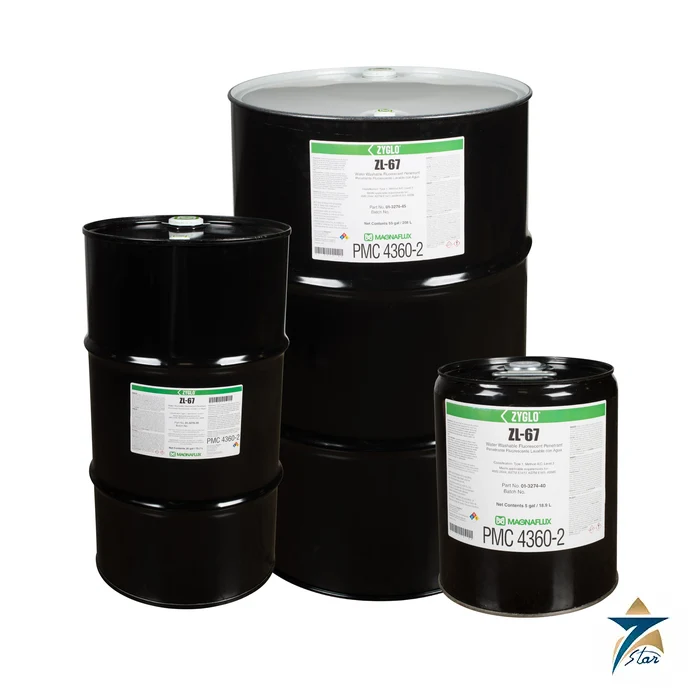
Magnaflux ZL-67 is a Level 3, high-sensitivity, water-washable fluorescent penetrant. According to the data sheet it is designed to find small, fine indications in safety-critical components common to aerospace and engineering use, and it is often used on investment castings, jet engine components and highly machined surfaces.
The formulation relies on strong capillary action. The manufacturer says this lets the penetrant enter defects quickly and bleed out into developer faster and more completely than other penetrants, which gives stronger, higher-contrast indications even when the defect is very fine. The product is listed on the QPL SAE AMS 2644 Qualified Product List and approved for use by Pratt and Whitney.
Features from the data sheet
- Level 3 high sensitivity with bright, high-contrast indications
- Water washable with controlled washability and high water tolerance
- High UV and thermal stability so indications appear consistently
- Low odour, very low toxicity and low volatility
- Wide range of application methods
- Alloy compatibility with aluminium, steel, nickel and titanium
- Non-hazardous by all modes of transportation (as stated by the maker)
Technical specification
| Parameter |
Specification |
| Product type |
Water-washable fluorescent penetrant |
| Sensitivity |
Level 3, high sensitivity |
| Type / Method |
Type 1, Method(s) A and C |
| Flash point |
Above 200 F / 93 C |
| Density |
0.96 g/cc / 7.96 lb/gal |
| Viscosity at 100 F / 38 C |
21.06 cs |
| NPE-free |
Yes |
| Required equipment |
UV light source |
| Usage temperature |
40 to 125 F / 5 to 52 C |
| Storage temperature |
50 to 86 F / 10 to 30 C |
| Defect location |
Open to surface |
| Specifications listed |
AECL, AMS 2644, ASME BPVC, ASTM E1417, ASTM E165, Boeing BAC 5423 PSD 6-46 or 8-4, Boeing PS-21202, GE P3TF2, Honeywell EMS 52309, ISO 3452-2, MIL-STD-2132, MIL-STD-271, NAVSEA T9074-AS-GIB-010/271, Pratt and Whitney PMC 4360, QPL SAE AMS 2644 |
| Revision |
June 2021 |
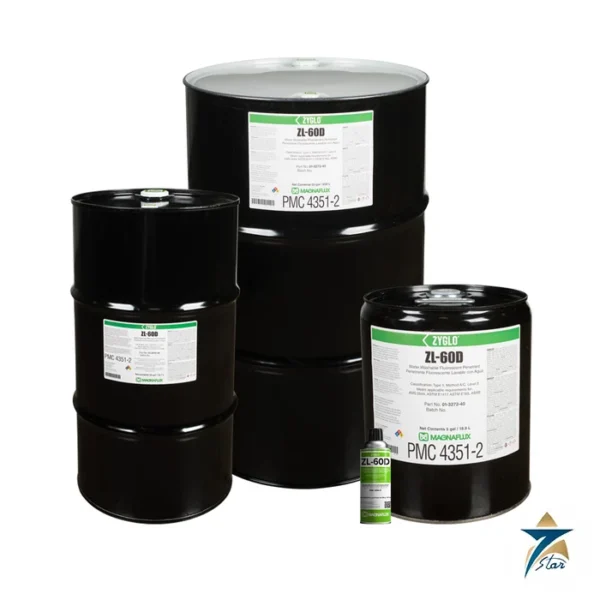
Compared with ZL-60D, the printed density (0.96 versus 0.92 g/cc) and viscosity (21.06 versus 10.27 cs) are both higher, consistent with a heavier, finer-flaw formulation. That comparison is our own reading of the two data sheets.
Ordering guide
ZL-67 is offered in bulk packs only in the data sheet; there is no aerosol listing.
| Pack |
Part number |
| 5 gal / 18.9 L pail |
01-3274-40 |
| 20 gal / 75.7 L drum |
01-3274-30 |
| 55 gal / 208 L drum |
01-3274-45 |
Because ZL-67 is a bulk product, it suits tank-based inspection lines rather than one-off spot checks. If the work is a handful of field welds, a ready-to-use aerosol system will usually be more economical.
Use and process considerations
A UV light source is required. The sheet states the use temperature range but no dwell or wash settings, so take these from your approved procedure. General practice, not from the sheet: because Level 3 products reveal very fine flaws, they also reveal poor cleaning, so pre-clean and dry thoroughly, avoid over-washing, and keep the developer film thin. Maintain the penetrant tank with regular checks against a known reference panel, since the sheet highlights high water tolerance as a way to keep performance stable over time.
Typical applications
Precision castings and forgings, machined components, investment castings, jet engine components and highly machined surfaces are the named uses. For GCC turbine, compressor and rotating-equipment shops, the same logic applies to blades, impellers and repaired components where very fine fatigue cracking is the concern.
How the penetrant process uses this product
Penetrant testing has a short sequence that the data sheet only partly describes, so this outline is general practice rather than manufacturer instruction. The surface is cleaned, penetrant is applied and left to enter defects, excess is removed (here by water washing), a developer is applied to draw penetrant out, and the part is inspected under UV light. Each step must be done to the controlled parameters of the governing specification.
The role of ZL-67 is the second step. Strong capillary action matters most where the opening is tight, such as a fatigue crack that is closed under residual stress, so Level 3 penetrants are chosen when the acceptance criteria call for very small indications. A matching dwell time, thin developer layer and a darkened inspection area are all needed to make use of that sensitivity.
Choosing ZL-67 for the right job
A Level 3 penetrant is selected because the acceptance criteria demand it, not because it sounds better. Before ordering, check the governing specification for the required sensitivity level, confirm that the parts are open to the surface and cleaned to the standard of the procedure, and verify that a UV light source and a darkened inspection area are available. The data sheet lists Type 1, Method A and Method C and a June 2021 revision, so quote those details when asking for approval from a customer inspector.
Storage and records
The sheet gives 10 to 30 C for storage and 5 to 52 C for use. Keep bulk containers tightly closed and out of direct sun. Because ZL-67 is supplied in 5 gal pails and 20 and 55 gal drums, it is normally decanted into a tank or dip station, so record the date of each fill, the batch number and the result of periodic system checks against a reference panel. These records support the high water tolerance the manufacturer emphasises and show an auditor that the line is under control.
Information needed for a quotation
Send the part number from the ordering table, the quantity, the delivery destination in Oman or the GCC and any specification the shipment must reference. If a developer, cleaner or UV light is also needed, list them in the same request so that the full penetrant line is quoted together and delivered at the same time.
Related items
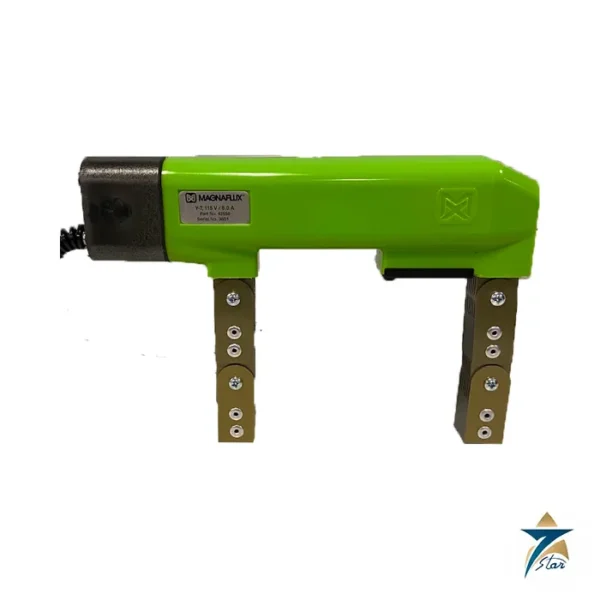
Pair with a solvent or other developer from the Zyglo and Spotcheck lines, and see the rest of our Non-Destructive Testing (NDT) range for particles, yokes and cleaners.
Frequently asked questions
What sensitivity level is ZL-67?
Level 3, high sensitivity.
Is it approved or listed anywhere?
The data sheet states it is on the QPL SAE AMS 2644 list and approved for use by Pratt and Whitney.
Does it come in aerosol cans?
The data sheet lists only 5 gal pail, 20 gal drum and 55 gal drum packs.
What is its viscosity?
21.06 cs at 100 F / 38 C.
Do I need a UV lamp?
Yes, a UV light source is listed as required equipment.
Documents and quotation
Download the official data sheet from this page and check pack sizes and approvals against your inspection specification. We supply as an independent company from Muscat; request a quotation with the part number 01-3274-40, 01-3274-30 or 01-3274-45.








Reviews
There are no reviews yet.