Submersible Ex ia probe with no media-contacting O-rings
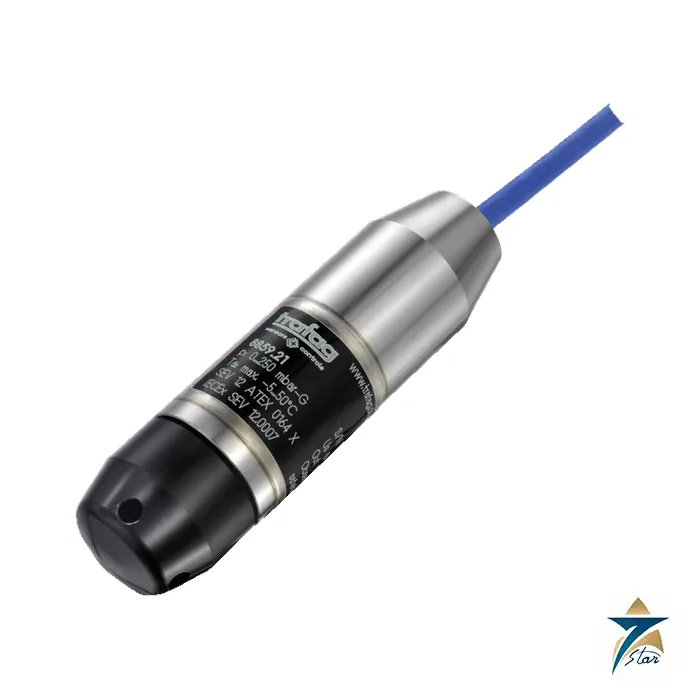
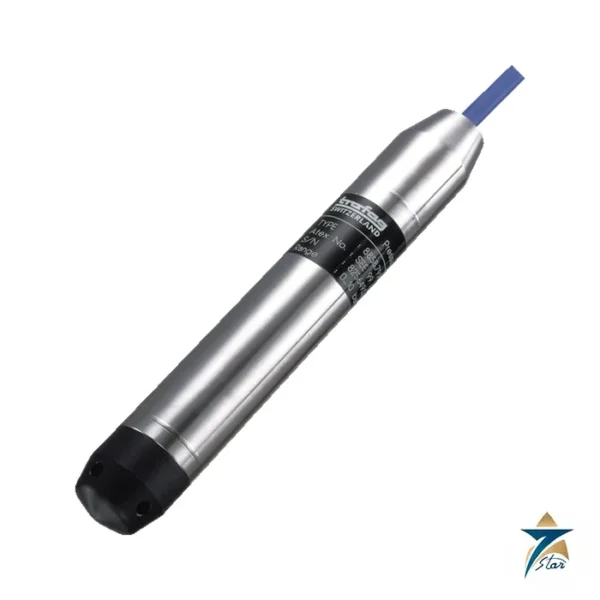
The Trafag EXNAL 8859 is a submersible pressure transmitter for hydrostatic level measurement in hazardous areas. It is intrinsically safe and certified to ATEX and IECEx for gas Zones 0, 1 and 2, dust Zones 20, 21 and 22 and mining, with DNV-GL listed as an additional approval.
Trafag points to two design features in its datasheet: pressure ranges starting from 100 mbar, and no media-contacting O-rings. Without a wetted elastomer seal, the probe avoids one of the usual swelling and ageing problems when it hangs in fuel, solvents or chemical sumps. The sensor is 316L stainless steel, with titanium offered for chemically aggressive liquids and a seawater application option.
Technical specifications of the EXNAL 8859
| Parameter |
Specification |
| Manufacturer |
Trafag AG, Switzerland |
| Product code |
8859 |
| Measuring principle |
Piezoresistive |
| Measuring range |
0 … 0.1 to 0 … 25 bar, relative or absolute |
| Output signal / supply |
4 … 20 mA; 9 … 28 VDC; load (US – 9 V) / 20 mA |
| Type of protection |
II 1G Ex ia IIC T3 … T6 Ga; II 1D Ex ia IIIC T145 °C Da; I M1 Ex ia I Ma |
| Zener barrier values |
28 V / 93 mA / 0.65 W |
| Approvals |
ATEX, IECEx, DNV-GL; IEC/EN 60079-0, -11, -26 and EN 50303 |
| Media and ambient temperature |
-5 to +80 °C |
| Protection |
Minimum IP68 |
| Accuracy NLH (BSL) |
Sensor 02: 0.25 % FS; sensor 01: 0.1 % FS |
| Repeatability |
0.05 % FS |
| Long-term drift |
Below 4 mbar for ranges up to 2 bar; below 0.2 % per year above |
| Vibration / shock |
10 g (4 to 2000 Hz) / 100 g, 60 ms |
| Sensor and housing |
1.4435 (AISI 316L) / 1.4404 (AISI 316L), or titanium |
| Sealing |
FKM, EPDM or Kalrez |
| Weight / torque |
About 220 g / 25 Nm |
Reading the ordering code
The pressure connection options are open, closed, G1/4 male and G1/2 male. The open and closed versions are the usual choices for hanging in a tank, with the closed version protecting the diaphragm when the probe is lowered. Electrical connection is by PUR cable (6 mm) or FEP cable (5 mm), and the cable length has to be stated when ordering.
Accessories listed are a detachable cable, special oil filling, temperature class T4 or T6, a seawater application version and titanium for the sensor and housing. Customised ranges are available on request.
Accuracy, overpressure and tank installation
Overpressure is 3 bar for ranges up to 1 bar and three times the range from 1.6 bar upward, for example 12 bar at the 4 bar range, 30 bar at 10 bar and 75 bar at 25 bar. The burst pressure is 200 bar throughout.
The datasheet gives a temperature error band for each accuracy class. For the 0.25 percent class it is 0.7 percent FS over minus 5 to plus 50 degrees C for ranges from 0.5 bar upward, rising to 1.0 percent FS up to 80 degrees C. The 0.1 percent class gives 0.3 percent and 0.75 percent over the same bands.
Trafag requires additional measures against static charge for the cable versions in Zone 0 to Zone 20, such as laying the cable with an earthed metal braid, metal hose or metal pipe. Keep the barrier close to the safe-area end of the loop, check the cable capacitance in the loop calculation, and make sure the vent path of the cable stays dry. Specify the measured medium when ordering so Trafag can confirm the material and seal selection.
Selecting the EXNAL 8859 for a level application
A submersible probe measures the hydrostatic pressure of the liquid column above it, so the measuring range follows from the maximum level and the density of the medium. Choose the smallest standard range that covers the highest expected level, and ask for a customised range where the standard steps do not fit. Relative measurement is the usual choice for vented tanks and wells, while absolute measurement suits applications where the reference pressure has to be included. Check the medium against the sensor and housing material, and decide between 316L and titanium; for seawater or brine the seawater application option should be discussed at the enquiry stage.
The hazardous-area classification of the installation must match the protection marking on the probe. Confirm the zone, the gas or dust group and the temperature class required, and make sure the associated barrier and the loop cabling fit the stated intrinsic-safety values.
Installation and commissioning practice
Lower the probe slowly into the tank or well and fix the cable at the top so that the probe hangs at a defined height above the bottom, away from inlet streams, mixers and sediment. Avoid letting the probe hit tank walls or swing in turbulent flow. Route the cable without sharp bends, protect it where it passes edges, and terminate it at a suitable point in line with the site intrinsic-safety drawings. At commissioning, compare the reading with a known level or dip measurement, record the zero offset given by the mounting height, and document the loop values for the Ex inspection file.
Operation and maintenance
In service, deposits on the diaphragm area and damage to the cable are the most common sources of error. Lift and inspect the probe at intervals set by the site, clean it carefully without touching the diaphragm with tools, and check the cable sheath along its whole length. Hazardous-area equipment should be inspected according to the plant’s Ex inspection procedures, and any repair must leave the certified design unchanged.
Ex level measurement in GCC facilities
Fuel depots, oil and gas sumps, wastewater lifts and chemical storage in Oman and the GCC combine hazardous-area rules with high heat and coastal humidity. Keep the cable termination and the safe-area end of the loop shaded and sealed, and check that cable runs above ground are protected from sun and mechanical damage. Media temperature in exposed tanks can rise in summer, so compare it with the stated limits. In the RFQ, give the measuring range, relative or absolute, the medium and its density, the hazardous-area zone and temperature class, the cable type and length, the pressure connection and the accuracy class.
Documents and quotation
The attached document is the Trafag EXNAL 8859 Ex submersible pressure transmitter datasheet (H72335c, 09/2024). The instructions and certificates are published separately by Trafag.
For a quotation, send the range, cable type and length, medium and accuracy class. For other level devices see Level Instrumentation.








Reviews
There are no reviews yet.