Inverted bucket drainage in a compact cast iron body
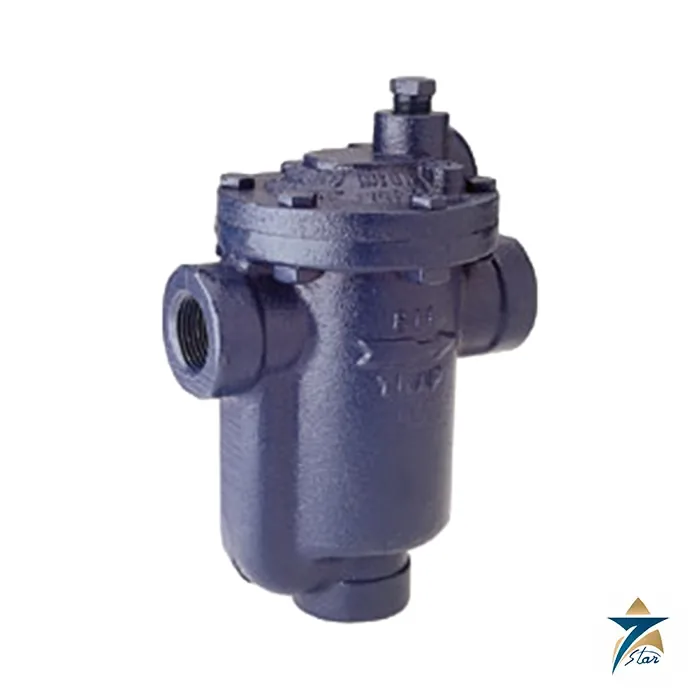
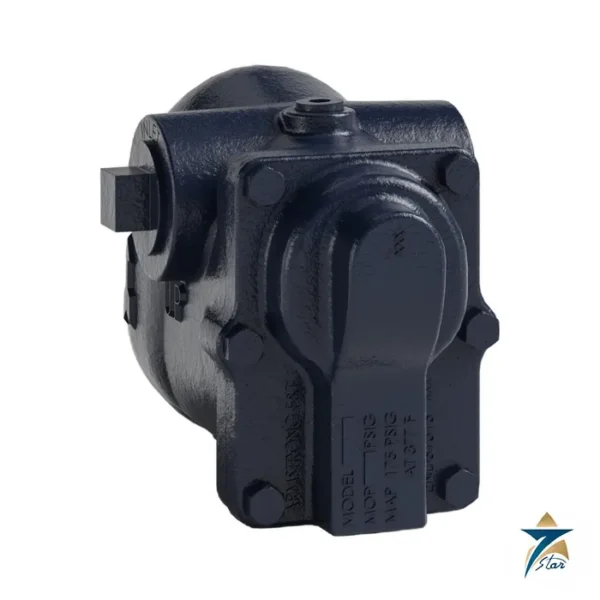
The Armstrong 800 Series groups four horizontal-installation inverted bucket steam traps, models 800, 811, 812 and 813, in an ASTM A48 Class 30 cast iron body. Armstrong rates the family for pressures to 250 psig (17 bar) and capacities to 4,400 lb/hr (2,000 kg/hr), with side inlet and side outlet screwed connections. The four sizes let a buyer match one body style to everything from a single unit heater drip to a larger process coil.
The data sheet describes the inverted bucket as the steam trap type that drains condensate from virtually all steam-using equipment. Inside, a free-floating lever mechanism with no fixed pivots multiplies the force of the bucket so that it can open the valve against system pressure. Because the mechanism sits at the top of the trap, dirt cannot collect around the orifice; small particles stay in suspension until the full-differential purge that happens when the bucket sinks and pulls the valve off its seat. The discharge orifice is surrounded by a water seal, which prevents live steam loss, and a small vent hole in the bucket passes air and CO2 continuously at steam temperature.
In operation the trap drains continuously but discharges intermittently, so condensate does not back up in the equipment, and Armstrong notes the design resists water hammer. All cast iron inverted bucket traps in this range are repairable, which is the basis of the maintenance-saving claim in the data sheet.
Technical specification
| Parameter |
Specification |
| Models in this series |
800, 811, 812, 813 (side inlet, side outlet) |
| Installation orientation |
Horizontal |
| Maximum allowable pressure (vessel design) |
250 psig @ 450 F (17 bar @ 232 C) |
| Maximum operating pressure, model 800 |
150 psig (10 bar) |
| Maximum operating pressure, models 811 to 813 |
250 psig (17 bar) |
| Capacity range for the series |
To 4,400 lb/hr (2,000 kg/hr) |
| Body |
ASTM A48 Class 30 cast iron |
| Internals |
All stainless steel, type 304 |
| Valve and seat |
Hardened chrome steel, 17-4PH |
| Test plug |
Carbon steel |
| Connections |
Screwed NPT and BSPT |
| Number of bolts (cover) |
6 |
| Certified drawing reference |
CD #1000 (per data sheet) |
Dimensions and weights
| Model |
800 |
811 |
812 |
813 |
| Pipe connection, in (mm) |
1/2, 3/4 (15, 20) |
1/2, 3/4, 1 (15, 20, 25) |
1/2, 3/4 (15, 20) |
3/4, 1 (20, 25) |
| Test plug, in (mm) |
1/4 (6) |
1/4 (6) |
1/2 (15) |
3/4 (20) |
| A, flange diameter, in (mm) |
3-3/4 (95.2) |
3-3/4 (95.2) |
5-5/8 (143) |
7 (178) |
| B, height, in (mm) |
5-7/16 (138) |
6-7/8 (175) |
9-1/16 (230) |
11-3/4 (298) |
| C, face to face, in (mm) |
5 (127) |
5 (127) |
6-1/2 (165) |
7-3/4 (197) |
| D, bottom to inlet centreline, in (mm) |
2-3/4 (70) |
4-1/4 (108) |
5-3/8 (137) |
7-1/32 (179) |
| Weight, lb (kg) |
5 (2.3) |
6 (2.7) |
15 (6.8) |
27-1/2 (12.5) |
Armstrong notes that designs, materials, weights and ratings are approximate and subject to change, so confirm against the current certified drawing before piping is fabricated.
Choosing a model and ordering options
The model number carries two practical limits. Model 800 is rated for 150 psig operating pressure, while 811, 812 and 813 are rated to 250 psig, so a 10 bar steam header suits all four but a 16 bar line needs 811 or larger. Physical size grows quickly: model 813 is 11-3/4 in (298 mm) high and weighs 27-1/2 lb (12.5 kg) against 5 lb (2.3 kg) for the 800, which matters for pipe support and for how much space a trap station needs.
Armstrong lists the following ordering information: the model number, the size and type of pipe connection, the maximum working pressure that will be encountered or the orifice size, and any options. Options named in the data sheet are a stainless steel internal check valve (add suffix CV), a thermic vent bucket (suffix T), a stainless steel pop drain, a probe connection, a thermo drain and a scrub wire. A footnote states that model 800 cannot be supplied with both the thermic vent bucket and the check valve.
- Specify the model number, 800, 811, 812 or 813.
- State pipe connection size and thread type, NPT or BSPT.
- Give the maximum working pressure or the orifice size required.
- List options such as CV or T suffix, pop drain, probe connection or thermo drain.
Where these traps are used
The data sheet positions the inverted bucket for efficient condensate drainage of virtually all types of steam-using equipment. In Gulf plants that means steam mains drip legs, unit heaters, heat exchangers, process coils and tracer lines in refineries, petrochemical units, power stations and food or beverage plants running on boiler steam. Cast iron is a sensible choice for ordinary steam service inside its 17 bar rating; for corrosive condensate or wider temperature swings, check the body material against your own specification.
Armstrong states that the traps operate efficiently for longer periods, which lowers replacement and labour costs, and that the all-stainless mechanism is repairable rather than disposable. Any site code or hazardous-area requirement is a project matter for the engineer of record; the data sheet makes no such claim.
Selection and installation notes
Specify a steam trap from the steam pressure, the condensate load and the connection size, and check the body material and the pressure rating against the system. Fit a strainer upstream, a union or flange for easy removal and isolation valves either side, prime the trap with condensate before start-up where the type requires it, and protect it from freezing. Inspect traps on a regular schedule to find failures early, because a failed trap wastes steam or floods the line.
Information needed for a quotation
Send the full model code, the quantity, the delivery location in Oman or the GCC, the intended use and any accessories needed, so that the complete package can be quoted together.
Documents and supply information
The manufacturer data sheet is attached to this page and should be read together with the project specification and the site risk assessment before a purchase is confirmed. Ratings, standards and dimensions are quoted as printed on that sheet. Lead time, stock position and certificates available with the shipment are confirmed in the quotation, and we supply to Oman and the wider GCC region for industrial, utility and building services projects.
Related items and documentation
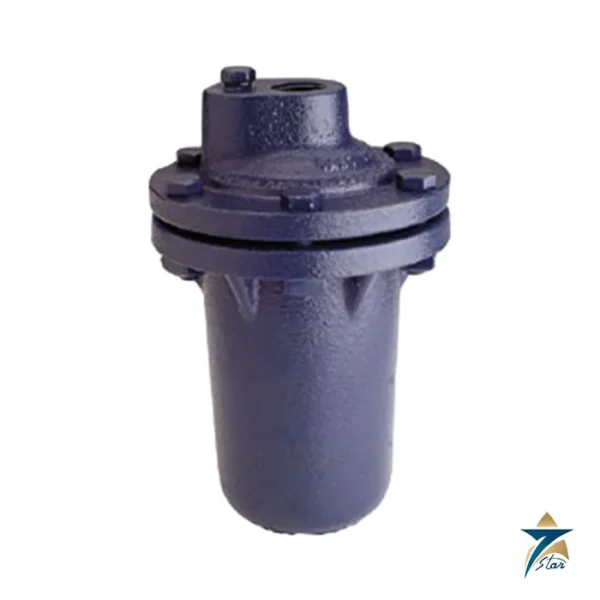
The Armstrong 200 Series is the vertical-installation counterpart with bottom inlet and top outlet, while the 800 Series is the side-inlet, horizontal choice. Browse the wider pipes and fittings range for strainers and fittings. The official data sheet is hosted on this page under the product documents.
Seven Star LLC is an independent supplier in Muscat. Send the model, connection size, working pressure and any option suffix through the RFQ form and we will confirm the exact configuration against the manufacturer data before quoting.






Reviews
There are no reviews yet.