General-purpose synthetic-fibre sheet for liquids and low-pressure steam
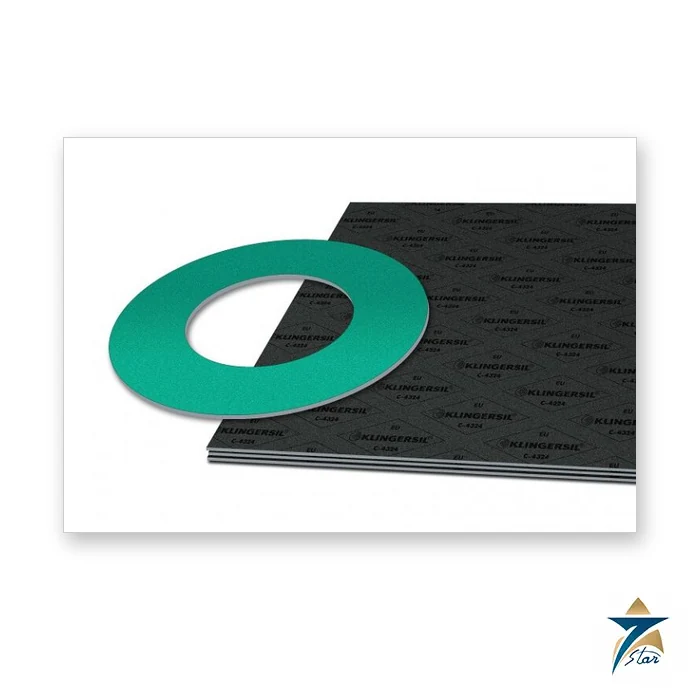
KLINGERSIL C-4324 is Klinger’s general-purpose high-pressure sheet made from synthetic high-performance fibres with an NBR binder. The datasheet positions it for liquids and steam at lower pressures and temperatures and names resistance to water, oils, hydrocarbons, refrigerants and other chemicals.
Klinger lists three key points for the grade: a general-purpose gasket material, dimensional stability and consistent composition. The benefits are an excellent price and performance ratio and suitability for many different media, which makes it the economical choice where a premium grade is not needed.
Technical specifications
| Parameter |
Specification |
| Manufacturer / model |
Klinger (Rich. Klinger Dichtungstechnik), KLINGERSIL C-4324 |
| Basis composition |
Combination of synthetic high-performance fibres bonded with NBR |
| Colour |
Black or green |
| Sheet size |
1000 x 1500 mm, 2000 x 1500 mm |
| Thickness |
0.5, 1.0, 1.5, 2.0, 3.0 mm |
| Tolerances |
Thickness per DIN 28091-1; length and width plus or minus 50 mm |
| Certificates and approvals as printed |
DIN-DVGW, Elastomer-Guideline, WRAS approval, SVGW approval, DNV approval |
| Industries listed |
General industry, chemical, oil and gas, energy, infrastructure, pulp and paper, marine, automotive, food and beverage |
| Compressibility, ASTM F 36 J (2.0 mm) |
10 % |
| Recovery, ASTM F 36 J |
55 % |
| Stress relaxation, DIN 52913, 50 MPa, 16 h |
31 MPa at 175 °C; 20 MPa at 300 °C |
| Stress relaxation, BS 7531, 40 MPa, 16 h at 300 °C |
23 MPa |
| Klinger cold/hot compression, 50 MPa, thickness decrease |
10 % at 23 °C; 25 % at 300 °C |
| Tightness, DIN 28090-2 |
0.03 mg/(s x m) |
| Thickness increase after immersion, ASTM F 146 |
5 % (oil IRM 903, 5 h at 150 °C); 10 % (fuel B, 5 h at 23 °C) |
| Density |
1.85 g/cm3 |
| Thermal conductivity |
0.50 W/mK |
| Classification, BS 7531:2006 |
Grade Y |
| ASME code sealing factors, 2.0 mm, tightness class 0.1 mg/(s x m) |
y 15 MPa, m 2.6 |
| Chemical resistance chart in datasheet |
A (small or no attack) for paraffinic hydrocarbon, motor oil, alcohol, water, diluted acid and diluted base; B (weak to moderate attack) for motor fuel and mineral lubricants; C (strong attack) for aromates, chlorinated hydrocarbon fluids, ketone and ester |
All values are typical values for a 2.0 mm sheet as printed in the Klinger datasheet; other thicknesses can differ.
When C-4324 is the economical choice
C-4324 has the simplest approval set of the fibre grades shown here (DIN-DVGW, Elastomer-Guideline, WRAS, SVGW and DNV) and no oxygen or fire-safe listing, so it is a fit for cooling water, service water, oil and general utility pipework rather than for oxygen, high-temperature steam or fire-safe duty. At 300 °C it keeps 20 MPa residual stress and loses 25 % of its thickness at 50 MPa, so it should not be taken to the top of the temperature range.
The m factor of 2.6 is higher than for C-4400 or C-4430, which means a greater required residual stress in code calculations, while the y factor of 15 MPa is the same as C-4400. The surface-resistance and dielectric data in the datasheet are useful only where insulation of the joint is a design requirement.
Related KLINGER gasket sheets
Related fibre-reinforced grades from the same range are compared below.
| Model |
Basis |
Colour |
Positioning printed by Klinger |
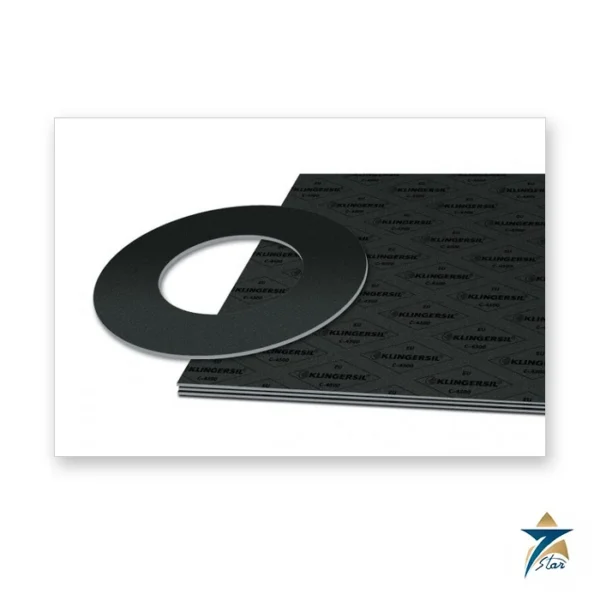
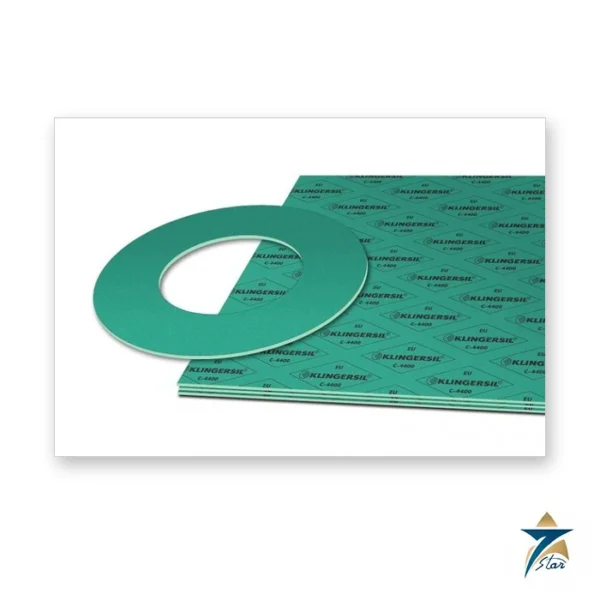
| KLINGERSIL C-4400 |
Aramid fibres, NBR |
Green |
Universal grade; very good resistance to refrigerants |
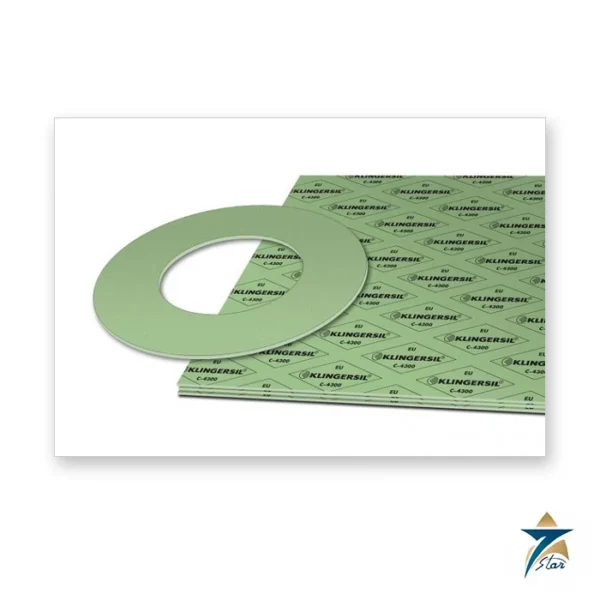
| KLINGERSIL C-4300 |
Aramid fibres, NBR |
Olive green |
Hot water, steam, oils and hydrocarbons |
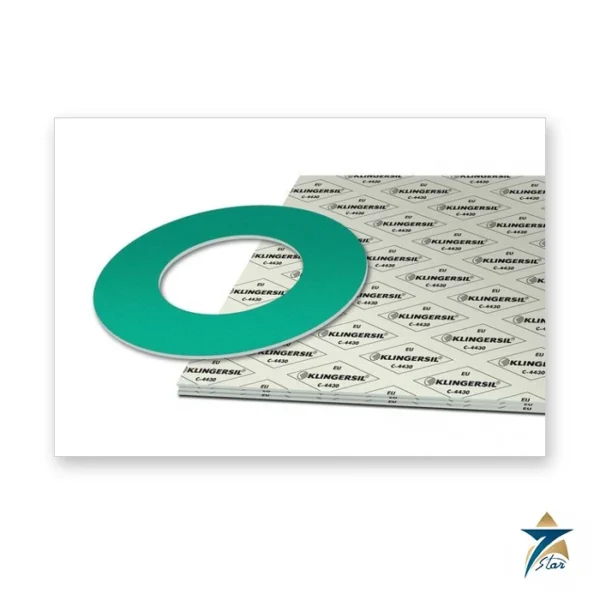
| KLINGERSIL C-4430 |
Synthetic fibres, NBR |
White or green |
Outstanding stress relaxation; hot water and higher-temperature steam |
| KLINGERSIL C-4500 |
Carbon fibres, heat-resistant additives, NBR |
Black |
Alkaline media and superheated steam; chemical industry |
Documents, ordering details and quotation
Tell us if the line carries drinking water so that the WRAS listing can be matched to the order. For a firm quotation please give the medium, pressure, temperature, flange details, bolt load available, thickness and quantity, and say if you need whole sheets or finished gaskets. As Klinger itself points out, the printed data cannot cover every installation, so have the final choice reviewed against the actual operating conditions. More products are shown in gaskets, seals and pipe fittings.










Reviews
There are no reviews yet.