- Automation & ControlView all 1,596 products
- AC Drives
- Industrial Communications
- PLC & I/O Cards
- Vibration Monitoring
- Automation Accessories
- Controllers & Data Acquisition
- CCTV & Security
- Safety Switches & Guard Locking
- Encoders
- Industrial Computers
- Servo Drives
- Motor Soft Starters
- HMI Displays
- Pneumatic Cylinders
- Isolator & Barrier
- Automation Software
- Machine Vision
- Robotics
















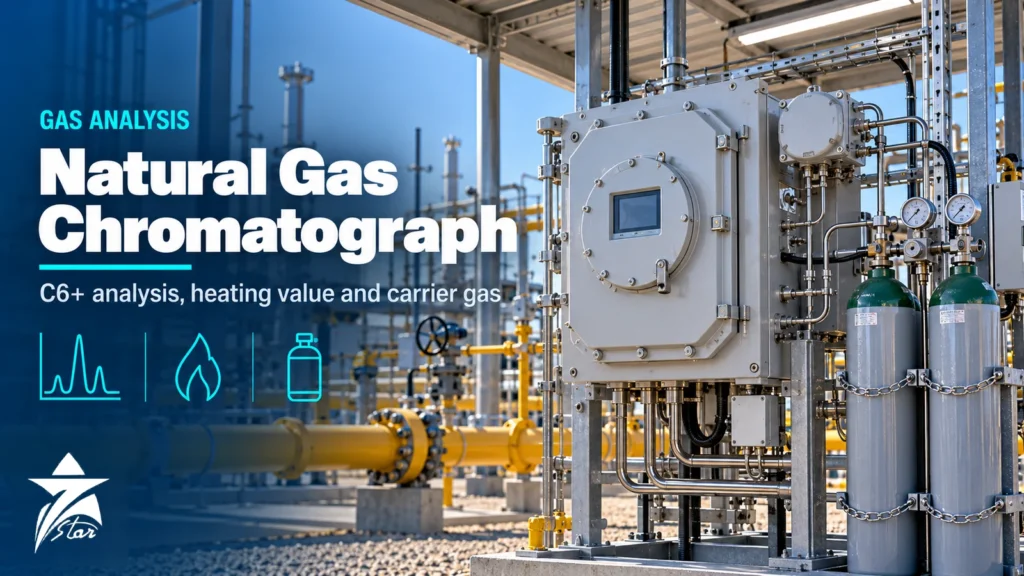
On a gas sales line, the flow meter measures volume but the invoice is written in energy. The number that converts one to the other comes from a natural gas chromatograph, and a small composition error flows straight into heating value, density, compressibility and the money that changes hands. This guide explains how a field gas chromatograph separates and measures natural gas components, what C6+ analysis means, how heating value is calculated, why carrier gas and calibration gas quality matter, and what maintenance keeps the analyzer within its uncertainty budget in hot, dusty GCC metering stations.
What a Natural Gas Chromatograph Measures
A GC does not measure heating value directly. It separates the gas into its components, measures the amount of each and reports a normalised composition in mole percent. A typical custody transfer analysis reports methane, ethane, propane, iso-butane, normal butane, neo-pentane (where configured), iso-pentane, normal pentane, nitrogen, carbon dioxide and a grouped C6+ fraction. From that composition, the analyzer or flow computer calculates gross and net heating value, relative density, Wobbe index and the input data for compressibility calculations.
Calculation methods are standardised. GPA 2172 and ISO 6976 define how heating value, density and relative density are calculated from composition, while compressibility for flow calculation is usually computed in the flow computer using AGA Report No. 8 or ISO 12213. Analysis methods themselves are described in GPA 2261, ASTM D1945 and the ISO 6974 series.
How the Separation Works
A small, precisely measured sample is injected by a sample valve into a stream of carrier gas that flows through a set of columns in a temperature-controlled oven. Each component interacts differently with the column packing or coating, so components leave the column at different times. A detector at the column outlet produces a peak for each component, and the peak area or height, multiplied by a response factor from calibration, gives its concentration.
- Sample and switching valves inject the sample, route it through different columns and reverse flow for back-flushing.
- Columns are chosen to separate light gases (N₂, CH₄, CO₂, C₂H₆) on one set and C3–C5 hydrocarbons on another.
- Thermal conductivity detector (TCD) measures the change in thermal conductivity as each component passes in carrier gas. It is robust, universal and standard for natural gas.
- Oven temperature control keeps retention times and response factors stable; it is critical in field enclosures exposed to large ambient swings.
- Controller integrates peaks, applies calibration, runs calculations and communicates results to the flow computer via Modbus or another protocol.
C6+ Analysis Explained
Natural gas contains small amounts of hexanes and heavier hydrocarbons. Separating each heavy component would lengthen the analysis considerably, so most field GCs back-flush them as a single combined peak called C6+. The valve reverses flow through the pre-column after the lighter components have passed, so all heavier compounds elute together quickly.
Because C6+ is a mixture, its heating value and other properties are assigned from an assumed split, for example a ratio of hexanes, heptanes and octanes defined by the user or by historical extended analysis. The assumption matters for rich gas: a wrong split shifts heating value and, more importantly, gives a poor estimate of hydrocarbon dew point. For lean pipeline gas the effect is small; for associated gas from oil fields it can be significant, and an extended C9+ analysis or a periodic laboratory analysis should be used to set the split.
Analysis Types Compared
| Analysis type | Components reported | Typical use | Notes |
|---|---|---|---|
| C6+ (standard) | C1–C5 individually, N₂, CO₂, C6+ grouped | Custody transfer heating value and density | Most common field configuration |
| C9+ (extended) | Adds C6, C7, C8 individually and C9+ grouped | Rich gas, dew point estimation, better C6+ split | Longer cycle or additional column train |
| With H₂S / sulfur | Adds H₂S or total sulfur | Sour gas quality monitoring | Usually a separate detector or analyzer |
| With O₂ / H₂ / He | Adds trace or minor non-hydrocarbons | Biomethane, blended or specialty gases | May require a different carrier gas on one channel |
Carrier Gas: Purity, Supply and Alternatives
Helium is the usual carrier because its thermal conductivity is very different from that of hydrocarbons, giving strong TCD signals. It must be high purity, commonly 99.995 % or better as specified by the GC manufacturer, because moisture, oxygen or hydrocarbon contamination produces baseline noise, ghost peaks and column degradation.
- Use cylinders with a dual-stage regulator and automatic changeover so the GC never runs dry; an empty carrier bottle stops analysis and can damage the TCD filament on some designs.
- Fit inline purifiers or filters where the manufacturer recommends them.
- Use clean stainless tubing and leak-test all carrier connections; carrier leaks shift retention times.
- Hydrogen is used as a carrier in some laboratory and process GCs, and argon or nitrogen is used on a channel measuring helium or hydrogen. Changing carrier is a configuration change that requires the manufacturer’s approval and a new calibration.
- Plan cylinder logistics; in remote GCC stations, carrier and calibration gas deliveries are often the practical limit on uptime.
Calibration and Validation
Field GCs are calibrated against a certified calibration gas whose composition is close to the process gas. The calibration establishes a response factor for each component. Many analyzers run an automatic calibration on a schedule, commonly daily, and compare new response factors with previous values; large deviations trigger alarms instead of being accepted.
- Choose a calibration gas blend representative of the line gas, with a certificate traceable to recognised standards.
- Store calibration cylinders above the hydrocarbon dew point of the blend; heavy components can condense in cold cylinders and change the delivered composition. In GCC desert nights and air-conditioned shelters this can still happen.
- Verify the unnormalised total after each analysis; a total drifting away from 100 % points to sample pressure, valve, or calibration problems.
- Run periodic validation with a separate check gas and compare heating value against the certificate.
- Record calibration, validation and alarms for audit; custody transfer contracts usually define the verification procedure.
For the wider measurement chain in which the GC sits, see our custody transfer metering system guide.
Sample System Requirements
Most GC errors originate upstream of the analyzer. The sample must remain a single gas phase from the probe to the sample valve. When gas pressure is reduced, it cools by Joule-Thomson expansion, and rich gas can drop liquids that strip heavy components from the sample, giving low heating value.
- Install the sample probe in a location free from flow disturbances and drawing from the central part of the pipe, following API MPMS Chapter 14.1 or ISO 10715 guidance.
- Use a heated pressure regulator at the probe or a probe-mounted regulator, and heat-trace the transport line when the gas is near its dew point.
- Keep transport lines short and the flow high enough that the lag time is small compared with the analysis cycle.
- Use membrane filters to stop liquids and particles reaching the GC valves.
- Avoid dead legs and unswept volumes that hold old gas.
Field Installation in GCC Conditions
Field-mounted GCs are designed for hazardous areas and usually carry flameproof or other Ex certification for Zone 1 or Division 1 installation close to the meter run. Still, desert sites stretch their environmental limits. Oven temperature stability depends on the ambient range, so direct sun on the enclosure, summer air above 50 °C and cold winter nights all make the oven work harder. Sun shades or ventilated shelters, correct orientation away from direct morning and afternoon sun, sealed cable entries against fine dust, and clean breather devices are simple measures that extend reliability. Air-conditioned analyzer shelters help, but condensation on cold calibration lines must then be considered.
Maintenance and Troubleshooting
| Symptom | Likely cause | Corrective action |
|---|---|---|
| Retention times drifting | Carrier pressure change, oven temperature problem, column ageing | Check regulator and leaks; verify oven stability; adjust timing or replace columns |
| Unnormalised total outside alarm limits | Sample pressure or flow change, valve leak, calibration error | Check sample system; leak-test valves; recalibrate |
| Low heating value against lab | Liquid dropout in sample line, wrong C6+ split | Check heating, regulator and dew point; review C6+ properties |
| Noisy baseline | Contaminated carrier, detector issue, electrical noise | Change carrier cylinder; check purifier; inspect grounding |
| Ghost peaks | Contaminated valve or carry-over | Clean or rebuild valves per maintenance procedure |
Routine work typically includes checking carrier and calibration gas pressures, reviewing calibration trends, replacing filter elements, rebuilding valves at the manufacturer’s interval and backing up the configuration. Keep spare valves, filter elements and a configuration backup on site, since a failed valve can stop the analysis for days on a remote station.
Specification Checklist
- Gas type and range of composition, including heavy component content and H₂S
- Required components: C6+, C9+, H₂S, O₂, He, H₂
- Calculation standards for heating value and density, and the flow computer interface
- Cycle time requirement and number of sample streams
- Hazardous area classification and certification
- Environmental conditions, shelter or field mounting
- Sample system: probe, heated regulator, filters, stream switching
- Carrier gas and calibration gas arrangement
Seven Star LLC supplies field and laboratory gas analyzer systems including natural gas chromatographs, plus gas analyzer accessories such as filters, regulators and valve kits, and flow computers that receive GC data. For other gas measurements in refineries and gas plants, see our process gas analyzer guide.
Gas Analysis and Metering Products We Supply
A heating value measurement is only useful when it reaches the flow computer. These examples cover both the analyser and the metering electronics.
| Product | Type | Where it fits |
|---|---|---|
| AccuChrome™ GC5 Gas Chromatograph Analyzer | Gas chromatograph | Natural gas composition and heating value. |
| AccuChrome™ GC4: BTU Heating Value Analyzer | BTU heating value analyser | Heating value for fuel gas and sales gas. |
| FloBoss S600+ Flow Computer | Emerson Custody Transfer & Fiscal Measurement | Flow computer | Custody transfer stations that take composition from a gas chromatograph. |
| Elster gas-net F1 Flow Computer for Gas Measurement | Gas flow computer | Volume correction for gas metering. |
| Swagelok DOT Sample Cylinder, Double-Ended and Single-Ended | Sample cylinder | Spot samples for laboratory checks against the online analyser. |
To specify a chromatograph, send the gas composition range, required components, area classification and the flow computer protocol through our quote request form.
Sourcing Natural Gas Chromatographs Through Seven Star LLC
Seven Star LLC supplies natural gas chromatographs, sample system components and spare parts on request for gas plants, pipelines and metering stations in Oman and the GCC. We help with selection and cross-checking part numbers for analyzers from manufacturers such as Emerson, ABB, Yokogawa and Siemens, including valve kits, columns and controller boards for installed units. Availability and lead time are confirmed at quotation.
Send your GC nameplate or model code, the gas composition and the components you need to report with your RFQ, and we will prepare a matched offer for analyzers and spares.
Frequently asked questions
Does a gas chromatograph measure BTU directly?
No. The GC measures the mole percent of each component, and heating value is calculated from that composition using standard component properties such as those in GPA 2172 or ISO 6976. Any composition error therefore carries straight into the heating value.
What does C6+ mean in natural gas analysis?
C6+ is the combined fraction of hexane and all heavier hydrocarbons, back-flushed through the columns so it elutes as a single peak. Its properties are assigned from an assumed split of C6, C7 and C8, which should be based on extended analysis for rich gases.
Why is helium used as a carrier gas?
Helium has a thermal conductivity very different from hydrocarbons, so the thermal conductivity detector gives strong, linear signals. It is also inert and safe. Other carriers such as hydrogen, nitrogen or argon are used only in specific configurations approved by the manufacturer.
How often should a natural gas chromatograph be calibrated?
Many field GCs run automatic calibration daily against a certified calibration gas, with alarms when response factors change too much. The required frequency for custody transfer is usually set by the contract or local regulation, often together with periodic validation using a check gas.
Why does my GC report low heating value compared with the laboratory?
The most common cause is liquid dropout in the sample system, where pressure reduction cools the gas below its hydrocarbon dew point and strips heavy components. Check the heated regulator, heat tracing and filters, and review the C6+ property assumptions.
What does the unnormalised total tell me?
It is the sum of all measured components before normalisation to 100 %. A stable total close to 100 % shows that sample injection and calibration are consistent; a drifting total indicates sample pressure, valve or calibration problems that need investigation.
Was this guide helpful?One click helps us write better guides for engineers.
Thank you! Glad it helped. Need this equipment for your project? Request a quotation
Thank you. We will use this to improve the guide.