- Automation & ControlView all 1,595 products
- AC Drives
- Industrial Communications
- PLC & I/O Cards
- Vibration Monitoring
- Automation Accessories
- Controllers & Data Acquisition
- CCTV & Security
- Safety Switches & Guard Locking
- Encoders
- Industrial Computers
- Servo Drives
- Motor Soft Starters
- HMI Displays
- Pneumatic Cylinders
- Isolator & Barrier
- Automation Software
- Machine Vision
- Robotics
















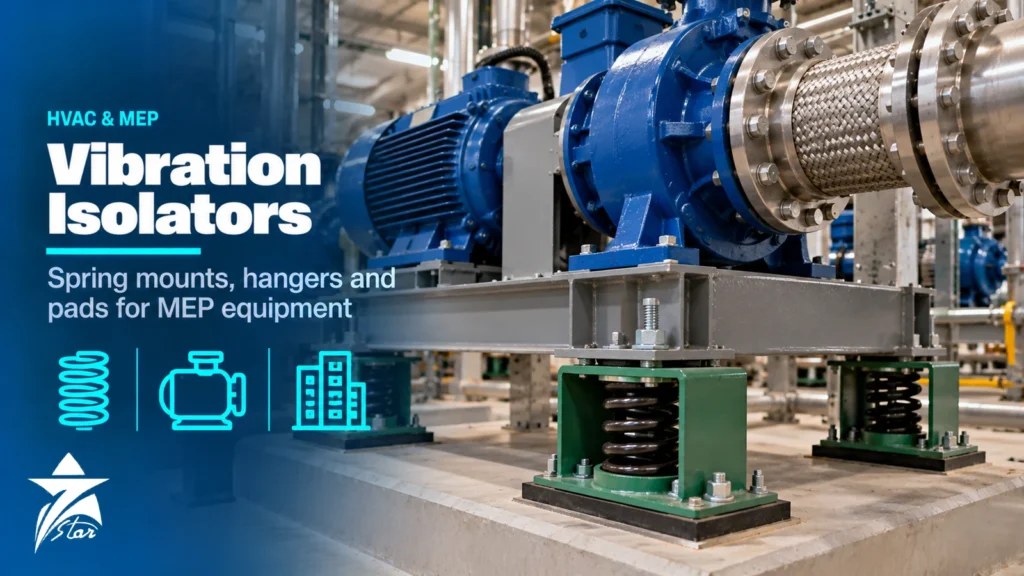
Every chiller, pump, fan, air handling unit and generator in a building vibrates. Without isolation, that vibration travels into the slab, the pipework and the structure, and turns into noise in offices, hotel rooms and hospital wards several floors away. Vibration isolators, spring mounts and hangers break that path. They are small items on an MEP schedule, but choosing the wrong type or deflection is one of the most common causes of noise complaints after handover. This guide explains the main types of vibration isolators and how to choose them for projects in Oman.
How Vibration Isolation Works
An isolator is a spring, made of steel or rubber, placed between the machine and the structure. Under the weight of the machine, the isolator compresses by a certain amount, called the static deflection. The deflection sets the natural frequency of the mounted machine: approximately, natural frequency in Hz = 15.8 divided by the square root of the deflection in millimetres. A 25 mm deflection gives about 3.2 Hz, and a 5 mm deflection about 7 Hz.
Isolation only starts when the machine runs at a frequency above about 1.4 times the natural frequency, and it improves the further apart the two are. A pump running at 1,450 rpm (about 24 Hz) is well isolated on 25 mm springs, but a slow fan or a large chiller on an upper floor needs more deflection. That is why deflection, not the isolator type, is the first thing to specify.
Types of Vibration Isolators
| Type | Typical deflection | Typical use | Example |
|---|---|---|---|
| Rubber or neoprene pad | A few millimetres | Small equipment on grade, under spring mounts, and as a noise break | Mason Super W molded rubber pad |
| Double deflection neoprene mount | Up to about 10 mm | Small fans, pumps and equipment on grade or in basements | Mason ND double deflection neoprene mount |
| Free-standing spring mount | 25 to 50 mm and more | Chillers, pumps, AHUs and fans, especially on upper floors | Mason SLFH spring mount with bolt-down baseplate |
| Restrained spring mount | 25 to 50 mm | Equipment that changes weight (chillers, cooling towers) or must resist wind and seismic loads | Mason SLR restrained spring mount |
| Spring and rubber hanger | 25 mm and more | Suspended pipework, ducts and ceiling-hung fans and FCUs | Mason 30N spring and double deflection hanger |
Choosing Isolators by Equipment
- Chillers: restrained spring mounts, because the unit weight changes between drained and operating conditions, and on upper floors and roofs the deflection must be higher.
- Pumps: spring mounts under an inertia base, which lowers the centre of gravity and limits movement at start-up. Add flexible connectors on suction and discharge.
- AHUs and fans: spring mounts or hangers, with thrust restraints for fans with high static pressure.
- Cooling towers: restrained springs to resist wind and the change of weight when the basin fills.
- Generators: spring mounts under the base frame, and flexible exhaust and fuel connections.
- Pipework: spring hangers for the first runs of pipe from pumps and chillers, so vibration does not travel along the pipe into the building.
Why Floor Level Matters
A machine on a ground-bearing slab can often use low-deflection mounts, because the ground is stiff. The same machine on a long-span floor or a roof needs more deflection, because a flexible floor can resonate with the equipment. On high-rise projects in Muscat, roof-mounted chillers and plant on transfer floors are where the largest deflections and restrained springs are usually needed. Check the consultant specification, which often follows the selection tables in the ASHRAE Applications Handbook.
Inertia Bases and Flexible Connectors
Isolators work best as part of a system. An inertia base is a concrete-filled steel frame that sits on spring mounts and carries the pump or fan. Its extra mass lowers the centre of gravity, reduces rocking when the motor starts, and keeps the pump and motor in alignment. As a rule, the base weighs at least as much as the equipment it carries, and more for end-suction pumps with high starting torque.
Flexible connectors, made of rubber or braided stainless steel, are fitted between the equipment and the pipework. Without them, a rigid pipe joint bypasses the springs and carries vibration straight into the risers. Use connectors rated for the system pressure and temperature, install them without stretching or offset, and support the pipe on both sides so the connector does not carry the pipe weight. The same idea applies to electrical conduits and ductwork: use flexible lengths at every isolated machine so nothing rigid bridges the isolators.
Common Mistakes
- Choosing isolators by size or bolt pattern instead of load per mount and deflection.
- Using the same isolator at every corner when the load is not evenly distributed.
- Fitting rigid pipe connections, conduits or ducts that short-circuit the isolators.
- Leaving the travel limit stops tight after installation, so the springs never work.
- Forgetting wind and seismic restraints for roof equipment.
- Not checking that the spring is still level and at the right height after the equipment is filled and running.
What to Send for a Quote
- Equipment list with operating weight, number of mounting points and weight distribution if known.
- Running speed of each machine (rpm).
- Location: on grade, upper floor or roof, and the floor span if known.
- Required static deflection or the specification clause.
- Need for restrained springs, seismic or wind restraint, and inertia bases.
- Hangers: pipe or duct sizes and loads.
Vibration Isolators in Muscat and Across Oman from Seven Star LLC
Seven Star LLC supplies vibration isolators from Mason Industries, including rubber pads, neoprene mounts, spring mounts, restrained springs and spring hangers, to MEP contractors and facility teams in Muscat, Sohar, Duqm, Salalah and across Oman and the GCC. See our vibration isolation category, or send your equipment list through our quote request form or by email to [email protected]. We select each isolator by load and deflection before quoting.
Send Seven Star LLC your equipment weights and locations and we will select isolators with the right deflection for each machine.
Frequently asked questions
What is static deflection in a vibration isolator?
Static deflection is how much the isolator compresses under the weight of the machine. It sets the natural frequency of the mounted equipment, so a larger deflection gives a lower natural frequency and better isolation.
When should I use spring mounts instead of rubber mounts?
Use spring mounts when you need large deflections, typically 25 mm or more, such as for chillers, pumps, AHUs and fans on upper floors or roofs. Rubber or neoprene mounts suit small equipment on stiff slabs.
What is a restrained spring mount?
A restrained spring mount has a housing that limits vertical and horizontal movement. It is used for equipment that changes weight, such as chillers and cooling towers, and for equipment exposed to wind or seismic loads.
Do pipes need vibration isolation?
Yes. Pipes connected to pumps and chillers carry vibration into the building, so spring hangers are used for the first runs of pipe, together with flexible connectors at the equipment.
How do I choose the right isolator size?
Choose each isolator by the load at that mounting point and the required static deflection, not by bolt size. The load per point depends on the operating weight and how it is distributed across the base.
Where can I buy vibration isolators in Oman?
Seven Star LLC supplies Mason vibration isolators, spring mounts and hangers across Oman and the GCC. Send your equipment list through the quote request form or to [email protected].
Was this guide helpful?One click helps us write better guides for engineers.
Thank you! Glad it helped. Need this equipment for your project? Request a quotation
Thank you. We will use this to improve the guide.