- Automation & ControlView all 2,146 products
- Automation Accessories
- AC Drives
- PLC & I/O Cards
- Industrial Communications
- Vibration Monitoring
- Controllers & Data Acquisition
- Isolator & Barrier
- CCTV & Security
- Safety Switches & Guard Locking
- Encoders
- HMI Displays
- Pneumatic Cylinders
- Motor Soft Starters
- Industrial Computers
- Servo Drives
- Machine Vision
- Automation Software
- Robotics
















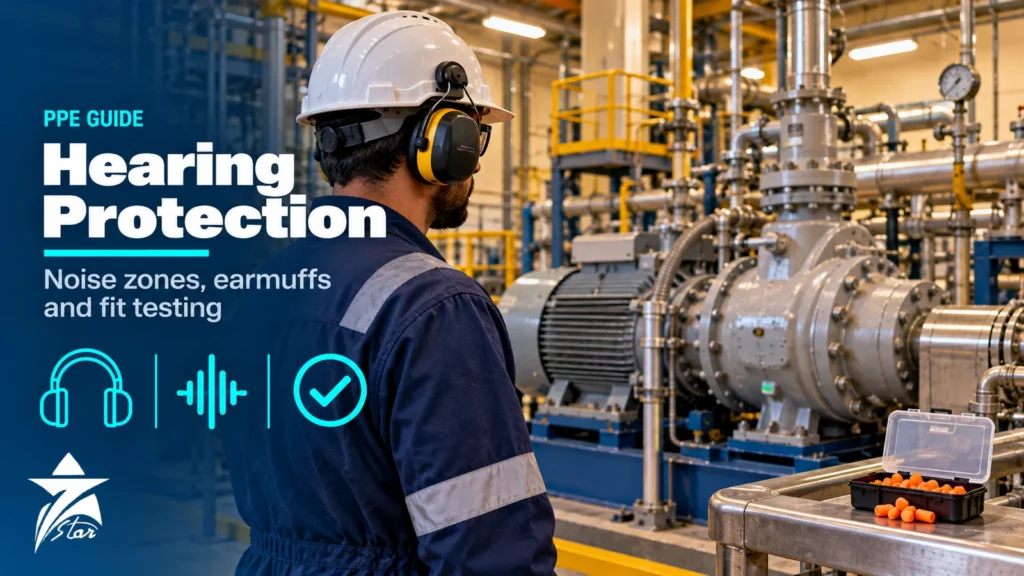
Effective hearing protection starts long before anyone hands out earplugs. Compressor houses, gas turbine packages, pump rooms, fabrication shops and blasting areas routinely exceed safe noise levels, and noise-induced hearing loss is permanent, painless and gradual, so workers rarely notice it until the damage is done. This guide explains how occupational noise limits work in the US and Europe, how to read NRR and SNR ratings without overestimating protection, which protector types fit which tasks, and how to build a programme that actually reduces exposure on industrial sites in Oman and the wider GCC.
How Noise Exposure Is Measured
Noise exposure combines level and time. Levels are measured in A-weighted decibels, dB(A), which approximate the sensitivity of human hearing; impulsive peaks are measured with C-weighting, dB(C). Because the decibel scale is logarithmic, a small increase in level means a large increase in energy: under the equal-energy rule, every 3 dB increase doubles the sound energy, so the permissible time is halved.
Area surveys use sound level meters built to IEC 61672, while personal exposure is best measured with noise dosimeters (IEC 61252) worn on the shoulder for a full shift. The result is expressed as an 8-hour equivalent level, often written LEX,8h or TWA, and as a percentage dose against the applicable limit.
Exposure Limits: OSHA, NIOSH and the EU
| Framework | Lower trigger | Upper trigger / limit | Exchange rate |
|---|---|---|---|
| US OSHA 29 CFR 1910.95 | Action level 85 dBA TWA (hearing conservation programme) | PEL 90 dBA TWA over 8 h | 5 dB |
| US NIOSH REL (recommended) | – | 85 dBA TWA over 8 h | 3 dB |
| EU Directive 2003/10/EC | Lower action value 80 dB(A), peak 135 dB(C) | Upper action value 85 dB(A), peak 137 dB(C); limit value 87 dB(A), peak 140 dB(C) at the ear | 3 dB |
The exchange rate matters a great deal. Under OSHA’s 5 dB rule, 95 dBA is allowed for 4 hours; under the 3 dB rule used by NIOSH and the EU, the same 4 hours is reached at only 88 dB(A) when the base is 85. Many international operators and GCC projects adopt the stricter 85 dB(A) and 3 dB approach in their HSE standards. Note that the EU limit value of 87 dB(A) takes hearing protection into account, while the action values do not.
Typical Noise Sources on Process and Utility Sites
Noise on industrial sites comes from a fairly predictable list of equipment, and knowing the main sources helps target surveys and controls. Each source has its own frequency character, which affects both engineering fixes and the choice of protector.
- Compressors and gas turbines – broadband noise with strong tonal components; enclosures help, but levels inside packages during maintenance stay very high.
- Pressure-reducing valves, vents and blowdowns – high-frequency aerodynamic noise that can produce short peaks well above continuous levels.
- Pumps, motors and cooling fans – steady medium-level noise that adds up over long shifts in pump rooms and on fin-fan decks.
- Diesel generators and engines – dominant low-frequency content, where earplugs generally hold up better than lightweight muffs.
- Fabrication and maintenance work – grinding, hammering, air tools and abrasive blasting create impulsive noise and very high short-term exposure.
Because these sources change with load and operating mode, surveys should be repeated after process changes, new equipment installation or modifications to enclosures.
Hierarchy of Control Before PPE
Hearing protectors are the last line of defence. Sites that rely on them alone usually see poor results because protectors are removed, worn incorrectly or the wrong type. Controls in order of preference:
- Eliminate or substitute – choose quieter equipment at purchase, including low-noise fans, motors and valves with noise specifications.
- Engineering controls – acoustic enclosures, silencers on vents and blowdowns, lagging on pipework, resilient mounts and vibration isolation to stop structure-borne noise.
- Administrative controls – limit time in noisy areas, mark hearing protection zones, schedule noisy work when fewer people are present.
- Hearing protection – for the residual exposure, properly selected and worn all the time in the zone.
Control valves can be major noise sources on gas service; our control valve selection and sizing guide covers low-noise trim options.
Understanding NRR and SNR Ratings
Laboratory ratings describe how much a protector attenuated sound under ideal fitting by trained subjects. Real-world protection is lower, which is why each system applies derating.
NRR (US)
The Noise Reduction Rating is tested under the US EPA labelling rule. OSHA guidance for estimating protection from A-weighted measurements is to subtract 7 dB from the NRR and then, as a field adjustment, divide the result by two. A plug labelled NRR 33 therefore gives an estimated reduction of (33 − 7) ÷ 2 = 13 dB in practice. For dual protection (plugs plus muffs), OSHA guidance adds 5 dB to the higher of the two derated values, not the sum of both ratings.
SNR and HML (Europe)
Protectors certified to the EN 352 series carry a Single Number Rating (SNR) measured under ISO 4869-2, plus H, M and L values for high-, medium- and low-frequency noise. The HML method gives a better estimate when octave-band data are not available but the noise character is known, such as the low-frequency rumble of engines. UK HSE guidance recommends subtracting 4 dB from the calculated protection to allow for real-world factors.
Avoiding over-protection
More attenuation is not always better. EN 458 suggests aiming for a level at the ear of roughly 70 to 80 dB(A) and avoiding protection that brings it well below about 65 dB(A). Over-protected workers cannot hear alarms, radios or colleagues, feel isolated and tend to lift their muffs or loosen their plugs – which destroys the protection entirely.
Types of Hearing Protectors
- Foam earplugs – high attenuation and low cost, but effective only when rolled down and inserted deeply; single-use in dirty environments.
- Premoulded reusable plugs – washable, multiple sizes, easier to insert, good for clean users who wear them daily.
- Banded or semi-aural plugs – quick to insert and remove for people who move in and out of noisy zones.
- Custom-moulded plugs – shaped to the ear canal, comfortable over long shifts; filter choice sets the attenuation.
- Passive earmuffs – easy to fit correctly and visible for supervision; helmet-mounted versions suit construction and plant work.
- Level-dependent muffs – electronics let low-level speech through while limiting loud noise, improving situational awareness.
- Communication headsets – combine attenuation with radio or Bluetooth links for crane, loading and emergency teams.
Fit Matters More Than the Label
A plug that sits half-way out of the ear canal can lose most of its rated attenuation. Safety glasses with thick arms, long hair and hard-hat straps break the seal of earmuffs. Practical steps include training with the roll-pull-hold method for foam plugs, offering several sizes and styles, and using individual fit-testing systems, which measure the personal attenuation rating (PAR) of a worker’s own fit. Fit testing is especially useful for workers with recorded threshold shifts.
Hearing Protection in GCC Heat
Heat and humidity make earmuffs uncomfortable and sweaty, and dusty sites contaminate reusable plugs. Workers in summer conditions often prefer plugs, but dirty hands inserting foam plugs can cause ear infections. Useful measures include hygiene covers for muff cushions, replacing cushions on schedule, dispensers placed at zone entrances, washable premoulded plugs for clean workers and banded plugs for intermittent exposure. Store protectors out of direct sun, because heat hardens cushions and reduces the seal.
Audiometry and Early Warning Signs
Audiometric testing is the only way to see whether a hearing conservation programme is working. A baseline audiogram is taken when a worker joins a noisy job, followed by periodic tests compared against it. Under OSHA, a standard threshold shift is an average change of 10 dB or more at 2,000, 3,000 and 4,000 Hz in either ear relative to the baseline, and it triggers follow-up such as refitting, retraining and a review of the protector.
Noise damage typically shows first as a notch around 4,000 Hz, before people notice any difficulty with speech. Temporary ringing (tinnitus) or muffled hearing after a shift is a warning that exposure was too high that day. Group-level trends in audiometry results are also valuable: if several workers in one area show shifts, the cause is usually the noise source or the protector choice, not individual behaviour.
Hearing Conservation Programme Essentials
- Noise survey and personal dosimetry for each similar exposure group
- Noise maps and signage marking mandatory hearing protection zones
- Engineering control plan with priorities and noise specifications for new equipment
- Selection of protectors with adequate but not excessive attenuation
- Training on fitting, care and the effects of noise
- Baseline and periodic audiometry, with follow-up on standard threshold shifts
- Records of exposure, audiometry, training and protector issue
Hearing Protector Selection Checklist
- Measured noise level and frequency content (dB(A), dB(C), octave bands if available)
- Duration of exposure per shift and whether it is continuous or intermittent
- Required attenuation after derating, targeting 70–80 dB(A) at the ear
- Need to hear alarms, radios or speech
- Compatibility with hard hats, safety glasses, respirators and face shields
- Heat, dust and hygiene conditions
- Certification marks: EN 352 or ANSI/EPA labelling
- User preference and comfort trials
Hearing Protection We Supply
These examples cover earmuffs and earplugs.
| Product | Type | Where it fits |
|---|---|---|
| 3M Peltor X5A Over-the-Head Earmuffs, NRR 31 dB | Earmuffs, NRR 31 dB | High noise areas. |
| Moldex MX-6 6130 High-Attenuation Earmuff, NRR 30 dB | Earmuffs, NRR 30 dB | High noise areas. |
| Moldex Mellows 6820 Uncorded Disposable Foam Earplugs | Disposable foam earplugs | General noise protection. |
| Bruel & Kjaer 2250-L-D21 Class 1 Sound Level Meter | Class 1 sound level meter | Measuring noise exposure. |
Send the noise level and the number of users through our quote request form.
Sourcing Hearing Protection Through Seven Star LLC
Seven Star LLC supplies earplugs, dispensers, passive and level-dependent earmuffs, helmet-mounted muffs and communication headsets on request, from manufacturers such as 3M, Honeywell, MSA and Moldex. See our hearing protection range, the wider safety and PPE category and portable test and measurement for sound level meters and dosimeters. We help with selection and cross-checking part numbers, and availability and lead time are confirmed at quotation.
Equipping a new noise zone or replacing muff cushions and plugs? Send us the product label or part numbers, your noise survey results or your RFQ, and we will reply with matched options and a clear quotation.
Frequently asked questions
What noise level requires hearing protection?
Under OSHA a hearing conservation programme is required at an 85 dBA 8-hour TWA, and the permissible limit is 90 dBA. Under EU Directive 2003/10/EC protectors must be made available at 80 dB(A) and worn at 85 dB(A).
How do I calculate real protection from an NRR?
OSHA guidance for A-weighted measurements is to subtract 7 from the NRR and then divide by two as a field adjustment. An NRR 33 plug is therefore estimated to give about 13 dB of real-world reduction.
What is the difference between NRR and SNR?
NRR is the US rating under the EPA labelling rule, while SNR is the European single-number rating measured under ISO 4869-2 for EN 352 protectors. They use different test methods and calculations, so the numbers are not directly interchangeable.
Does wearing earplugs and earmuffs together double the protection?
No. OSHA guidance adds only about 5 dB to the better of the two derated values. Dual protection is used for very high noise, such as near vents or in turbine enclosures.
Can hearing protection be too strong?
Yes. EN 458 suggests a level at the ear of around 70 to 80 dB(A). Over-protection makes it hard to hear alarms and speech, so workers often remove protectors, which leaves them unprotected.
How often should audiometric tests be done?
OSHA requires a baseline audiogram and annual tests for workers in the hearing conservation programme. Other national rules and company standards set their own intervals, usually annual for exposed workers.
Was this guide helpful?One click helps us write better guides for engineers.
Thank you! Glad it helped. Need this equipment for your project? Request a quotation
Thank you. We will use this to improve the guide.