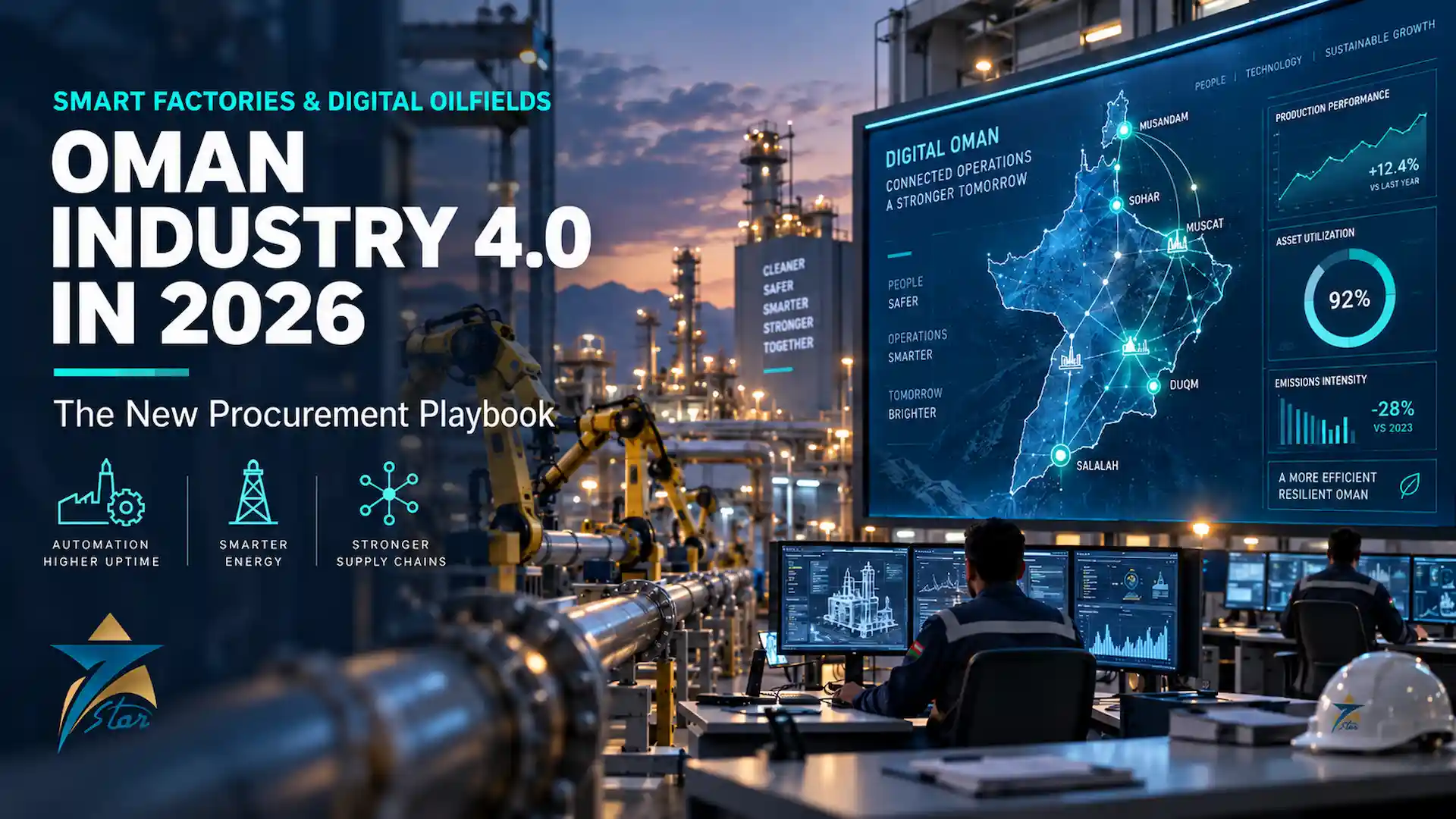
Oman Industry 4.0 in 2026: Smart Factories, Digital Oilfields and the New Procurement Playbook
Introduction: Why 2026 Is the Tipping Point
Oman is no longer preparing for industrial digitalization — it is executing it. The Eleventh Five-Year Development Plan (2026–2030) channels investment into smart manufacturing, digital oilfields, green hydrogen, and logistics automation, all anchored to Vision 2040. For procurement teams and plant operators, this shift changes the rules of sourcing: the equipment you specify today must be connected, interoperable, and ready for data-driven operations tomorrow.
This article maps the Industry 4.0 in Oman landscape for 2026 — the pillars driving adoption, the instrumentation backbone every smart plant depends on, and a practical procurement playbook for buyers. It is written for decision-makers who need more than a technology overview: they need to know what to buy, in what order, and from whom.
What Industry 4.0 Means for Omani Industry
Industry 4.0 is the convergence of operational technology and information technology: sensors feeding real-time data into control systems, edge and cloud analytics converting that data into decisions, and automation acting on those decisions without human latency. In the Omani context, four forces make it urgent rather than optional:
- Cost competitiveness: With regional rivals automating rapidly, Omani plants must cut operating expenditure to defend margins — predictive maintenance alone can reduce maintenance costs by up to 30%.
- Workforce optimization: Skilled technicians are scarce; connected instruments let fewer people supervise more assets remotely.
- Vision 2040 targets: Economic diversification demands world-class industrial output, which digitalized plants deliver more consistently.
- Energy transition: Green hydrogen and solar projects (Duqm, Salalah) are greenfield opportunities where digital instrumentation is built in from day one.
Four Pillars Driving Oman’s Digital Industrialization
1. Digital Oilfields and Gas Processing
PDO and OQ-backed operators are expanding remote monitoring of wells, separators, and pipeline networks. The pattern is consistent: wireless or HART-connected sensors and transmitters stream pressures, temperatures, and flow rates into historians, where exceptions trigger alarms instead of requiring patrols. For brownfield sites, retrofitting a metering system with smart electronics delivers most of the benefit at a fraction of greenfield cost.
2. Smart Manufacturing and Industrial Cities
From Sohar to Sur, manufacturers are upgrading legacy control loops with modern automation and control platforms. The measurable goals are consistent: tighter batch repeatability, lower energy per unit, and traceable quality data. PLC and I/O refreshes, HMI modernization, and standardized industrial communication networks form the typical first phase — quick wins that fund later phases.
3. Green Hydrogen and Renewable Energy
Oman’s hydrogen strategy targets over one million tonnes of green hydrogen annually by 2030. Electrolyzer plants and solar farms are instrument-dense: precise flow and pressure instrumentation, analyzer systems for gas purity, and gas analytics for safety. Every electrolyzer skid ships with dozens of transmitters — and every one of them must be specified, sourced, and supported by partners who understand the duty.
4. Ports, Logistics and Utilities
Salalah, Duqm, and Sohar ports are investing in automated material handling and smart utility networks. Desalination plants — already critical to Omani water security — are adding digital flow metering and level instrumentation to detect losses in real time. For operators of rotating assets, vibration monitoring protects pumps, compressors, and motors from unplanned failure.
Pillar-to-Technology Snapshot
| Pillar | Key Technology | Typical Instrumentation |
|---|---|---|
| Digital oilfield | Remote monitoring, HART/Fieldbus | Pressure & temperature transmitters, flow computers |
| Smart manufacturing | PLC refresh, MES connectivity | Controllers, HMI, industrial communication |
| Green hydrogen | Electrolyzer control, gas purity | Gas analyzers, flow metering, safety systems |
| Ports & utilities | Asset health, leak detection | Vibration monitoring, level & flow instruments |
The Instrumentation Backbone of a Smart Omani Plant
Every Industry 4.0 initiative in Oman — regardless of sector — rests on the same five instrumentation layers. When you plan a digitalization project, verify each layer has a named owner and a supported product:
- Measurement layer:Sensors & transmitters for pressure, temperature, level, and flow — the eyes of the plant. Accuracy classes and HART/Profibus protocol support determine how usable the data is downstream.
- Computation layer:Flow computers and controllers that convert raw signals into corrected volumes and control actions — the brain of custody and process measurement.
- Condition layer:Vibration monitoring and NDT instruments (thickness gauges, flaw detectors) that watch asset health — the immune system of rotating and static equipment.
- Quality layer:Analyzer systems and gas analytics for composition and emissions — the senses for product quality and regulatory compliance.
- Connectivity layer:Industrial communication hardware that carries data reliably in harsh environments — the nervous system linking every layer to the control room.
Buyers often make the same mistake: they purchase the measurement layer first and discover later that protocol compatibility, spares availability, and local technical support were the real constraints. A smarter sequence is connectivity and computation first, measurement second — so that every transmitter you add is born connected.
The 2026 Procurement Playbook for Digital Projects
For Omani buyers funding Industry 4.0 initiatives, five practices separate successful projects from shelfware:
- Standardize before you scale: Commit to one or two fieldbus protocols and a shortlist of preferred brands. Mixed-protocol estates multiply spares inventory and engineering effort.
- Specify for the environment: Desert heat, humidity, and corrosive coastal air are the default in Oman — verify ingress protection, temperature ratings, and material selection before comparing price.
- Buy from an authorized channel: Genuine, traceable instruments with manufacturer warranty protect your liability in safety-instrumented functions. Grey-market savings disappear at first failure.
- Plan the support contract: Calibration documentation, spare parts, and responsive local service matter more in Year 2 than the discount in Year 1.
- Phase for payback: Start with condition monitoring on your most critical rotating assets, quantify avoided downtime, and reinvest the savings into broader connectivity.
How Seven Star LLC Supports Your Roadmap
Seven Star LLC has supplied instrumentation to Omani industry since the early 2000s, and today supports every layer of the smart-plant stack described above — from sensors and transmitters to automation and control platforms, vibration monitoring, and NDT equipment. As an authorized distributor for the principals behind the major brands, we offer:
- Genuine, traceable product with manufacturer warranty.
- Technical pre-sales support: tag review, protocol selection, and application engineering.
- Competitive lead times via regional warehousing.
- After-sales calibration and replacement support for the life of the instrument.
Submit your tag list and project timeline through the inquiry form and receive an itemized quotation — usually within one working day.
Conclusion: The Window Is Open
Oman’s industrial digitalization is a once-in-a-generation procurement opportunity. The plants that specify connected, supported, and standardized instrumentation in 2026 will compound that advantage for a decade — while laggards face retrofits at double the cost. Whether you are planning a digital oilfield rollout, a hydrogen project, or a manufacturing modernization, the starting point is the same: a shortlist of genuine, serviced, in-country instrumentation. Start yours today.
More Blog