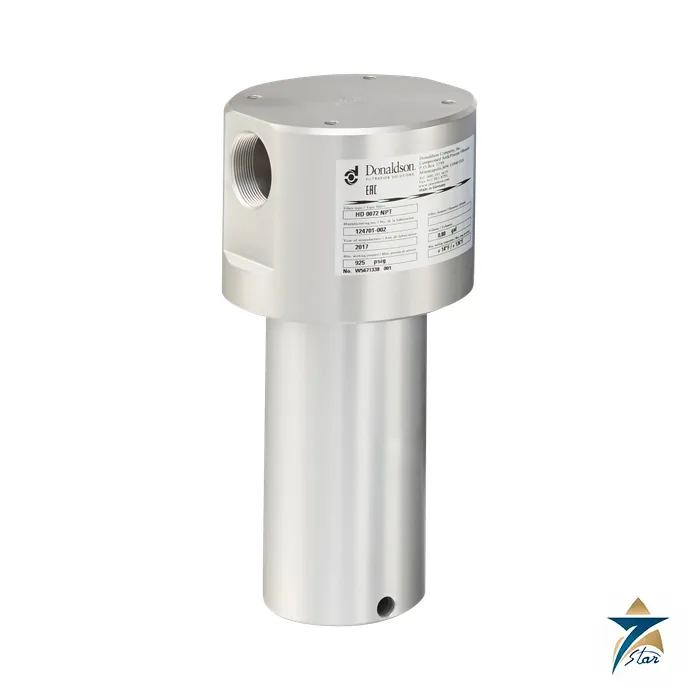
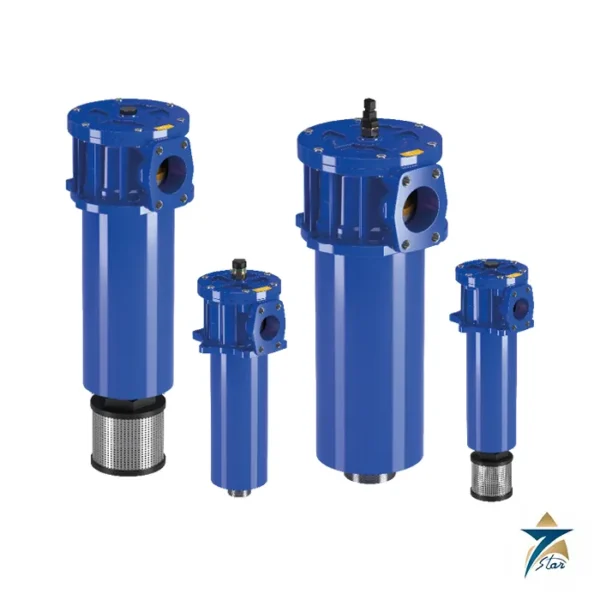
A threaded high-pressure housing for compressed air and industrial gases
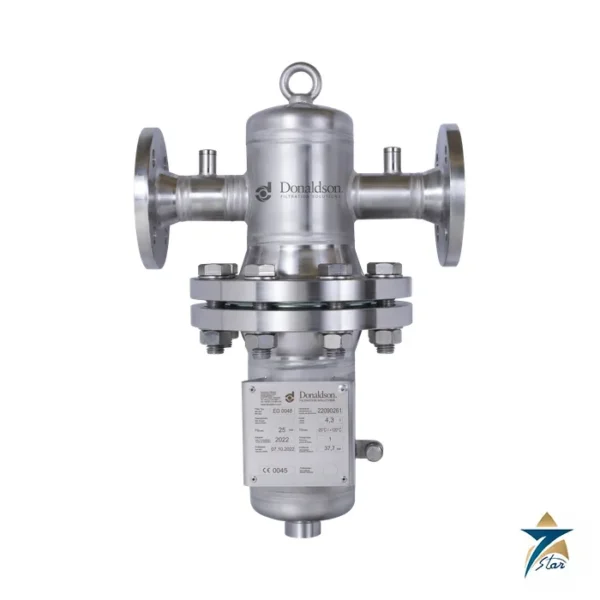
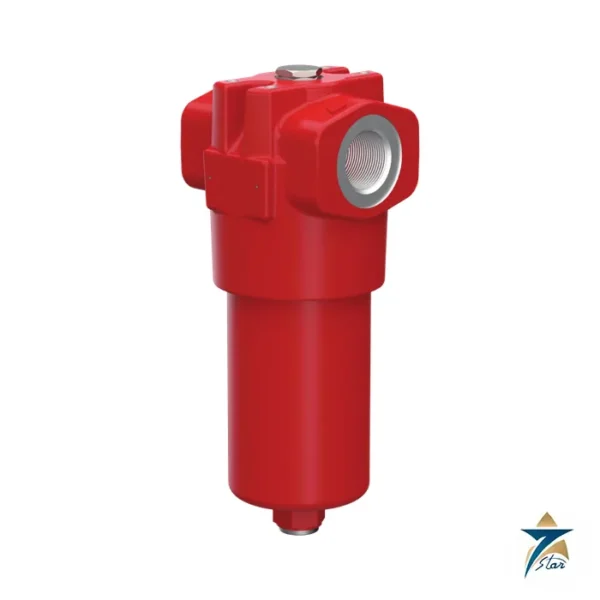
The Donaldson HD 0003-0072 is a compact high-pressure filter housing for compressed air and for industrial gases of fluid group 1 and 2. Eight sizes with 1/4 inch to 2 inch BSP connections handle 90 to 8,640 m3/h, and the pressure range runs from PN 25 up to PN 400, which is well above what the standard DF or SG compressed air housings are built for.
Donaldson lists three uses: final filtration of process gases including removal of oil vapour and hydrocarbons, a pre-filter or dust filter around adsorption dryers, and hydrogen filtration for bottle refilling and refuelling stations that follow ISO 14687:2019 purity requirements for fuel cells.
Technical specifications
| Parameter |
Specification |
| Series / sizes |
HD 0003, 0006, 0012, 0018, 0027, 0036, 0048, 0072 |
| Connection |
G 1/4 to G 2 (BSP) |
| Flow range |
90 to 8,640 m3/h at 1 bar abs. and 20 C |
| Pressure ratings |
PN 25, PN 40, PN 64, PN 100, PN 250, PN 400 (25 / 40 / 64 / 100 / 250 / 400 bar) |
| Test pressure |
36, 57.2, 92, 143, 357.5 and 572 bar for the respective PN ratings |
| Operating temperature |
-10 C to +80 C |
| Housing materials |
Anodised aluminium, electroless nickel-plated carbon steel, or stainless steel |
| Seals |
Perbunan, compound-free housing O-ring |
| Element grades |
CF, SB, AK, FF, MF, SMF; CFE and SMFE for ATEX zones 1 and 2 |
| Classification |
Pressure Equipment Directive 2014/68/EU, fluids of group 2; Art. 4 par. 3 to Cat. III by size and pressure |
| Housing volume |
0.19 l (HD 0003) to 2.4 l or 3.02 l (HD 0072) depending on material |
Flow by size and pressure class
- 0003: Port G 1/4; PN 25 m3/h 90; PN 40 m3/h 120; PN 64 m3/h 240; PN 100 m3/h 360
- 0012: Port G 1/2; PN 25 m3/h 360; PN 40 m3/h 480; PN 64 m3/h 960; PN 100 m3/h 1,440
- 0027: Port G 1; PN 25 m3/h 810; PN 40 m3/h 1,080; PN 64 m3/h 2,160; PN 100 m3/h 3,240
- 0048: Port G 1 1/2; PN 25 m3/h 1,440; PN 40 m3/h 1,920; PN 64 m3/h 3,840; PN 100 m3/h 5,760
- 0072: Port G 2; PN 25 m3/h 2,160; PN 40 m3/h 2,880; PN 64 m3/h 5,760; PN 100 m3/h 8,640
Aluminium housings cover PN 25 to PN 64; carbon and stainless steel extend the same sizes to PN 100, PN 250 and PN 400, where the flow figure stays at 360 m3/h for HD 0003 up to 8,640 m3/h for HD 0072.
Element grades and hydrogen service
The coalescing grades quoted for these housings are FF (initial differential pressure 0.11 bar, residual oil below 0.2 mg/m3), MF (0.18 bar, below 0.03 mg/m3) and SMF (0.33 bar, below 0.01 mg/m3), all at 7 bar nominal and 3 mg/m3 inlet. CF and SB are 100 percent efficient at 25 micrometre, and AK activated carbon lists 0.003 mg/m3 behind an MF or SMF filter.
The conductive SMFE and CFE elements are meant for ATEX zone 1 and 2 use, for example bio-methane and hydrogen. Specify the pressure class first: the housing, the element size code (03/05 up to 10/30) and the weight all change with material and PN rating, so the dimension tables must be read for the exact variant. The classification under directive 2014/68/EU also changes with size and pressure, from Article 4 paragraph 3 for the small sizes to Category III for HD 0072 at 400 bar.
Selection checks before ordering
Start from the highest pressure the line can reach, including relief valve settings and compressor or booster surges, and choose a PN class that sits above it. Then confirm the flow at actual operating conditions: the figures in the size list are referred to 1 bar absolute and 20 C, so convert the real process flow to the same basis before comparing. Check that the gas is compatible with the housing material and the Perbunan seals, and that the operating temperature stays inside the -10 C to +80 C window, particularly downstream of a compressor aftercooler that may not be working perfectly on a hot day.
Element grade follows the purpose of the stage. A particulate or coalescing grade normally sits upstream to protect an AK activated carbon stage, as the data sheet pairs AK with MF or SMF. For hydrogen or bio-methane in ATEX zones, specify the conductive CFE or SMFE grades named above and include the zone classification in the enquiry.
Installation in high-pressure lines
Install the housing in the orientation shown in the Donaldson instructions, with inlet and outlet connected the right way round for the pipe flow. Use thread sealing suited to the gas and the PN class; on hydrogen and other group 1 fluids, follow the site's procedure for leak-tight threaded joints. Support the pipework on both sides so the housing does not carry the weight or thermal movement of the line, and leave enough clearance around the housing to withdraw the element during service.
Before pressurising, check that every connection is tight and that the system can be isolated and vented on both sides of the filter. Bring the line up to pressure gradually and leak-test the joints with a method approved for the gas in use.
Operating conditions in Oman and the GCC
Compressor rooms and gas skids in the region often see high ambient temperatures and dusty air. Warm intake air carries more moisture, so coalescing stages downstream of compressors can receive more condensate in summer than in winter. Locate the housing where any liquid it removes can be drained safely, away from direct sun if possible, and keep the outside of the housing clean so damage or corrosion is easy to see. In coastal sites with humid, salty air, inspect the external surfaces of carbon steel housings regularly.
Element change and maintenance
Change elements according to the Donaldson recommendations and the differential pressure across the filter rather than waiting for a downstream problem. Always isolate and fully depressurise the housing before opening it; with stored high-pressure gas this step is critical. Inspect the housing O-ring when the housing is opened and replace it if it shows damage. Record the element grade, the date of change and the measured pressure drop so that service intervals can be adjusted to the real conditions on site.
Documents and quotation
We quote HD 0003-0072 on request from Muscat. Confirm the pressure class, housing material and element grade against Donaldson HD high-pressure industrial filter housings data sheet (F119007, 07/2025) (attached as a PDF), then submit the code. Browse Filter Housings.

Reviews
There are no reviews yet.