A heat-regenerated dryer with a final purge cooling step
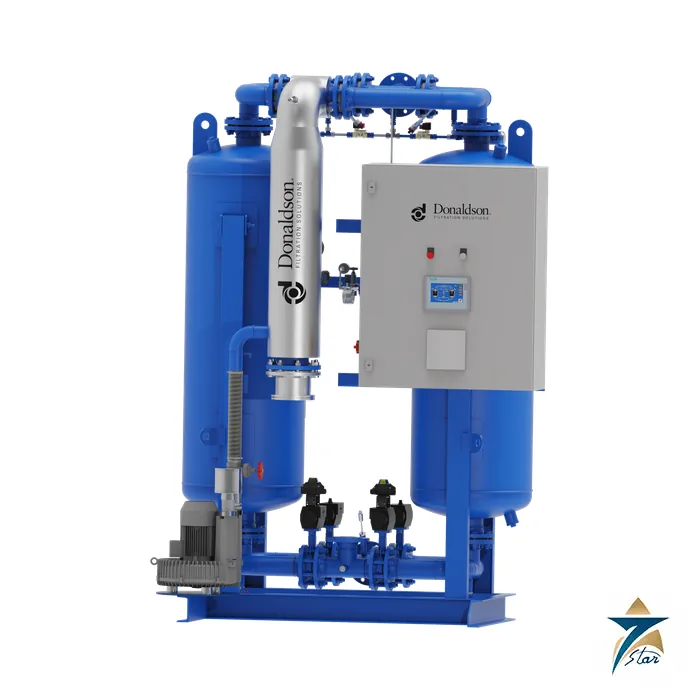
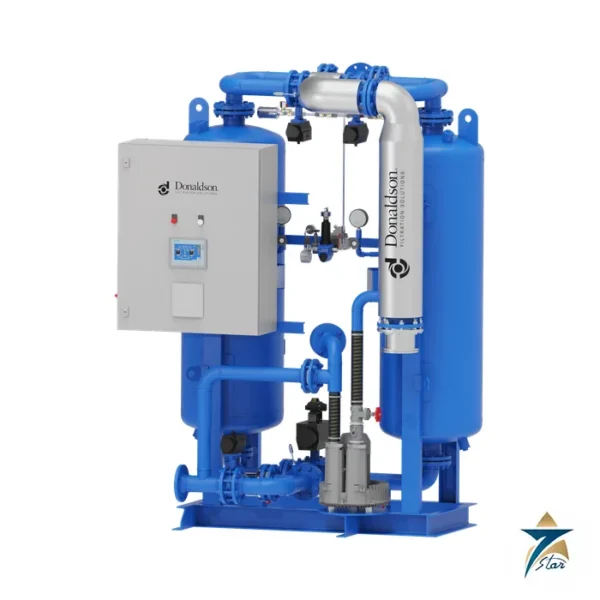
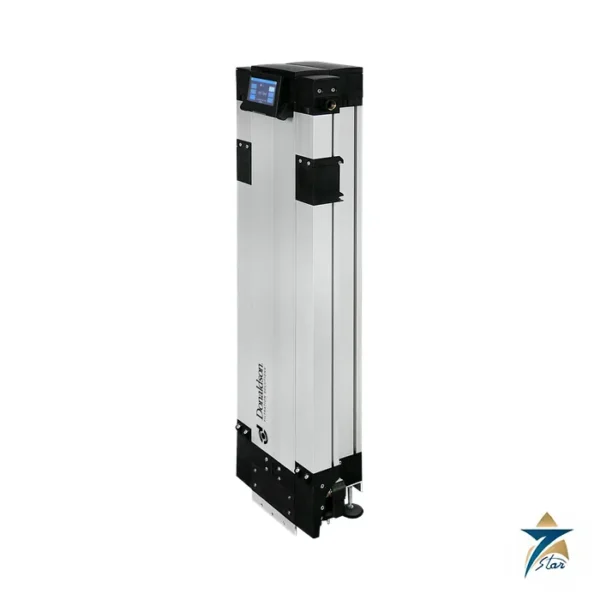
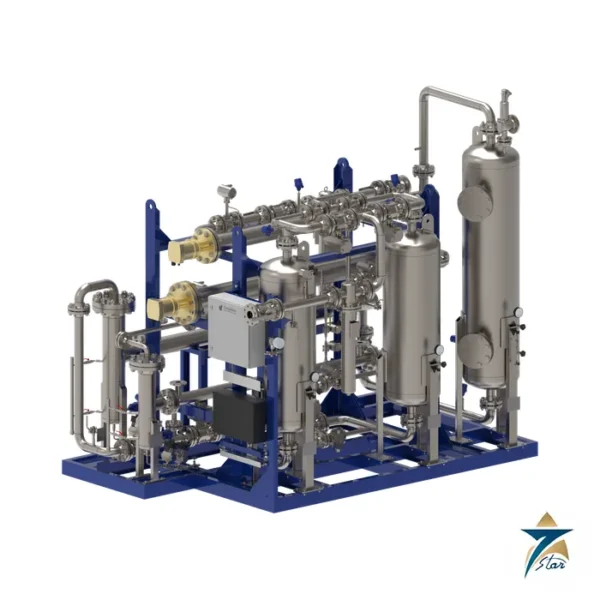
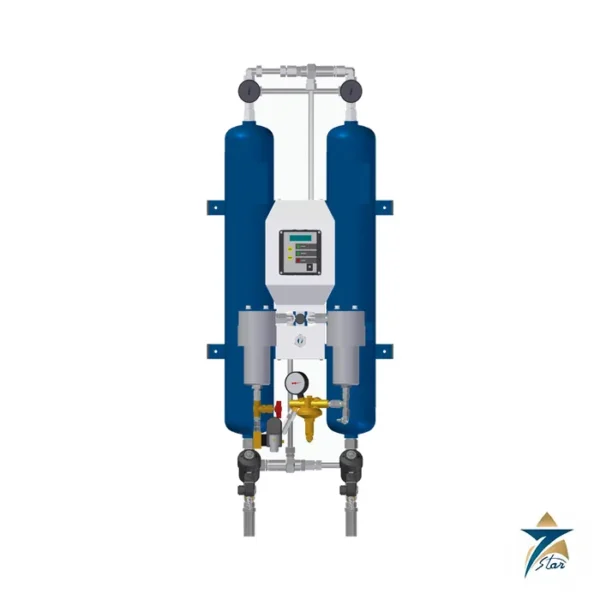
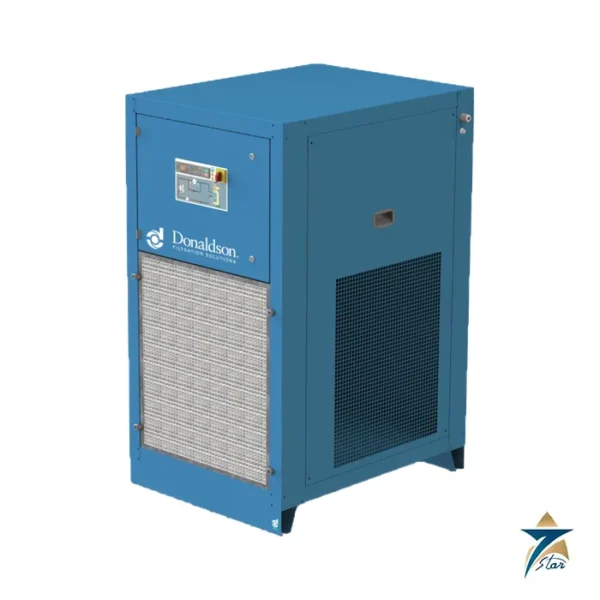
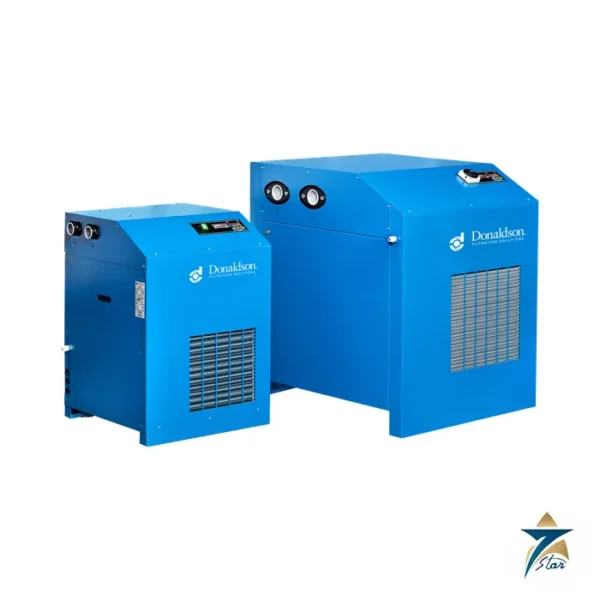
The Donaldson Ultradryer HRE+ 0375-8750 spans the whole Ultradryer flow range, from 375 to 8,750 m3/h in sixteen sizes, with a pressure dew point of -40 C at 7 bar(g). Regeneration uses ambient air to heat and to cool the desiccant, followed by a final purge cooling step with a small amount of dry air or gas, which is what sets it apart from the zero-purge HRS+ and the closed-loop HRS-L+.
Donaldson recommends the purge cooling concept for sites with high ambient temperature or humidity. The dryer is controlled by a Siemens S7-1215C PLC with a KTP700 touch panel and Ultraconomy dew point control, and it runs the usual six-hour cycle.
Technical specifications
| Parameter |
Specification |
| Size range |
Sixteen models, HRE+ 0375 up to HRE+ 8750 |
| Rated flow |
375 to 8,750 m3/h referred to 1 bar and 20 C |
| Pressure dew point |
-40 C at 7 bar(g) |
| Rated condition |
Gauge 7 bar, inlet air 35 C, fully saturated |
| Desiccant regeneration |
Heating and cooling with room air, then a closing purge-cooling step using dried air or gas |
| Site temperature window |
Both inlet air and surroundings 5 C to 40 C |
| Line pressure |
4 to 10 bar(g) |
| Thermal design range |
Minus 10 C to plus 230 C |
| Vessel and pipe rating |
11 bar(g) vessels through 2750, 10 bar(g) pipework |
| Electrics |
S7-1215C with 7-inch KTP700 panel; 400 V, three phase, 50 Hz |
| Port arrangement |
Sizes 0375-2750: inlet front, outlet back; sizes 3500-8750: both on the front |
Sizes and power
- 0375: Throughput m3/h 375; Nozzle size DN 50; Heater and fan kW 7.8; dP mbar 100
- 1000: Throughput m3/h 1,000; Nozzle size DN 80; Heater and fan kW 14.5; dP mbar 110
- 2750: Throughput m3/h 2,750; Nozzle size DN 100; Heater and fan kW 38.0; dP mbar 130
- 3500: Throughput m3/h 3,500; Nozzle size DN 100; Heater and fan kW 44.5; dP mbar 100
- 5000: Throughput m3/h 5,000; Nozzle size DN 150; Heater and fan kW 71.0; dP mbar 90
- 7000: Throughput m3/h 7,000; Nozzle size DN 180; Heater and fan kW 95.0; dP mbar 120
- 8750: Throughput m3/h 8,750; Nozzle size DN 200; Heater and fan kW 115.0; dP mbar 80
The small sizes of HRE+ list the same connection and power as HRS+, so the choice between the two turns on the regeneration concept and the site conditions, not on dryer size.
Selecting between the Ultradryer variants
Use the correction factor table of the sheet to move from your compressor flow to the nominal flow: it is arranged by dew point, inlet temperature (30 C, 35 C and others) and operating pressure from 4 to 10 bar(g), with factors that run from 0.72 at 4 bar(g) up to 1.51 at 10 bar(g) for a 30 C inlet. Purge cooling consumes a small share of the dried air, so include that in the net flow calculation.
The same energy and data options as for the other Ultradryers are listed: ENERSAVE, insulation, Weekend STOP, flow and energy monitoring, and Modbus or Profibus modules. Confirm the electrical supply, the control voltage and the room conditions for the blower, which the sheet limits to 35 C at 45 percent humidity or 30 C at 60 percent, before you order.
When the HRE+ purge cooling concept makes sense
Heat-regenerated dryers that use ambient air for heating and cooling are sensitive to the moisture content of that air. In hot or humid climates the desiccant bed can pick up moisture again during the cooling phase, which shows up as a dew point peak after the vessels switch over. The final purge cooling step of the HRE+ addresses exactly this point: a small amount of dry air or gas finishes the cooling, so the regenerated bed returns to service in a dry condition. This is why Donaldson recommends the concept for sites with high ambient temperature or humidity, and why it is worth considering for compressor stations in coastal or desert locations.
The trade-off is the purge consumption. Where ambient conditions are moderate and every share of compressed air counts, the zero-purge HRS+ or the closed-loop HRS-L+ may be the better fit. Comparing the three variants against the real site conditions, not only the nominal flow, gives the most reliable selection.
Typical application context
Dryers of this size class are installed downstream of the main compressors in central compressed air stations, where a stable pressure dew point protects distribution pipework, pneumatic equipment, instrumentation and processes that are sensitive to moisture. The wide size range allows one dryer concept to be applied to small and large stations alike, and the Ultraconomy dew point control lets the cycle follow the actual load instead of running on a fixed schedule.
Installation and commissioning considerations
Plan the dryer room with the ambient limits in mind and provide enough ventilation for the regeneration air. Check the port arrangement for the chosen size, since the smaller and larger models differ in where inlet and outlet are located, and allow space around the vessels for inspection and desiccant handling. Route the inlet and outlet piping so that it does not place strain on the dryer connections, and follow the manufacturer instructions for installation and lifting.
During commissioning, verify the line pressure, the electrical supply and the control voltage, then set up the Ultraconomy dew point control on the touch panel. Observe at least one complete cycle, including the purge cooling step, and record the pressure dew point after switchover. Comparing this value over the first weeks of operation gives a useful reference for later performance checks. If Modbus or Profibus modules are ordered, check the data exchange with the plant control system at this stage.
How to specify your request
State the required model or, if not yet chosen, the compressor flow, operating pressure, inlet air temperature, ambient temperature and humidity, and the required pressure dew point. Add the electrical supply available at site and the options of interest, such as ENERSAVE, insulation, Weekend STOP, monitoring or communication modules, so the size and configuration can be confirmed with the correction factors.
Documents and quotation
To get availability for HRE+ 0375-8750, send the code. Review the flow, ambient conditions and electrical supply using the PDF Donaldson Ultradryer HRE+ 0375-8750 data sheet (F119008, 12/2025) attached here first. Further items: Compressors.



Reviews
There are no reviews yet.