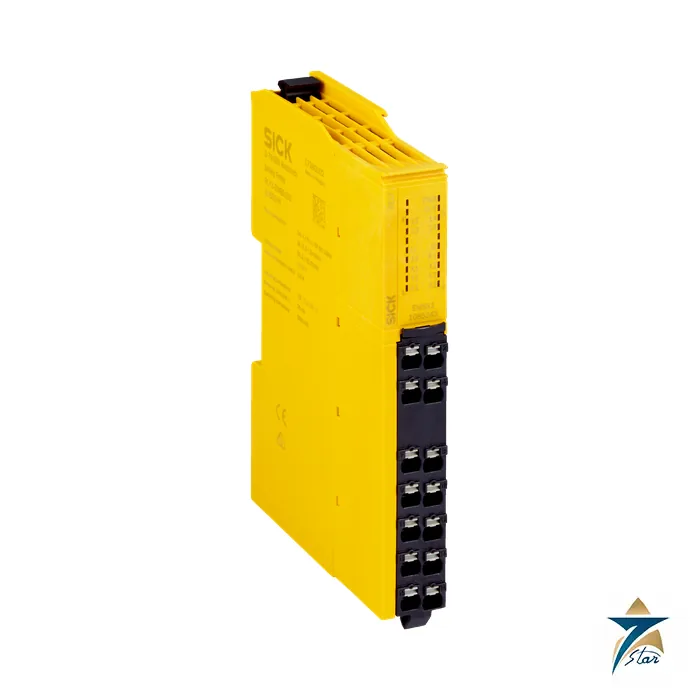
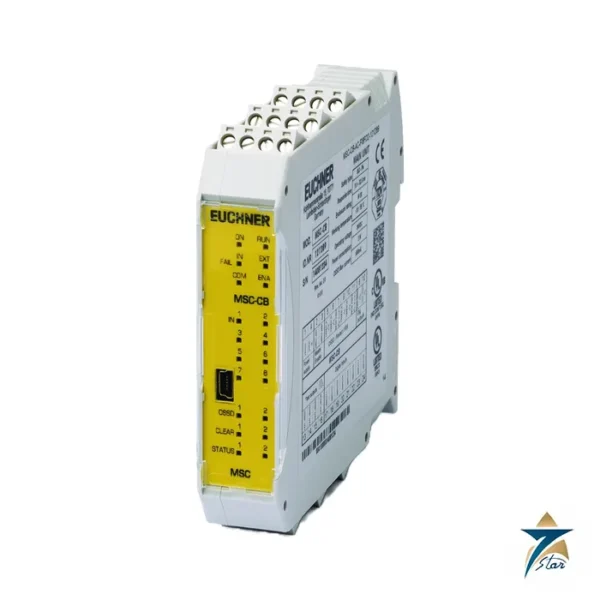
RLY3-EMSS100 is a SICK ReLy safety relay (part no. 1085345), an evaluation unit for safety sensors with potential-free outputs. It is 18 mm wide, has spring-terminal front connectors and is wired hard, so no software is needed. The data sheet lists SIL 3 (IEC 61508), PL e (ISO 13849-1) and category 4 (iso 13849-1); outputs are 2 enabling current paths (safe); 2 application diagnostic outputs (not safe); 3 test pulse outputs (not safe).
What the RLY3-EMSS100 evaluates and what it switches
The EMSS version is designed for safety sensors with potential-free contacts, such as emergency stop devices, safety door switches and safety mats. It monitors the two input channels for discrepancy and cross-circuits (the data sheet lists discrepancy monitoring; Cross-circuit detection) and opens its enabling current paths when a channel opens, with restart interlock and external device monitoring available.
Safety figures as printed: SIL 3 (IEC 61508), Category 4 (ISO 13849-1), PL e (ISO 13849-1), PFHD 1.0 x 10⁻⁹, mission time 20 years (ISO 13849-1), stop category 0 (IEC 60204-1). Reset: automatic; Manual. The two enabling current paths are N/O contacts, positively guided, switching 10 V AC … 230 V AC and 10 mA … 6 A up to a total of 12 A. Response time 10 ms.
Technical specifications
| Parameter |
Specification |
| Type code |
RLY3-EMSS100 |
| Part number |
1085345 |
| EAN |
4047084415746 |
| Product family |
ReLy |
| Applications |
Evaluation unit |
| Compatible sensor types |
Safety sensors with potential-free outputs |
| Safety integrity level |
SIL 3 (IEC 61508) |
| Category |
Category 4 (ISO 13849-1) |
| Performance level |
PL e (ISO 13849-1) |
| PFHD (mean probability of a dangerous failure per hour) |
1.0 x 10⁻⁹ |
| Stop category |
0 (IEC 60204-1) |
| Sensor monitoring |
Discrepancy monitoring; Cross-circuit detection |
| Restart interlock |
Yes |
| Reset |
Automatic; Manual |
| External device monitoring (EDM) |
Yes |
| Connection type |
Front connector with spring terminals |
| Inputs |
2 safety inputs; 1 input for reset pushbutton or external device monitoring (EDM) |
| Outputs |
2 enabling current paths (safe); 2 application diagnostic outputs (not safe); 3 test pulse outputs (not safe) |
| Display elements |
LEDs |
| Configuration method |
Hard wired |
| Voltage supply |
PELV or SELV |
| Supply voltage VS |
24 V DC (16.8 V … 30 V) |
| Residual ripple |
≤ 2.4 V |
| Power consumption |
≤ 2.5 W (DC) |
| Safety inputs: Number |
2 |
| Safety inputs: Input voltage HIGH |
24 V DC (11 V … 30 V) |
| Safety inputs: Input voltage LOW |
0 V DC (–3 V … 5 V) |
| Safety inputs: Input current |
4 mA … 6 mA |
| Safety inputs: Activation time tolerance between the two start buttons |
≤ 3 s |
| Reset pushbutton or external device monitoring (EDM) input: Number |
1 |
| Reset pushbutton or external device monitoring (EDM) input: Input voltage HIGH |
24 V DC (11 V … 30 V) |
| Reset pushbutton or external device monitoring (EDM) input: Input voltage LOW |
0 V DC (–3 V … 5 V) |
| Reset pushbutton or external device monitoring (EDM) input: Input current |
4 mA … 6 mA |
| Enabling current paths: Response time (opening of enabling current paths) |
10 ms |
| Enabling current paths: Number |
2 |
| Enabling current paths: Type of output |
N/O contacts, positively guided |
| Enabling current paths: Contact material |
Silver alloy, gold flashed |
| Enabling current paths: Switching voltage |
10 V AC … 230 V AC |
| Declarations and certificates in the data sheet |
EU declaration of conformity; UK declaration of conformity; ACMA declaration of conformity; China RoHS; CCC certificate; UK-Type-Examination approval; cULus certificate; EAC certificate / DoC; cTUVus certificate; S Mark certificate; EC-Type-Examination approval; EC-Type-Examination approval (Machinery Directive); EC-Type-Examination approval (Machinery Regulation); Third party certificate |
Type code RLY3-EMSS100 and part number 1085345
The ReLy family uses short type codes: RLY3 is the family and the letters after the hyphen indicate the input side (EMSS for potential-free contacts); the digits are SICK’s own variant numbering. The two units look the same on the DIN rail but are not interchangeable: RLY3-OSSD200 (part no. 1085344) is its counterpart for OSSD sensors. Always quote the part number 1085345 and state the sensors you want to connect.
Wiring, validation and cabinet notes
Supply 24 V DC (16.8 V … 30 V), power consumption ≤ 2.5 W (DC); dimensions 18 mm x 124.6 mm x 85.5 mm, weight 130 g; enclosure rating IP20 (IEC 60529) (installation in a control cabinet); ambient operating range –25 °C … +55 °C. A safety relay is one part of a safety function: the required performance level depends on the whole chain of sensor, relay and actuator, so verify the calculation for your machine and the reset and EDM wiring before commissioning.
Selection considerations
Choose this relay when the safety devices on the machine provide potential-free contacts and a hard-wired solution is preferred over a programmable safety controller. It is a practical fit for single safety functions such as an emergency stop circuit or a guard door interlock on a stand-alone machine. Where many safety functions must be combined, or where sensors with OSSD outputs are used, a different device from the family or a configurable controller may be more suitable. Check that the load on the enabling current paths, typically contactor coils or a drive enable circuit, stays within the printed switching voltage and current.
Installation and commissioning practice
Install the relay in a control cabinet that provides the protection the IP20 rating does not, and supply it from a PELV or SELV source. Wire both input channels separately so that the cross-circuit detection can do its job, and connect the feedback contacts of the switched contactors to the EDM input when external device monitoring is used. Decide whether automatic or manual reset fits the risk assessment; manual reset is generally used where a person could be inside the hazard zone when the guard closes.
Commissioning should include a functional test of every safety device connected to the relay: operate each emergency stop and each door switch, confirm that the machine stops as intended, and check that it cannot restart until the reset condition is met. Simulate a fault on one channel to confirm the discrepancy response. Document the tests as part of the validation of the safety function.
Operation in GCC control panels
Control cabinets in Oman and the GCC can run close to the upper ambient limit in summer, so cabinet ventilation or cooling should keep the internal temperature inside the operating range. Keep cabinets closed to limit dust ingress on the spring terminals, and check terminations during periodic maintenance. Repeat the functional tests at the intervals defined by the machine risk assessment.
Documents and quotation
For RLY3-EMSS100 the manufacturer’s data sheet (part no. 1085345) is attached as a PDF copy; read it together with your control drawing before you commit to the order. A quotation needs only the part number, the quantity and the delivery destination; the RFQ form takes all three. Related items are listed under Safety Switches & Guard Locking. We suggest a last check of the output type, plug and ratings against your site documents before the order is placed; the data sheet governs.



Reviews
There are no reviews yet.