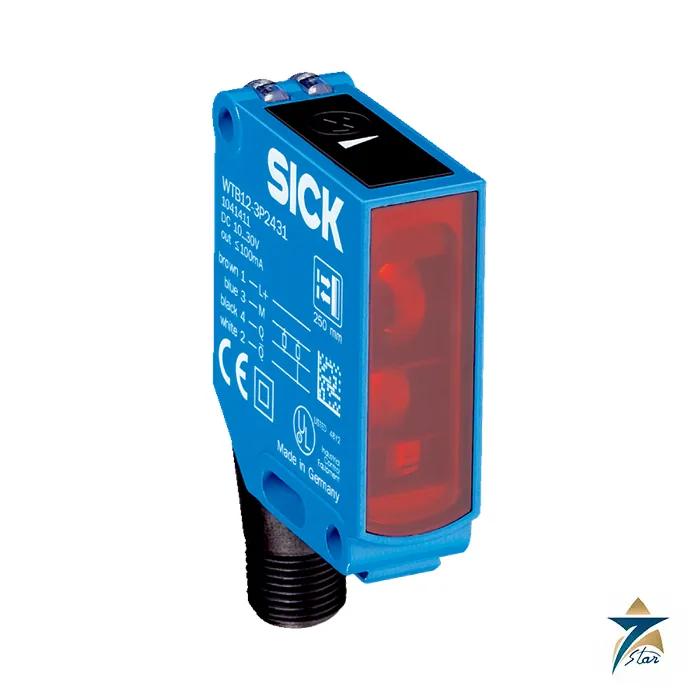
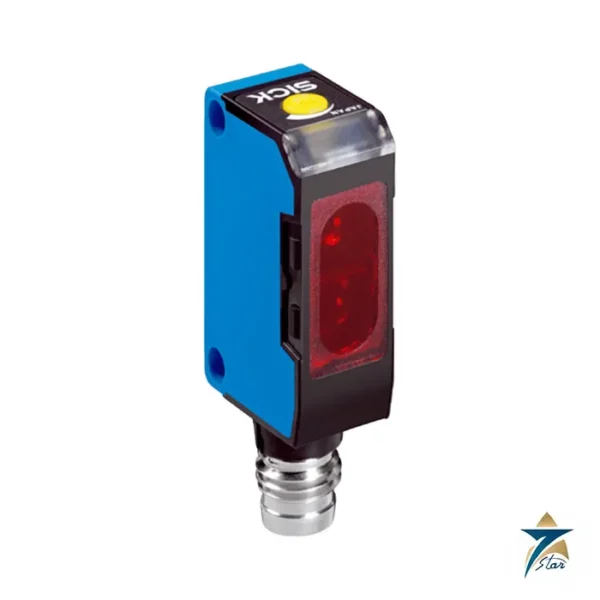
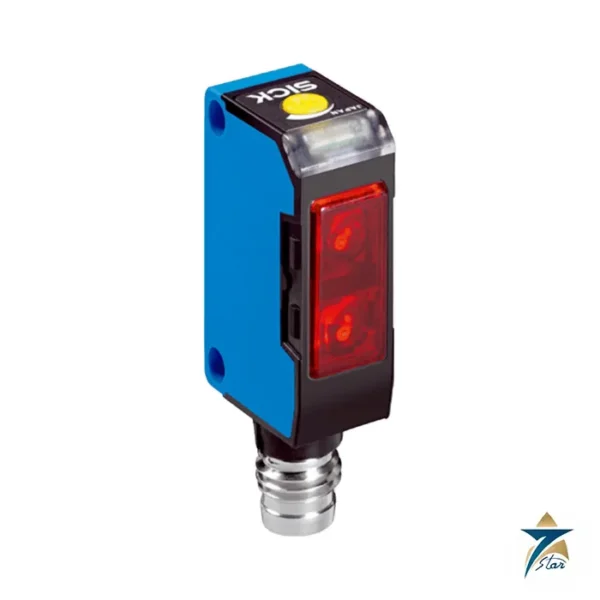
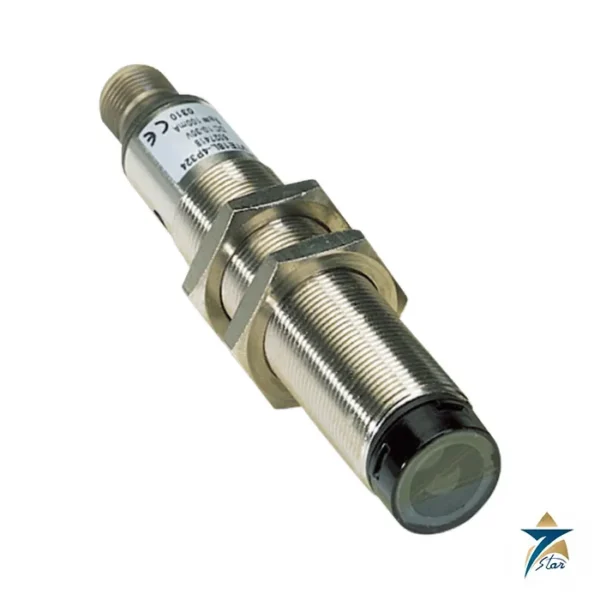
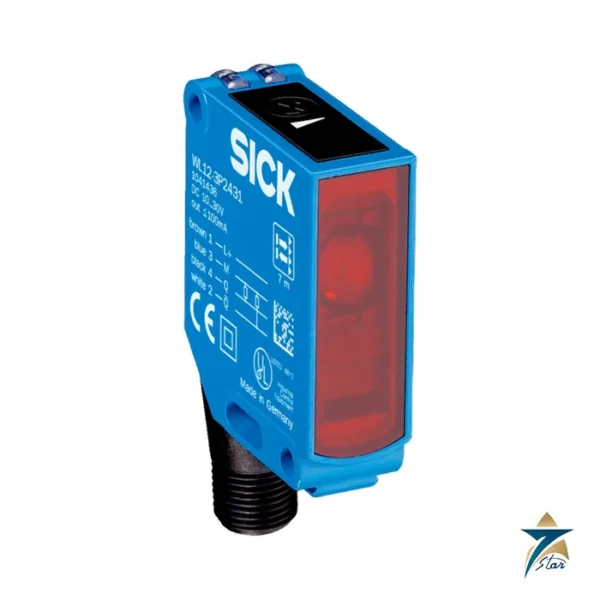
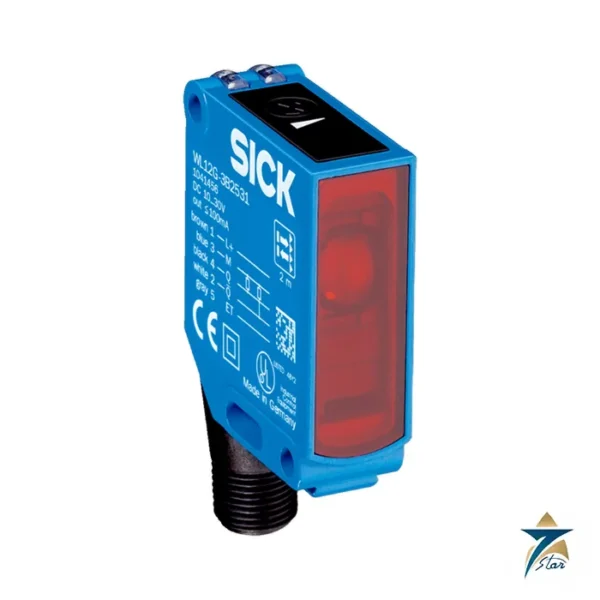
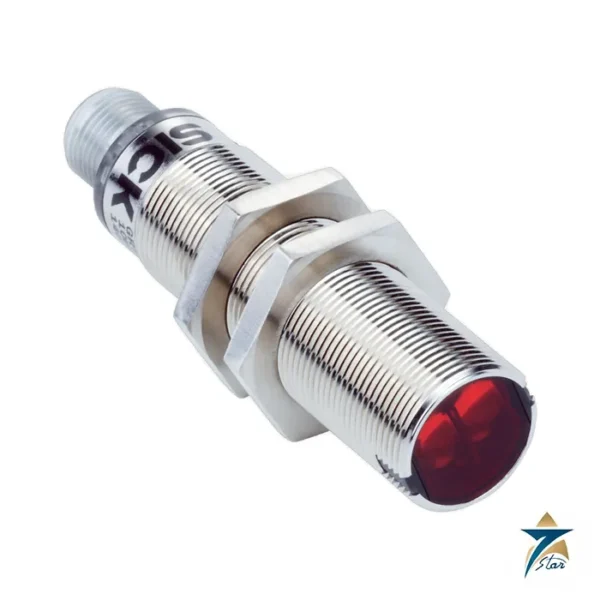
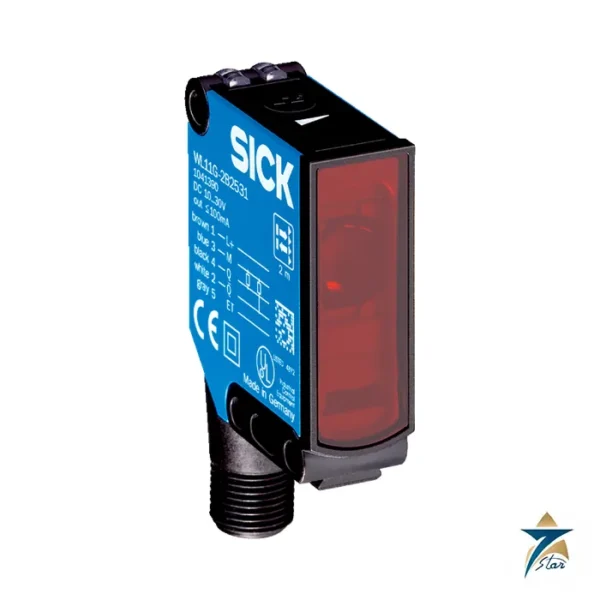
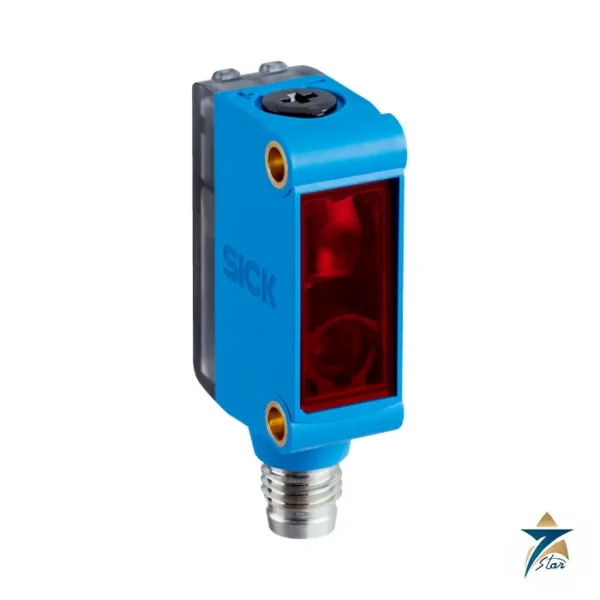
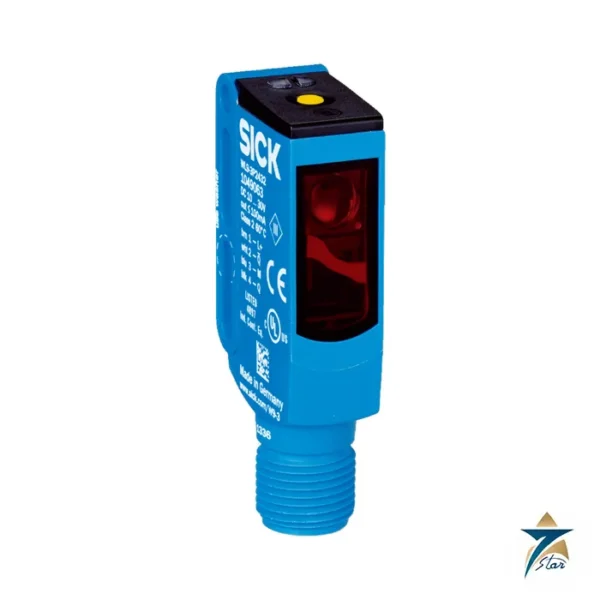
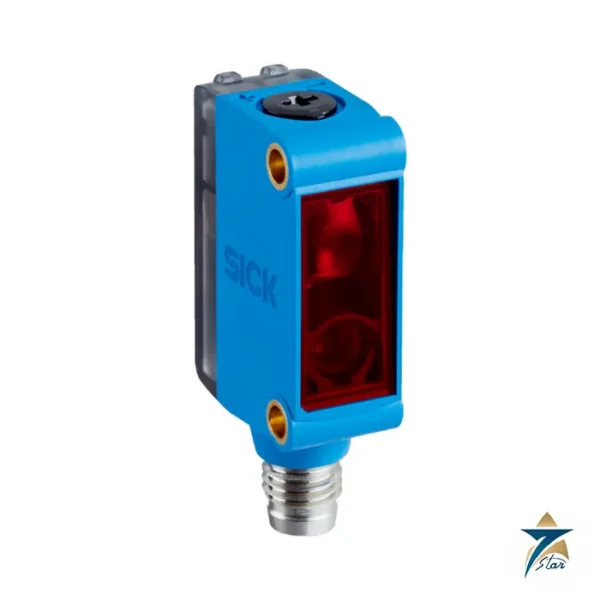
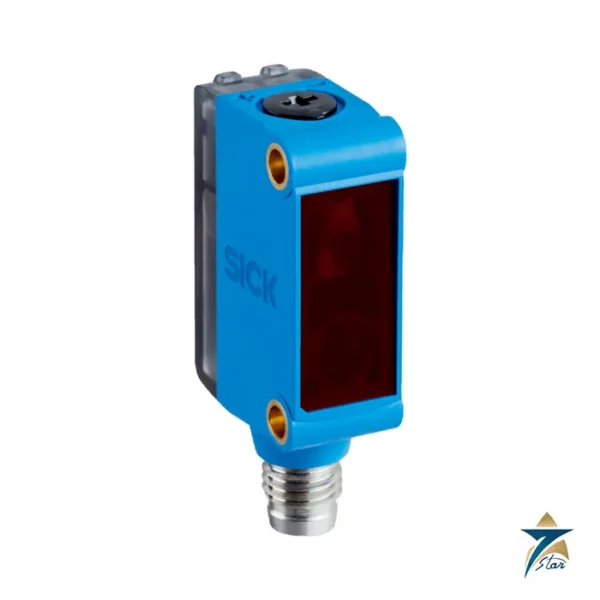
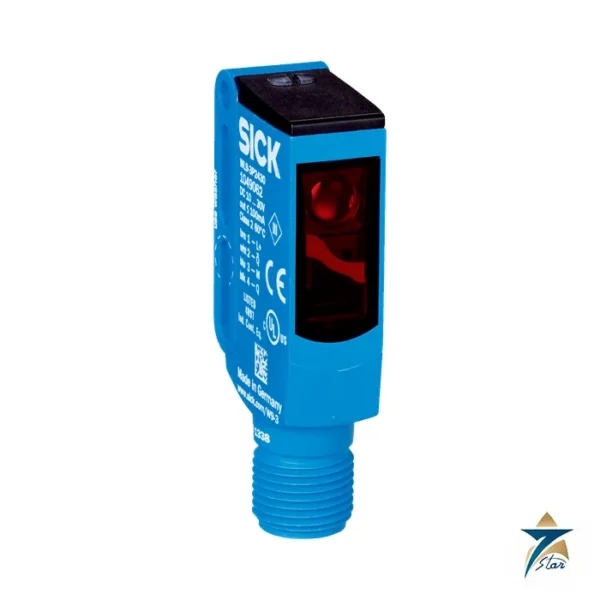
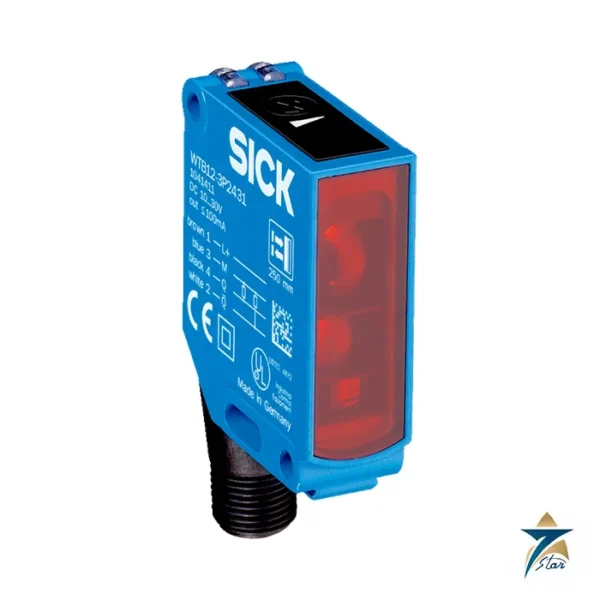
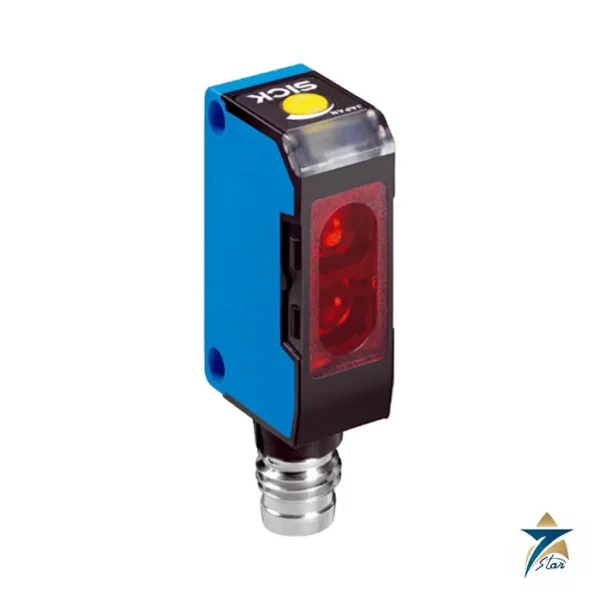
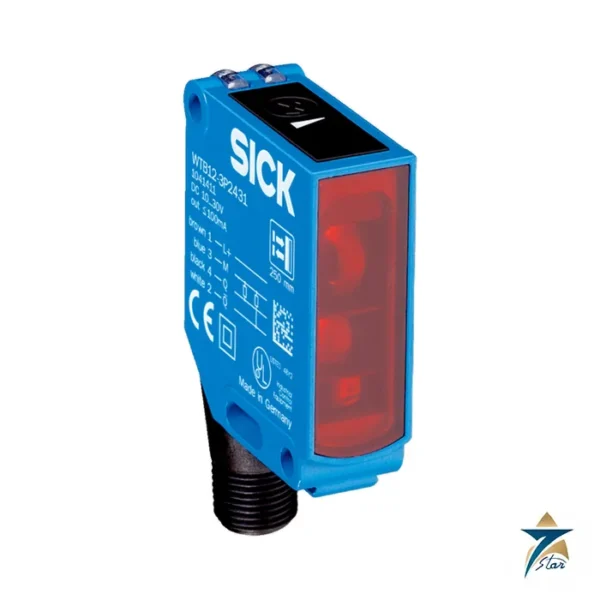
The WTB12-3P2411 (SICK part no. 1041422) detects objects against a cluttered background. It belongs to the W12 photoelectric family and uses background suppression, so the cut-off distance, not the brightness of the background, decides whether it switches. The data sheet gives a maximum sensing range of 20 mm … 600 mm. The switching output is PNP with light/dark switching, the supply is 10 V DC … 30 V DC and the connection is Male connector M12, 4-pin.
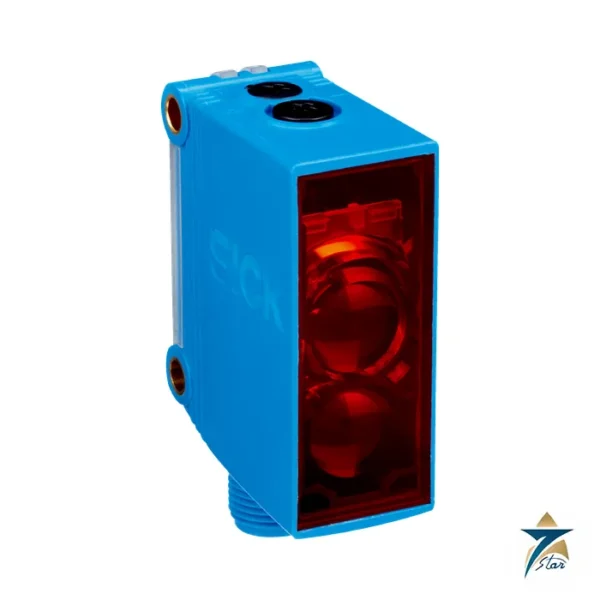
Background suppression on the W12 housing
Because the decision is geometric rather than energy-based, target colour and gloss matter far less than with a plain diffuse proximity sensor, although very shiny or strongly angled surfaces still deserve a trial on the real part. Typical jobs are presence checks on conveyors, pallet and carton detection, end-of-travel monitoring and counting products that pass a fixed point.
Light comes from a LED emitting infrared light with a spot of 15 mm x 15 mm (200 mm). Adjustment: potentiometer, 5 turns. Response time ≤ 330 µs.
Technical specifications
| Parameter |
Specification |
| Type code |
WTB12-3P2411 |
| Part number |
1041422 |
| EAN |
4047084140969 |
| Product family |
W12 |
| Functional principle |
Photoelectric proximity sensor |
| Functional principle detail |
Background suppression |
| Sensing range max. |
20 mm … 600 mm |
| Sensing range |
20 mm … 600 mm |
| Emitted beam: Light source |
LED |
| Emitted beam: Type of light |
Infrared light |
| Emitted beam: Light spot size (distance) |
15 mm x 15 mm (200 mm) |
| Key LED figures: Wave length |
850 nm |
| Adjustment |
Potentiometer, 5 turns |
| Items supplied |
2 x clamps BEF-KH-W12, incl. screws |
| MTTFD |
533 years |
| DCavg |
0 % |
| TM (mission time) |
20 years |
| Supply voltage UB |
10 V DC … 30 V DC |
| Ripple |
< 5 Vpp |
| Current consumption |
55 mA |
| Protection class |
III |
| Digital output: Type |
PNP |
| Digital output: Switching mode |
Light/dark switching |
| Digital output: Signal voltage PNP HIGH/LOW |
> Uv – 2,5 V / ca. 0 V |
| Digital output: Output current Imax. |
≤ 100 mA |
| Digital output: Response time |
≤ 330 µs |
| Digital output: Switching frequency |
1,500 Hz |
| Output function |
Complementary |
| Circuit protection |
A ; C ; D |
| Housing |
Rectangular |
| Dimensions (W x H x D) |
15.6 mm x 48.5 mm x 42 mm |
| Connection |
Male connector M12, 4-pin |
| Material: Housing |
Metal |
| Material: Front screen |
Plastic, PMMA |
| Weight |
120 g |
| Enclosure rating |
IP66; IP67; IP69K |
| Ambient operating temperature |
–40 °C … +60 °C |
| Ambient temperature, storage |
–40 °C … +75 °C |
| Declarations and certificates in the data sheet |
EU declaration of conformity; UK declaration of conformity; ACMA declaration of conformity; Moroccan declaration of conformity; China RoHS; China Compulsory Product Certification (CCC) exempt; ECOLAB certificate; cULus certificate; Photobiological safety (DIN EN 62471) certificate |
Type code WTB12-3P2411 and part number 1041422
When you order from a type code, ask which variant is meant: the prefix WTB12 covers several versions, and an S-suffix, where present, marks a factory-specific option. The part number 1041422 removes the doubt because it belongs to exactly one version in SICK’s catalogue.
Related catalogue entries in the same family, each ordered under a different number:
- WTB12-3P2413 (part no. 1041423) – Enclosure rating: IP66
- WTB12-3P2441 (part no. 1041421)
- WTB12-3P2411T01 (part no. 1041425)
- WTB12-3P2441S59 (part no. 1056725)
- WTB12-3P2441S50 (part no. 1044106)
Mounting, wiring and set-up notes for WTB12-3P2411
Wire it to a supply of 10 V DC … 30 V DC. Protection is IP66; IP67; IP69K, and the permitted ambient range in operation is –40 °C … +60 °C. The body measures 15.6 mm x 48.5 mm x 42 mm and weighs 120 g. Current draw is 55 mA. Supplied with it: 2 x clamps BEF-KH-W12, incl. screws. Use a sensor cable with the correct pin count and check the pin assignment in the data sheet before connecting, because colours alone are not a reliable guide between manufacturers.
Choosing the right position and target for the WTB12-3P2411
Background suppression works best when there is a clear distance between the object to be detected and whatever lies behind it. Before fixing the bracket, measure the distance from the sensor face to the target and to the background, and make sure the target sits well inside the sensing range while the background stays clearly beyond the switching point. Try the sensor on real production parts, including the darkest, the brightest and the most reflective items that pass the line, because a set-up that only works on one sample often causes nuisance stops later.
Aim the light spot so that it falls fully on the target rather than on an edge. On conveyors, mount the sensor so that products cannot strike the housing if they jam or tip over, and avoid pointing it directly at another photoelectric sensor or at strong reflective surfaces such as polished guards.
Commissioning and adjustment
Power the sensor, place a representative target at the working distance and turn the potentiometer slowly until the output switches reliably. Then remove the target and confirm that the background does not trigger the output. Repeat with a few different targets and settle on a setting that leaves margin in both directions. Check in the PLC that the signal arrives with the expected logic and that light or dark switching has been wired as intended, then note the final setting on the commissioning sheet so a replacement unit can be adjusted the same way.
Use in Oman and GCC plant conditions
Heat, dust and washdown are the usual concerns in Gulf food, packaging and logistics plants. The operating range given above runs up to +60 °C, so check the real temperature at the mounting point, especially near ovens, sealers or on equipment in direct sun inside open loading bays. Fine dust settling on the front screen reduces the light returned from the target and can make detection less stable over time, so include the sensor in the routine cleaning plan. Where hoses are used for cleaning, the listed enclosure ratings help, but the M12 cable connection should still be fitted correctly and the cable routed so that water runs away from the connector.
Routine maintenance
Wipe the front screen with a soft cloth and a cleaning agent that is compatible with PMMA, check that the clamps are still tight after vibration, and inspect the cable for cuts or crushing where it passes moving parts. If detection becomes unreliable, check alignment and cleanliness first before changing the potentiometer setting.
Documents and quotation
The SICK data sheet for WTB12-3P2411 (part no. 1041422) is attached to this page as a PDF, exactly as SICK publishes it, so you can check it against your wiring and mounting drawings. To request a price, give us the part number, the quantity and where the goods should go, using the RFQ form. Related items are listed under Sensors & Transmitters. Confirm before ordering that the version matches your installation: connection, output type and ratings. The data sheet prevails over this summary.


Reviews
There are no reviews yet.