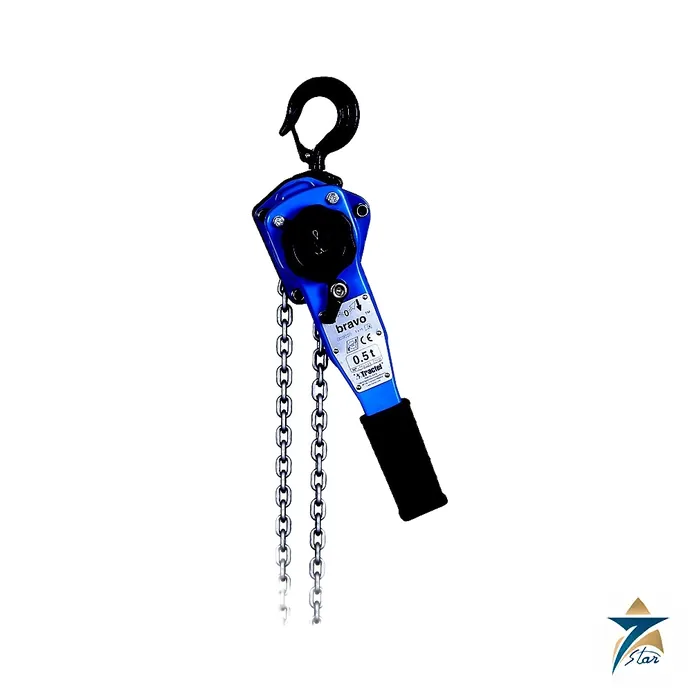
The Tractel Bravo desync is a compact manual lever chain hoist for lifting, towing and tensioning. Its distinguishing feature is the Double Click system: two unsynchronised clicks per cycle that, according to the technical sheet, guarantee the reliability of lifting, towing and tensioning operations against the risk of veering. The manufacturer specifically recommends it for tensioning steel ropes. Capacities run from 0.25 t to 9 t, and the hoist is light enough for riggers to carry to the point of use and operate in confined positions.
Double Click and where it helps
The manufacturer describes a patented desynchronised two-click cycle that enhances grip security and reduces the risk of unintentional load release, particularly when tensioning steel ropes. Other features listed are low handle effort, minimal hook clearance and a coated load chain. The hooks rotate through 360 degrees, carry the WLL marking and are fitted with removable safety latches. The hoist is designed to withstand dynamic testing at 1.1 times and static testing at 1.5 times the WLL, with a minimum mechanical strength of four times the WLL. The 0.25 t size does not use the Double Click system.
Technical specifications
| Parameter |
Specification |
| Product |
Bravo desync manual lever chain hoist |
| Capacity range |
0.25, 0.5, 0.75, 1, 1.5, 3, 6 and 9 t |
| Standard lifting height |
1.5 m; other heights 3, 4.5 and 6 m for 0.5 t to 9 t; 6 m for 0.25 t |
| Mechanism |
Desynchronised double click (two unsynchronised clicks) double brake system; not on the 0.25 t model |
| Load chain |
Coated |
| Hooks |
360 degree rotating, WLL marked, removable safety latches |
| Testing basis |
Dynamic test 1.1 x WLL, static test 1.5 x WLL, minimum strength 4 x WLL |
| Standards |
Machinery Directive 2006/42/EC; EN 13157 + A1:2009 on the product page |
| Option |
Dynamic load limiter on 0.5 t to 9 t |
| Technical sheet |
T-2433 GB revision 02, 06/2020 |
Capacity and size table
Values come from the technical sheet T-2433. The sheet states that lifting height beyond the standard adds weight per metre, shown in the last column.
| WLL (t) |
Min. distance between hooks (mm) |
Handle force at WLL (daN) |
Chain (mm) |
Falls |
Net weight (kg) |
Added weight per m lift (kg) |
| 0.25 |
230 |
28 |
4 x 12 |
1 |
2.1 |
0.35 |
| 0.5 |
305 |
50 |
5 x 15 |
1 |
5.0 |
0.56 |
| 0.75 |
315 |
30 |
5 x 15 |
2 |
7.0 |
0.80 |
| 1 |
320 |
37 |
6 x 18 |
1 |
7.3 |
0.80 |
| 1.5 |
365 |
47 |
7 x 21 |
1 |
11.5 |
1.08 |
| 3 |
480 |
45 |
7 x 21 |
2 |
21.4 |
2.23 |
| 6 |
610 |
47 |
10 x 30 |
2 |
30.2 |
4.46 |
| 9 |
800 |
48 |
10 x 30 |
3 |
56.1 |
6.69 |
Using a lever hoist safely and what to confirm
A lever hoist is for pulling or lifting along the line of the chain only, and the handle must not be extended with a pipe or other lever. Choose the WLL from the load including slings and shackles, and check the minimum distance between hooks against the available headroom. Choose a lifting height that gives margin at both ends, because a very long chain adds weight and slack. For tensioning ropes or for use where a load limiter is wanted, specify the dynamic load limiter, which is available on 0.5 t and above. Before ordering, confirm the WLL, lifting height, limiter option, marking requirement and the standard required by your project. The manufacturer publishes a manual, a declaration of conformity and a certificate for the range, and users should inspect the chain, hooks, latches and brake before every use.
Picking the right Bravo desync size
Start from the heaviest load the hoist will ever see, including slings, shackles and any spreader, and choose the next WLL up from the eight sizes between 0.25 t and 9 t. Then check two dimensions against the job. The minimum distance between hooks tells you how much headroom the hoist itself consumes, which ranges from 230 mm on the smallest size to 800 mm on the 9 t unit; in a cramped pipe rack or under a beam this can decide which size fits. The handle force at WLL, roughly 28 to 50 daN depending on size, tells you how much effort one rigger must apply, which matters for long pulls in awkward positions.
Weight is the third consideration. The net weight climbs from 2.1 kg to 56.1 kg across the range, and each extra metre of lifting height adds the figure in the last column of the table. For a hoist that must be carried up ladders or scaffolding, it often pays to specify only the lift actually needed rather than the longest option.
Tensioning versus lifting
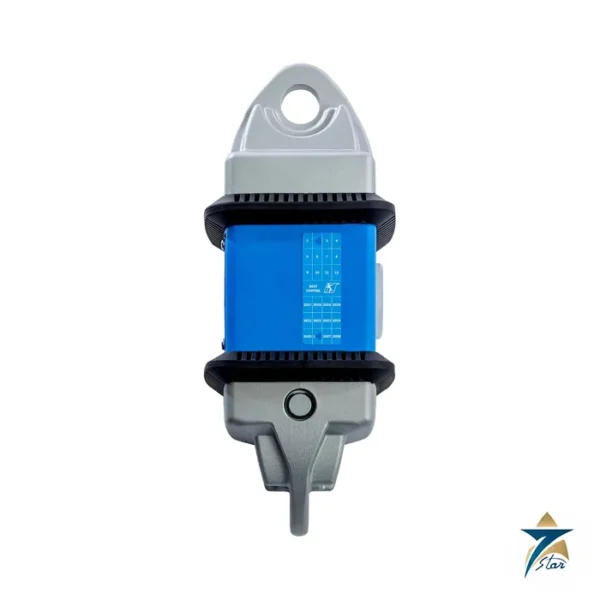
For pulling cables, stays or steel ropes tight, the Double Click mechanism is the reason to choose this hoist, so avoid the 0.25 t size, which does not have it. Where there is a risk of over-tensioning a rope or overloading an anchor, add the dynamic load limiter option, available from 0.5 t upward.
Rigging and first use on site
- Attach the top hook to an anchor point rated for the load, with the hook latch closed and the load seated in the bowl of the hook, not on the tip.
- Keep the chain straight between the hooks with no twists, knots or kinks, and never wrap the load chain around the load.
- Operate the handle by hand only, through its normal stroke, and stop if the effort rises unexpectedly.
- Before releasing tension, make sure everyone is clear of the line of pull.
Inspection and care between jobs
Pre-use checks are the operator’s job: look for stretched or worn chain links, hooks that have opened or twisted, missing or bent latches, and a brake that does not hold. Any hoist that fails these checks should be tagged out and returned for examination by a competent person. Between jobs, store the hoist dry, hung up rather than dropped in a toolbox, and keep the chain lightly lubricated according to the Tractel manual so the coating and links are not left exposed.
Working with lever hoists in Gulf conditions
On construction sites, oil and gas facilities and ports in Oman, lever hoists are exposed to blowing sand, high humidity and salty air. Sand in the chain and brake area causes wear and erratic engagement, so wipe the chain after use in dusty areas and keep the hoist in a closed case when moving between locations. At coastal sites, check the chain and hooks for corrosion more often than you would inland. Metal parts left in direct summer sun can also become too hot to handle comfortably, so keep spare hoists shaded and provide riggers with gloves.
Documents and quotation
The Bravo technical sheet is attached. Seven Star LLC is an independent supplier. To request a quotation, please send the load, the lifting height and whether a load limiter is needed. See also Material Handling and Lifting Equipment.



Reviews
There are no reviews yet.