- Automation & ControlView all 1,732 products
- AC Drives
- Industrial Communications
- PLC & I/O Cards
- Vibration Monitoring
- Automation Accessories
- Controllers & Data Acquisition
- CCTV & Security
- Safety Switches & Guard Locking
- Isolator & Barrier
- Encoders
- Industrial Computers
- Servo Drives
- Motor Soft Starters
- HMI Displays
- Pneumatic Cylinders
- Automation Software
- Machine Vision
- Robotics
















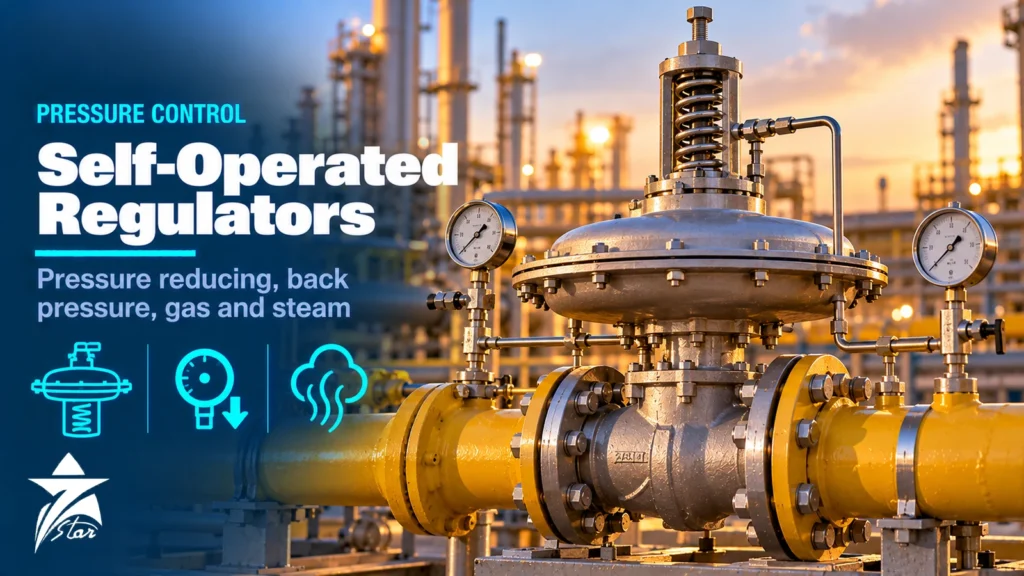
Not every pressure control loop needs a transmitter, a controller and a control valve with an actuator. Across steam distribution, fuel gas to burners and heaters, nitrogen blanketing, water systems and utility air, a self-operated pressure regulator does the job using only the energy of the process fluid. It is simple and reliable when it is selected properly, and frustrating when it is not: outlet pressure that sags at full load, hunting at low flow, or a regulator that will not shut off tight. This guide explains how pressure reducing and back pressure regulators work, what droop and lockup mean, how direct-operated and pilot-operated designs compare, and how to size and install regulators for gas and steam service.
How a Self-Operated Pressure Regulator Works
Every self-operated regulator combines three elements in one assembly:
- Restricting element: the valve plug or disc and seat that throttle the flow.
- Measuring element: usually a diaphragm, sometimes a piston or bellows, that senses the controlled pressure.
- Loading element: a spring, weight, gas dome or pilot that applies the set-point force against the measuring element.
The regulator moves until the force from the controlled pressure on the diaphragm balances the loading force. If the controlled pressure moves away from set point, the force balance shifts and the plug moves to correct it. No external power or signal is needed, which is why self-operated regulators are used in remote locations, as backup to instrumented loops and wherever a simple, fixed set point is sufficient.
Pressure Reducing vs Back Pressure Regulators
The two families look similar but control opposite sides of the valve:
- Pressure reducing regulator: controls the downstream (outlet) pressure. When outlet pressure falls because demand rises, the regulator opens; when outlet pressure rises, it closes. Typical uses are steam pressure reduction, fuel gas supply to burners and engines, water pressure reduction and tank blanketing.
- Back pressure regulator: controls the upstream (inlet) pressure. When inlet pressure rises above set point, it opens to pass more flow; when inlet pressure falls, it closes. Typical uses are holding pressure on separators and vessels, maintaining pump minimum pressure, controlling tank vapour pressure and protecting upstream equipment from pressure loss.
A back pressure regulator resembles a relief valve in action, but it is a control device, not a safety device. Overpressure protection must still be provided by a certified pressure relief valve; see our pressure relief valve guide for sizing and testing basics.
Direct-Operated vs Pilot-Operated Regulators
In a direct-operated regulator, the main diaphragm and spring move the valve plug directly. In a pilot-operated regulator, a small pilot regulator senses the controlled pressure and adjusts the loading pressure on a larger main valve, amplifying small pressure changes into large plug movements. The differences are significant:
| Feature | Direct-operated | Pilot-operated |
|---|---|---|
| Control accuracy | Moderate; outlet pressure droops with flow | High; small droop over the flow range |
| Capacity | Low to medium for a given size | High for a given size |
| Response speed | Fast | Slightly slower, depends on pilot and restrictor |
| Complexity | Simple, few parts | More parts, small passages to keep clean |
| Sensitivity to dirt | Low | Higher (pilot orifices, restrictors) |
| Typical uses | Small loads, utilities, instrument gas, simple steam stations | Large steam stations, gas distribution, burners with wide load range |
| Sensing | Usually internal, sometimes external | Usually external sensing line |
Droop, Accuracy and Lockup
Three performance terms decide whether a regulator suits the process.
Droop (offset or proportional band): in a spring-loaded regulator, the plug must open further to pass more flow. As it opens, the spring extends and its force falls, so the outlet pressure that balances the spring also falls. Outlet pressure is therefore highest at low flow and lowest at maximum flow. Droop is larger with smaller diaphragms, stiffer springs and wide flow ranges; pilot operation, larger diaphragms and softer springs reduce it. The manufacturer’s flow curves show the droop at your flow rate and set point.
Lockup: when demand stops, the plug must close fully and seal. To generate the seating force, the outlet pressure rises slightly above set point. The lockup pressure has to stay below the setting of downstream relief devices and the rating of downstream equipment.
Accuracy and lockup classes for gas: EN 334, which covers gas pressure regulators for inlet pressures up to 100 bar, defines accuracy classes (AC) and lockup pressure classes (SG). A lower number means tighter control. For example, a regulator marked AC 5 holds outlet pressure within ±5% of set point across its stated operating range, and SG 10 means lockup pressure stays within 10% above set point. Confirm the classes for the specific model, set point range and inlet pressure on the manufacturer’s data.
Sizing a Pressure Regulator
Regulators are sized by flow capacity at the actual inlet pressure, outlet pressure and fluid conditions – never by line size alone. Collect the following before sizing:
- Fluid and its properties: gas composition or specific gravity, steam condition (saturated or superheated), liquid density and viscosity
- Minimum, normal and maximum inlet pressure
- Required outlet pressure (or inlet pressure for back pressure regulators) and acceptable droop
- Minimum, normal and maximum flow rate
- Operating and design temperature
- Lockup limit and downstream relief valve set pressure
- Required shut-off class and any accuracy or lockup class requirement
Check the regulator’s capacity at minimum inlet pressure and maximum flow, which is usually the worst case. For gases, if the pressure ratio is high enough for flow to become critical (choked), capacity no longer rises as outlet pressure falls; the manufacturer’s sizing method accounts for this. Avoid oversizing: a regulator that runs at very small lift on normal flow wire-draws its seat, hunts and fails to lock up cleanly. For very wide flow ranges, two regulators in parallel with staggered set points – one small for low loads and one large for peak loads – often perform better than one large valve. For very large pressure ratios, two-stage reduction in series reduces noise, wear and outlet pressure variation.
Steam Pressure Reducing Stations
Steam pressure reduction is one of the most common applications, and the station around the regulator matters as much as the valve itself. A typical arrangement includes:
- Upstream isolation valve, separator and steam trap to remove condensate and carry-over, protecting the regulator seat from wet steam erosion.
- Strainer immediately before the regulator.
- The pressure reducing regulator, with pressure gauges upstream and downstream.
- Downstream piping enlarged to suit the higher specific volume of low-pressure steam and keep velocity reasonable.
- A downstream safety valve sized for the full flow the regulator could pass if it failed wide open, unless the downstream system is rated for full upstream pressure.
- Downstream isolation valve and, where used, a manual bypass with a globe valve, which the safety valve must also cover.
For regulators with external sensing, connect the sensing line to a straight section of downstream pipe as the manufacturer specifies, away from elbows, reducers and valves where velocity effects distort the reading. On steam, the sensing line typically includes a water seal or condensate pot so that condensate, not live steam, reaches the diaphragm. For hygienic and pharmaceutical service, clean steam regulators with polished stainless steel bodies and suitable diaphragm materials are used.
Gas Regulators and Overpressure Protection
For natural gas and fuel gas, regulator failure must not over-pressurise burners, gas trains or engines. Gas pressure reducing stations commonly combine the active regulator with one or more of the following: a monitor regulator in series that takes over if the active regulator fails open, a slam-shut safety device that closes on overpressure (and sometimes underpressure), and a token relief valve that vents small lockup leakage. Gas regulator vents and relief outlets must be piped to a safe location, and the station must be designed for the area classification around it.
Common Mistakes
- Sizing to line size and ending up with a regulator that hunts at normal flow.
- Choosing a spring range where the set point sits at the extreme end; mid-range set points give better control.
- Taking the sensing line from a turbulent location or omitting the water seal on steam.
- Relying on a regulator for tight isolation; use a dedicated isolation valve.
- Omitting downstream relief or sizing it for normal flow instead of regulator failure.
- Ignoring droop: specifying a direct-operated regulator where the process needs tight pressure across a wide load range.
Maintenance and Troubleshooting
- Outlet pressure too low at high flow: regulator undersized, excessive droop, blocked strainer or low inlet pressure.
- Outlet pressure creeping up with no flow: seat leakage from debris or wear, or a damaged soft seat; check lockup.
- Hunting or cycling: oversized regulator, sensing line in a poor location, or pilot restrictor incorrectly set.
- Leakage from the spring case vent: diaphragm failure; replace the diaphragm and check its temperature and chemical rating.
- Erratic response on steam: wet steam, missing separator or trap upstream, or air in the sensing line.
Accurate test gauges and transmitters from our pressure instrumentation range make it easier to check set point, droop and lockup during routine maintenance.
GCC Considerations
Outdoor regulators on Gulf sites see high ambient and solar heating, which affects elastomer diaphragms and soft seats; check temperature ratings against the real metal temperature. Dust can block spring case vents, so fit vent protection that does not trap water or insects. Fuel gas on many Omani and GCC facilities contains H2S, which requires materials and elastomers compatible with sour service under NACE MR0175 / ISO 15156. In desalination and utility plants, water pressure reducing valves need body and trim materials compatible with the specific water chemistry.
Regulator Specification Checklist
- Function: pressure reducing or back pressure
- Design: direct-operated or pilot-operated; internal or external sensing
- Fluid properties and full range of pressures, flows and temperatures
- Spring range with set point in mid-range
- Acceptable droop, accuracy and lockup, with EN 334 classes for gas where required
- Body, trim, diaphragm and seat materials, including sour service
- Shut-off class and end connections
- Overpressure protection: relief valve, monitor or slam-shut
- Station components: strainer, separator, trap, gauges, isolation and bypass
Pressure Regulators We Supply
These examples cover direct-operated, pilot-operated, back pressure and instrument supply regulators.
| Product | Type | Where it fits |
|---|---|---|
| Masoneilan 172 Series Pressure Reducing Regulator (PCV 172-1203) | Pressure reducing regulator | Steam, gas and liquid pressure reduction. |
| Fisher 1098-EGR Pressure Reducing Regulator | Pilot-operated pressure reducing regulator | Gas supply where accuracy and capacity are both needed. |
| Spirax Sarco DP27 Pilot-Operated Pressure Reducing Valve | Pilot-operated pressure reducing valve | Steam pressure reduction. |
| Masoneilan 173 Series Self-Contained Back Pressure Regulator | Back pressure regulator | Holding upstream pressure in process systems. |
| Fisher 67C Series Instrument Supply Regulator | Instrument supply regulator | Supplying positioners and pneumatic instruments. |
| Swagelok KPR Series Regulator | Instrument pressure regulator | Analyser and sampling systems. |
Send the fluid, inlet and outlet pressures, flow rate, temperature and connections through our quote request form.
Sourcing Pressure Regulators Through Seven Star LLC
Seven Star LLC supplies self-operated pressure regulators for gas, steam, air and liquid service on request, together with safety relief valves and station components from established manufacturers. We help with selection and cross-checking part numbers, spring ranges and trim codes on existing regulators. Availability and lead time are confirmed at quotation.
Send us the regulator nameplate, datasheet or RFQ with fluid, inlet and outlet pressures and flow range, and we will prepare a matched quotation.
Frequently asked questions
What is droop in a pressure regulator?
Droop is the fall in controlled pressure as flow increases. In a spring-loaded regulator, the spring extends as the valve opens, reducing its force, so the balancing outlet pressure drops. Pilot-operated designs and larger diaphragms reduce droop.
What is the difference between a pressure reducing regulator and a back pressure regulator?
A pressure reducing regulator controls the downstream pressure and opens when outlet pressure falls. A back pressure regulator controls the upstream pressure and opens when inlet pressure rises above set point.
Can a back pressure regulator replace a pressure relief valve?
No. A back pressure regulator is a control device and is not certified as an overpressure protection device. Pressure relief valves sized and set to the applicable code must still be installed where overpressure protection is required.
What do AC and SG mean on a gas regulator?
Under EN 334, AC is the accuracy class, describing how closely outlet pressure is held around set point, and SG is the lockup pressure class, describing how far outlet pressure may rise above set point when flow stops. Lower numbers indicate tighter performance.
Why does a steam pressure reducing valve need a separator and trap upstream?
Wet steam carries condensate droplets that erode the regulator seat and plug at high velocity. A separator and steam trap upstream remove the condensate, protecting the valve and improving control stability.
When should two regulators be used instead of one?
Use two regulators in parallel with staggered set points when the flow range is very wide, so a small valve handles low loads and a larger one opens at peak demand. Use two in series when the pressure reduction ratio is very large, to reduce noise, wear and outlet pressure variation.
Was this guide helpful?One click helps us write better guides for engineers.
Thank you! Glad it helped. Need this equipment for your project? Request a quotation
Thank you. We will use this to improve the guide.