White-faced PTFE sandwich sheet for worn and glass-lined flanges
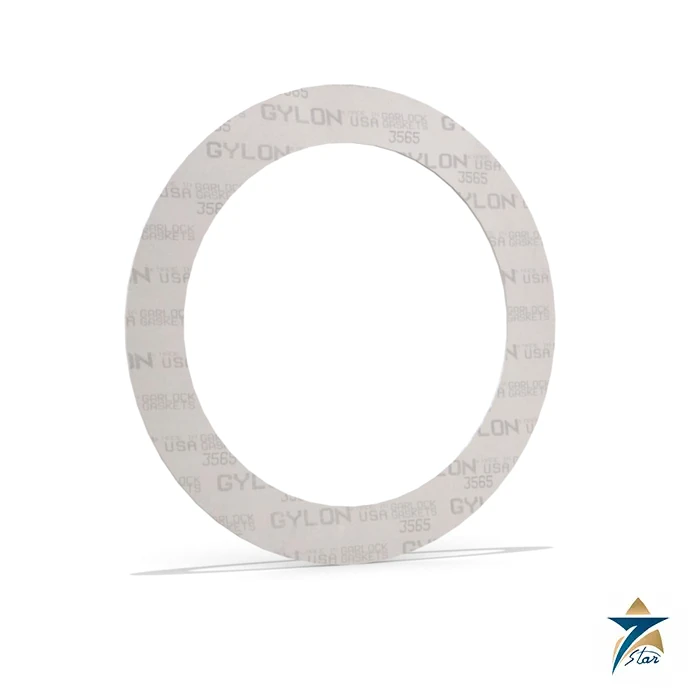
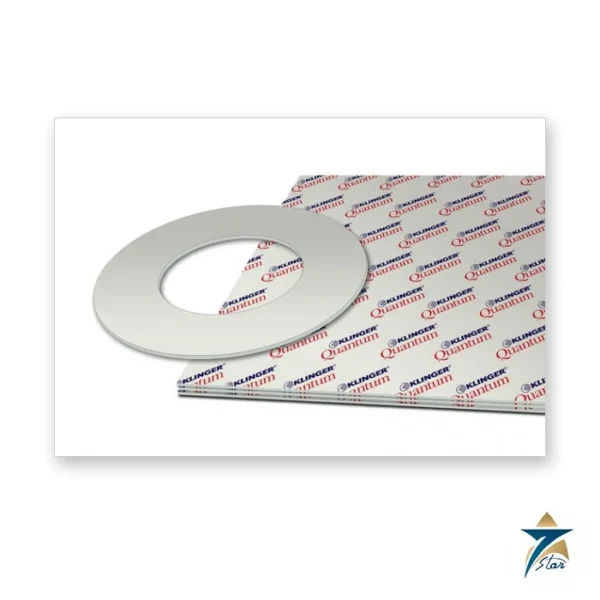
GYLON Style 3565 ENVELON is a layered PTFE sheet with a soft white exterior and a stable blue core. Garlock says the soft, durable exterior conforms to surface irregularities and suits worn, warped or pitted flanges, while the stable core improves cold-flow resistance.
The layers are sintered directly together, which prevents leak paths and adhesive contamination, and low bolt-load requirements give a tight seal on glass-lined or wavy flanges. Garlock presents it as an ideal replacement for slit, milled, formed-shield and double-jacketed envelope gaskets, which are prone to foldover during installation, and says custom gaskets can be cut from large sheets to reduce inventory.
Technical specifications
| Parameter |
Specification |
| Manufacturer / style |
Garlock, GYLON Style 3565 ENVELON |
| Composition |
PTFE with aluminosilicate microspheres |
| Colour |
White exterior and blue interior |
| Fluid services |
Moderate concentrations of acids, some caustics, hydrocarbons, solvents, hydrogen peroxide, refrigerants and cryogenics |
| Temperature, minimum / ideal operating limit / maximum |
-450 °F (-268 °C) / 400 °F (204 °C) / 500 °F (260 °C) |
| Pressure, minimum / ideal operating limit / maximum |
Full vacuum / 750 psig (52 bar) / 1200 psig (83 bar) |
| P x T maximum |
350,000 psig x °F (12,000 bar x °C) for 1/32 and 1/16 in; 250,000 (8,600) for 1/8 in |
| Specifications printed |
FDA 21 CFR 177.1550; will not support flame or bacterial growth |
| Compressibility, ASTM F36 |
30 to 50 % (1/16 in test material) |
| Recovery, ASTM F36 |
35 % (1/16 in) |
| Creep relaxation, ASTM F38 |
35 % (1/16 in) |
| Tensile strength across grain |
1800 psi (12.4 N/mm2) (1/16 in) |
| Specific gravity / density |
1.65 |
| Design factors, ASTM F586 (m; y) |
1/16 in and under: m 2.8, y 1400 psi (9.6 N/mm2); 1/8 in: m 3.7, y 2300 psi (15.9 N/mm2) |
| Sealing characteristics |
ASTM F37B Fuel A 1000 psi: 0.33 ml/hr; DIN 3535 nitrogen 4640 psi, 580 psig: less than 0.015 cc/min (results on 1/16 in material) |
| Catalogue example on garlock.com |
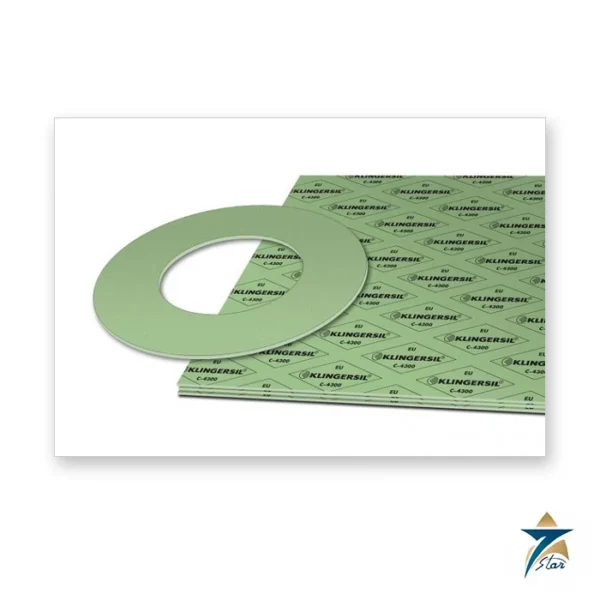
0.063 in x 60 x 60 in sheet (1.6 x 1524 x 1524 mm), white, branded |
Values are the typical properties printed in the Garlock spec sheet (August 2023). Garlock marks them as a general guide.
Using ENVELON where envelope gaskets are in service today
The media listed are hydrocarbons, solvents, moderate concentrations of acids and caustics, cryogenics, hydrogen peroxide and refrigerants, plus glass-lined equipment. The datasheet figures are marked as based on 1/16 in material: compressibility 30 to 50 %, recovery 35 %, creep relaxation 35 %, tensile strength 1800 psi (12.4 N/mm2) and specific gravity 1.65.
Design factors are m 2.8 and y 1400 psi (9.6 N/mm2) up to 1/16 in, rising to m 3.7 and y 2300 psi (15.9 N/mm2) at 1/8 in. The datasheet marks ROTT gasket constants as not available and leakage as 0.33 ml/hr in the Fuel A test, so allow for a slightly higher leak rate than the solid GYLON styles. Pressure is printed up to 1200 psig (83 bar) with 750 psig ideal.
Related Garlock gasket sheets
Garlock’s other conforming PTFE sheets are compared with ENVELON below.
| Garlock style |
Composition |
Colour |
Media and use printed by Garlock |
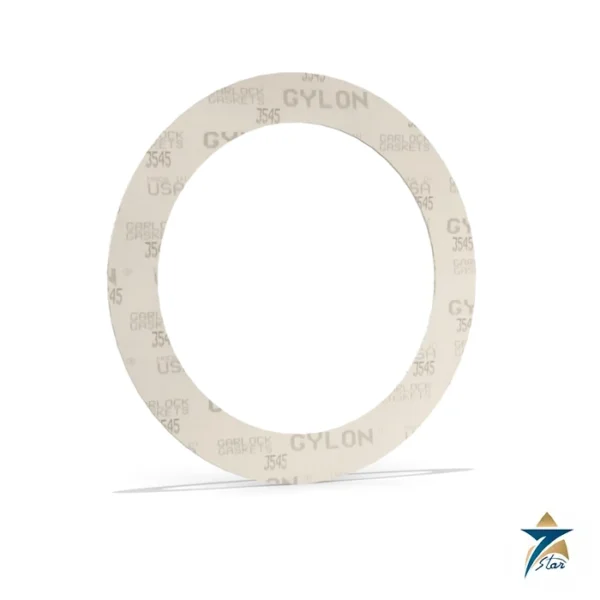
| GYLON Style 3545 |
Microcellular PTFE with rigid PTFE core |
White |
Low bolt load and glass-lined equipment, strong acids and caustics, hydrocarbons |
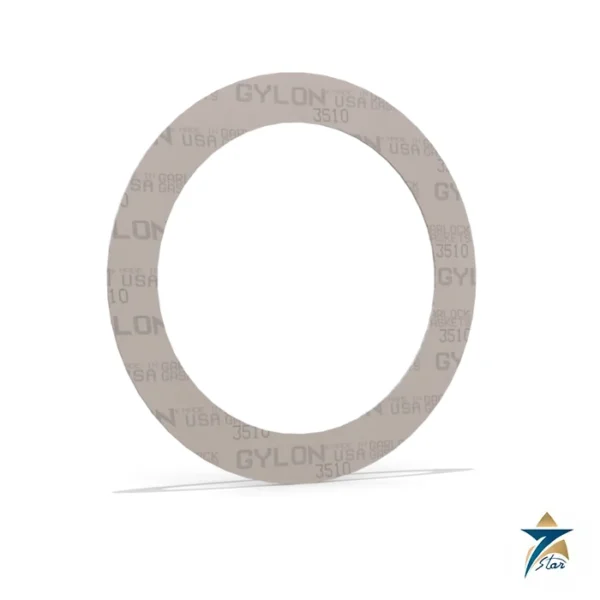
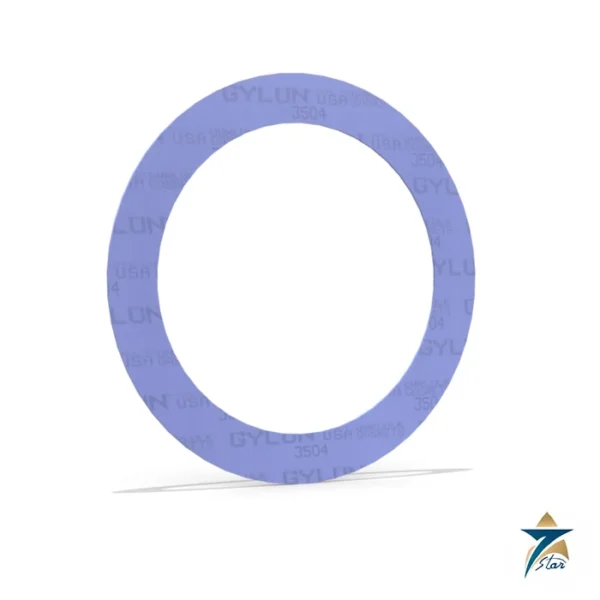
| GYLON Style 3504 |
PTFE with aluminosilicate microspheres |
Blue |
Many acids, some caustics, hydrocarbons, solvents, hydrogen peroxide, refrigerants, cryogenics |
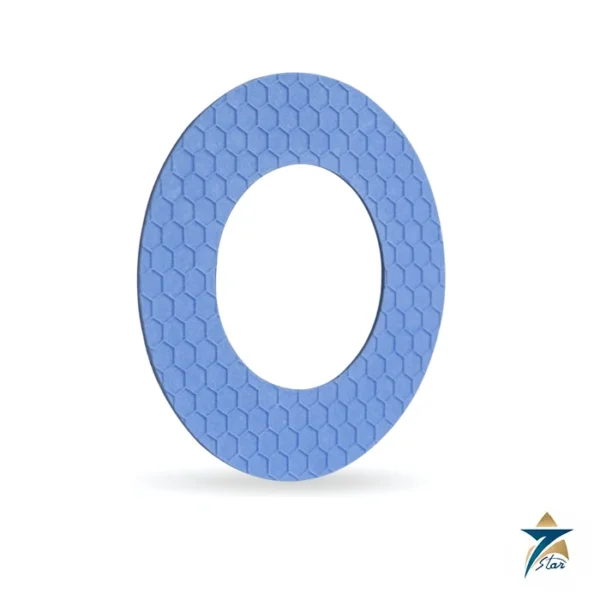
| GYLON EPIX Style 3504 EPX |
PTFE with aluminosilicate microspheres, hex profile |
Blue |
One thickness does the job of two; same material as traditional GYLON 3504 |
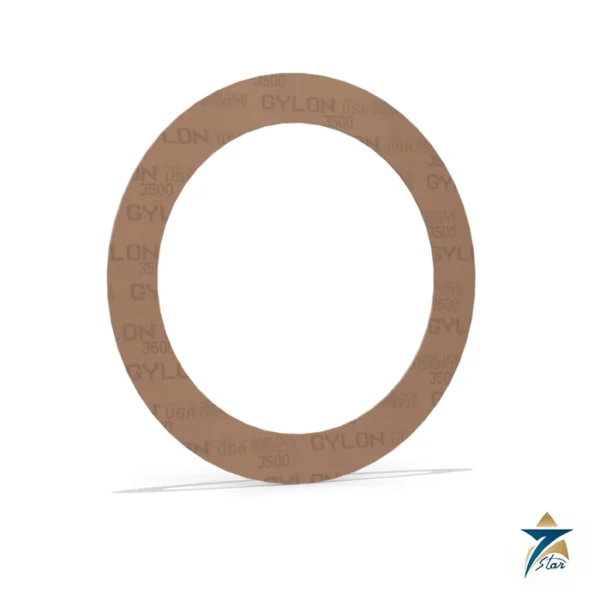
| GYLON Style 3500 |
PTFE with silica |
Fawn |
Strong acids (except hydrofluoric), solvents, hydrocarbons, water, steam, chlorine, cryogenics |
Cutting and installing ENVELON gaskets
Cut gaskets from the sheet on a clean, flat surface using a sharp knife, a circle cutter or a suitable cutting machine, so that the white faces are not scored or contaminated. Keep the inside diameter matched to the pipe bore so that the gasket does not protrude into the flow, and keep bolt holes accurately placed so the gasket stays centred. Store cut gaskets flat in their packaging until use, and never fold or roll them, because creases in the faces can become leak paths.
Before fitting, clean both flange faces, remove old gasket residue without scratching the surface, and inspect glass-lined or coated flanges for chips. Do not apply grease, paste or anti-stick compounds to the gasket unless the manufacturer instructions call for it. Lubricate the bolt threads and nut faces, then tighten in a cross pattern in several passes to the torque calculated for the joint, bringing the flanges together evenly. Because the soft exterior is chosen for its ability to conform to imperfect surfaces at low bolt loads, uneven tightening is a common cause of trouble on fragile glass-lined equipment.
Selection checks before ordering
Confirm that the medium, its concentration and the full range of operating, upset and cleaning temperatures fall inside the service listed by Garlock, and that the combination of pressure and temperature stays below the printed P x T limit for the chosen thickness. Consider the condition of the flanges: worn, warped or wavy faces are the situation ENVELON is described for, whereas flat, new flanges may be served by other styles. Check bolt load available on the joint, especially on glass-lined or non-metallic flanges where bolt torque is restricted.
Storage and service in Oman and GCC plants
Sheet and cut gaskets should be stored indoors, away from direct sun, heat sources and dust, in the original packaging. Warehouses in the Gulf can become very hot during summer, and dust and sand that settle on gasket faces will spoil the seal, so keep sheets covered and wipe faces clean before installation. In chemical plants, refineries and water treatment facilities along the Omani coast, external corrosion of flanges and bolting is common in humid, salty air; inspect these parts closely during shutdowns, because a corroded flange face or bolt can undermine any gasket.
Inspection and replacement
Treat gaskets as single-use items and fit a new one whenever a joint is opened. During routine rounds, look for weeping, staining or crystal deposits around flanged joints and record any joint that needed re-tightening, so that persistent leaks can be investigated for flange damage, misalignment or an unsuitable material choice.
Documents, ordering details and quotation
If you are replacing double-jacketed or envelope gaskets, please send the drawing or flange sizes. For a quotation please give the medium and concentration, design and test pressure, temperature, the flange standard and facing, bolting, the thickness and whether you need whole sheet or gaskets cut to size. Garlock describes its datasheet as a general guide that should not be the sole means of selecting or rejecting a material, so confirm the grade with Garlock Applications Engineering for any critical duty. More products are listed under gaskets, seals and pipe fittings.






Reviews
There are no reviews yet.