- Automation & ControlView all 1,799 products
- AC Drives
- Industrial Communications
- PLC & I/O Cards
- Vibration Monitoring
- Automation Accessories
- Controllers & Data Acquisition
- CCTV & Security
- Safety Switches & Guard Locking
- Isolator & Barrier
- Encoders
- HMI Displays
- Industrial Computers
- Servo Drives
- Motor Soft Starters
- Pneumatic Cylinders
- Automation Software
- Machine Vision
- Robotics
















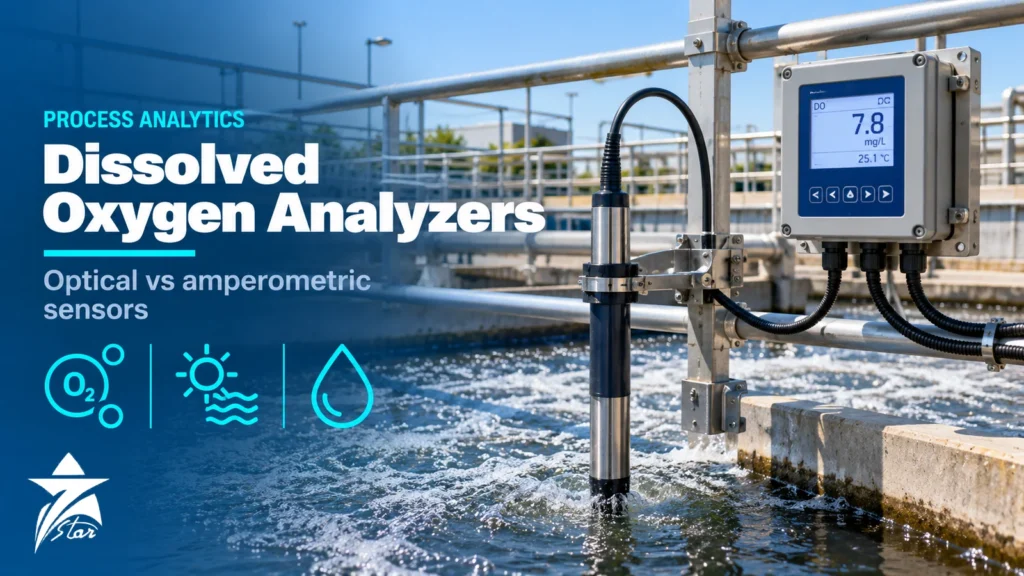
Oxygen in water is a problem at both ends of the scale. In a steam cycle a few extra parts per billion accelerate pitting and flow-accelerated corrosion; in an activated sludge basin a fraction of a milligram per litre separates healthy nitrification from wasted blower energy. A dissolved oxygen analyzer must therefore be selected for the concentration range, the sample and the maintenance the site can realistically provide. This guide compares optical (luminescent) and amperometric (membrane) sensors, then works through the two most common industrial applications: boiler feedwater at trace levels and wastewater aeration control in mg/L.
How Much Oxygen Water Can Hold
Oxygen solubility falls as temperature and salinity rise. Fresh water in equilibrium with air at sea level holds roughly 8.3 mg/L at 25 °C and below 7 mg/L at 35 °C; seawater holds less still. This matters in the GCC, where summer basin temperatures well above 30 °C reduce the oxygen available to biomass and make aeration control harder. Analyzers report either concentration (mg/L or µg/L, often written ppm and ppb) or percent saturation; converting between the two requires temperature, salinity and barometric pressure, so all three should be entered or measured in the transmitter.
Amperometric (Membrane) Sensors
The amperometric sensor, based on the Clark cell, has a cathode and an anode in an electrolyte behind a gas-permeable membrane. Oxygen diffuses through the membrane and is reduced at the cathode; the resulting current is proportional to oxygen partial pressure. Polarographic versions apply an external polarising voltage, while galvanic versions generate their own voltage from dissimilar metals.
- Strengths: long track record, very low detection limits in trace designs, fast response and well-understood behaviour in power plant chemistry.
- Oxygen consumption: because the sensor consumes oxygen, it needs a minimum sample velocity across the membrane; low or stopped flow gives a low reading.
- Warm-up: polarographic sensors need a polarisation period after power-up or electrolyte change before readings are valid.
- Maintenance: membrane and electrolyte replacement, plus cleaning or reconditioning of electrodes, at intervals that depend on fouling and sensor design.
- Interferences: some gases such as hydrogen sulfide can poison the electrodes, and in feedwater applications hydrogen can interfere with certain trace sensor designs.
Optical (Luminescent) Sensors
Optical sensors use a luminescent dye fixed in a sensor cap. The dye is excited by a light source, and oxygen molecules quench the emitted luminescence. The sensor measures the decay time or phase shift of the luminescence, which is related to oxygen partial pressure. No current flows and no oxygen is consumed.
- Strengths: no flow dependence, no polarisation time, no electrolyte, and stable calibration over long periods.
- Maintenance: periodic cleaning of the cap surface and replacement of the sensing cap at the interval stated by the manufacturer.
- Limitations: some dyes are affected by certain solvents, chlorine dioxide or strong oxidisers, and cap life shortens with high temperature and intense ambient light exposure.
- Trace capability: dedicated low-ppb optical sensors now exist for power plant chemistry, though amperometric sensors remain common at the lowest levels.
Optical vs Amperometric: Comparison
| Criterion | Amperometric (membrane) | Optical (luminescent) |
|---|---|---|
| Measurement principle | Electrochemical reduction of O₂ | Luminescence quenching of a dye |
| Oxygen consumption | Yes, needs minimum flow | No, flow-independent |
| Start-up | Polarisation period required | Immediate |
| Routine maintenance | Membrane and electrolyte change, electrode cleaning | Cap cleaning and periodic cap replacement |
| Calibration drift | Moderate, increases as electrolyte ages | Low under normal conditions |
| Wastewater aeration | Used, but fouling raises maintenance | Now the common choice |
| Trace ppb (feedwater) | Long-established | Available in dedicated trace designs |
| Interference risks | H₂S, hydrogen in some designs | Some solvents and oxidisers |
Boiler Feedwater and Steam Cycle Monitoring
In conventional all-volatile treatment, oxygen is removed mechanically in the deaerator and chemically by a scavenger, so the analyzer must resolve single-digit ppb. Deaerator performance is commonly specified at around 7 ppb oxygen at the outlet. Some once-through and combined-cycle units use oxygenated treatment, where a controlled oxygen level in the tens of ppb is deliberately maintained; there the analyzer is a control instrument rather than an alarm.
Typical measurement points
- Condensate pump discharge, to detect air in-leakage at the condenser
- Deaerator outlet, to verify mechanical deaeration performance
- Economiser inlet or final feedwater, to confirm scavenger dosing
- Make-up water and condensate polisher outlet where applicable
Getting trace readings right
At ppb levels, the sample system is usually the limiting factor, not the sensor. Use stainless steel tubing and double-ferrule compression fittings; plastic tubing and threaded joints let atmospheric oxygen diffuse in. Cool hot samples in a sample cooler and keep flow steady at the rate the sensor requires. Flush new sample lines for long enough that corrosion products and trapped air are removed, and avoid valves or filters with dead volume upstream of the sensor. A leaking fitting can easily add more oxygen than the deaerator leaves in the water, leading engineers to adjust chemistry for a problem that exists only in the sample line.
Wastewater Aeration Control
Aeration is usually the largest single energy consumer in an activated sludge plant, so dissolved oxygen control has a direct cost impact. Typical setpoints in the aerobic zone are in the range of about 1.5–2.5 mg/L; running higher wastes blower power, running lower risks incomplete nitrification and filamentous bulking. Modern plants control blowers through variable speed drives and air valves using DO as the feedback signal, sometimes combined with ammonia measurement. For blower drives in hot plant rooms, see our guide to variable frequency drive selection for hot climates.
Sensor placement
- Place sensors in a representative zone, away from direct diffuser plumes and dead corners.
- In plug-flow basins, use more than one sensor along the length; oxygen demand falls toward the outlet.
- Mount on a swing arm or handrail bracket so sensors can be lifted for cleaning without entering the basin.
- Use air-blast or water-jet cleaning where biofilm builds quickly.
- Protect cables and transmitters from direct sun; plastic housings and displays degrade quickly at GCC surface temperatures.
Other Industrial Applications in the GCC
Oilfield water injection
Produced water and seawater used for reservoir pressure maintenance are deaerated, often in vacuum or gas-stripping towers followed by oxygen scavenger dosing, because dissolved oxygen drives corrosion in injection pipelines and wells and feeds bacterial growth. The analyzer here works in the ppb range, often on saline water with traces of hydrogen sulfide, so sensor chemistry and wetted materials must be checked against the sample. Optical sensors avoid the electrode poisoning risk, but confirm with the manufacturer that the dye and cap are suitable for the sample composition.
Desalination and cooling water
In thermal desalination, dissolved oxygen is monitored after deaeration to protect the distiller and brine heater. In seawater cooling systems and RO intake, DO is used less for control and more for diagnosing biological activity and corrosion behaviour. In both cases the high salinity must be entered in the transmitter, and the sensor body and holder materials must tolerate chloride and bio-fouling.
Process and product water
Beverage, food and pharmaceutical producers use DO to protect product quality, while closed chilled-water and hot-water circuits use it to detect air ingress from failed expansion vessels or make-up problems. These are usually mg/L or high-ppb duties where optical sensors fit well.
Calibration Methods
- Air calibration: expose the sensor to water-saturated air at known temperature and barometric pressure. This is the standard routine method for both technologies.
- Zero check: immerse in oxygen-free solution, typically sodium sulfite, to verify the zero; essential for trace feedwater sensors.
- Comparison: compare with a portable reference meter or a Winkler titration for mg/L duties, and with a calibrated reference analyzer for ppb duties.
- Record as-found values before adjustment, so drift can be trended and intervals justified.
ASTM D888 covers dissolved oxygen in water, including luminescence-based methods, and ASTM D5462 covers on-line measurement of low-level dissolved oxygen. For interval setting and traceability, our instrument calibration program guide sets out a practical approach.
Common Mistakes
- Running an amperometric sensor in a sample panel with a flow rate below its minimum; the reading drifts low and the deaerator gets the blame.
- Using nylon or PE tubing on a ppb sample line.
- Forgetting to enter salinity for seawater or brine services, which overstates concentration.
- Calibrating in air without correcting for actual barometric pressure or in direct sunlight where the sensor heats unevenly.
- Leaving optical caps beyond their rated life because the reading still looks stable.
- Installing basin sensors where diffuser bubbles strike the sensing face directly.
Troubleshooting
| Symptom | Likely cause | Action |
|---|---|---|
| Feedwater reading higher than expected | Air ingress in sample line or fittings | Leak-check, replace plastic tubing, flush line |
| Reading falls when sample flow drops | Amperometric flow dependence | Restore minimum flow; consider optical sensor |
| Slow response after maintenance | Polarisation incomplete or air bubble under membrane | Allow polarisation; refit membrane correctly |
| Basin reading erratic | Bubble impact or biofilm | Relocate or angle sensor; enable auto-cleaning |
| Gradual low drift (optical) | Fouled or aged cap | Clean cap; replace if past rated life |
Selection and Specification Checklist
- Measuring range: ppb (feedwater) or mg/L (aeration, effluent, process water)
- Sample temperature, pressure, salinity and available flow
- Interferences: H₂S, hydrogen, solvents, chlorine dioxide
- Installation: flow cell on sample panel, immersion, or insertion with retractable housing
- Cleaning method and maintenance capacity on site
- Transmitter outputs and communication protocol
- Hazardous area requirements for refinery or gas plant water systems
- Existing model and part number if replacing
Seven Star LLC supplies dissolved oxygen sensors and transmitters from the liquid analytics range, including optical and amperometric DO sensors and complete analyzer systems for steam and water sample panels.
Dissolved Oxygen Products We Supply
These examples cover optical sensors, analysers and checking tools.
| Product | Type | Where it fits |
|---|---|---|
| ABB Optical dissolved oxygen sensor ADS420 | Optical DO sensor | Aeration basins and wastewater. |
| Hach LXV416.99.20001 LDO2 Dissolved Oxygen Sensor | Optical DO sensor | Wastewater and water treatment. |
| JUMO digiLine O-DO S10 Dissolved Oxygen Sensor | Digital DO sensor | Water and wastewater monitoring. |
| Yokogawa FLXA21-D P-D-CH-D1-NN-A-N-LA-N-NN/U Dissolved Oxygen Analyzer | DO analyser | Process and wastewater monitoring. |
| Swan AMI Oxytrace Trace Dissolved Oxygen Analyzer for High-Purity Water | Trace DO analyser | Boiler feed water and high-purity water. |
| CHEMetrics C-7540 Dissolved Oxygen Comparator (0–40 ppb) | DO comparator kit | Spot checks of low DO levels. |
Send the application, DO range, temperature and mounting through our quote request form.
Sourcing Dissolved Oxygen Analyzers Through Seven Star LLC
Seven Star LLC supplies dissolved oxygen analyzers, sensor caps, membranes, electrolyte kits and transmitters on request for power plants, desalination, oil and gas and wastewater facilities in Oman and the GCC. We help with selection and cross-checking part numbers for equipment from manufacturers such as Hach, Endress+Hauser, Mettler Toledo, Yokogawa and Emerson. Availability and lead time are confirmed at quotation.
Send your measuring range, sample conditions and the nameplate or order code of any installed DO analyzer with your RFQ, and we will match a sensor and transmitter to each point.
Frequently asked questions
Which is better, an optical or an amperometric dissolved oxygen sensor?
Optical sensors need less maintenance, have no flow dependence and no polarisation time, so they are now the common choice for wastewater and general process water. Amperometric sensors remain widely used for trace-ppb feedwater monitoring, where their low detection limits are well established. The right choice depends on range, sample and maintenance resources.
Why does my feedwater DO analyzer read higher than the deaerator specification?
The most frequent cause is air ingress in the sample line through plastic tubing, loose fittings or valves. Check the sample system with stainless tubing and compression fittings, flush the line thoroughly and verify flow before adjusting chemistry.
What DO setpoint is used for wastewater aeration?
Many activated sludge plants control aerobic zones around 1.5–2.5 mg/L. The best value depends on the process design, nitrification requirements and temperature, so it should be set by the process engineer and optimised using plant data.
How do you calibrate a dissolved oxygen sensor?
The routine method is air calibration in water-saturated air with correct temperature and barometric pressure. Trace sensors also need a zero check in oxygen-free sodium sulfite solution, and periodic comparison with a reference meter or titration is good practice.
Does temperature affect dissolved oxygen readings?
Yes. Oxygen solubility falls as temperature rises, and membrane permeability also changes with temperature. Analyzers include temperature sensors and compensate automatically, but salinity and barometric pressure must also be set for accurate concentration values.
How often should an optical DO sensor cap be replaced?
Follow the manufacturer's rated cap life, which is commonly in the order of one to two years under normal conditions. High temperature, aggressive chemicals and abrasive solids can shorten it, so trend calibration results to see when performance falls off.
Was this guide helpful?One click helps us write better guides for engineers.
Thank you! Glad it helped. Need this equipment for your project? Request a quotation
Thank you. We will use this to improve the guide.