- Automation & ControlView all 1,789 products
- AC Drives
- Industrial Communications
- PLC & I/O Cards
- Vibration Monitoring
- Automation Accessories
- Controllers & Data Acquisition
- CCTV & Security
- Safety Switches & Guard Locking
- Isolator & Barrier
- Encoders
- Industrial Computers
- HMI Displays
- Servo Drives
- Motor Soft Starters
- Pneumatic Cylinders
- Automation Software
- Machine Vision
- Robotics
















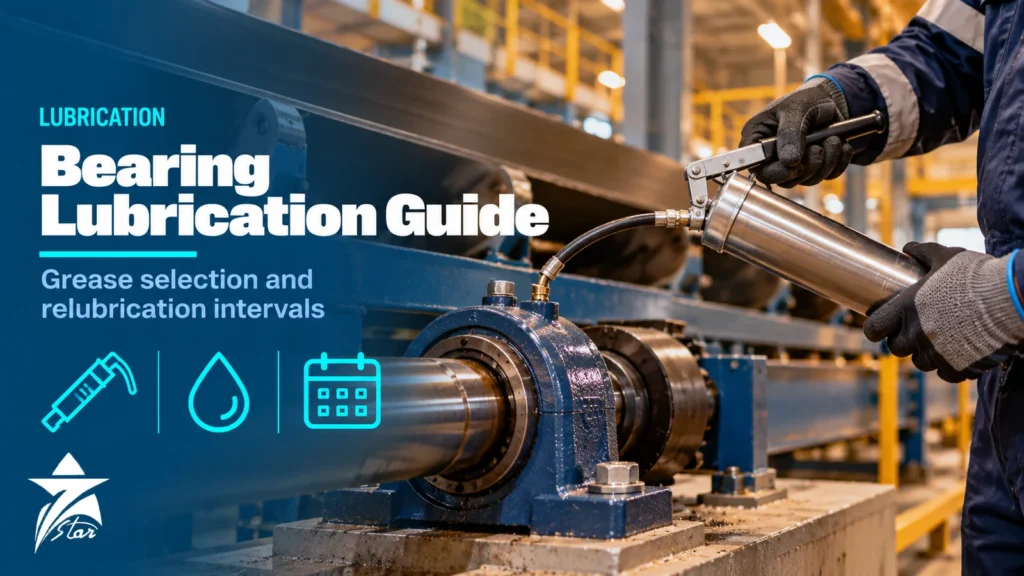
Lubrication problems are behind a large share of premature bearing failures, and most of them are avoidable. Too little grease starves the contacts, too much grease overheats the bearing, the wrong viscosity cannot form a film at operating temperature, and dirty grease guns pump sand straight into the raceways. Good bearing lubrication is therefore a specification task as much as a maintenance task. This guide explains how lubricants protect rolling bearings, how to select a grease, how to set relubrication intervals and quantities, why over-greasing is so common, and when oil lubrication is the better choice.
What the Lubricant Has to Do
In a rolling bearing the lubricant must separate the rolling elements from the raceways with a thin elastohydrodynamic film, reduce sliding friction at the cage and roller ends, protect steel surfaces against corrosion and, in the case of grease, help seal out dirt and water. Oil can also carry heat away. The thickness of the film depends mainly on the base oil viscosity at the operating temperature and on the speed. If the film is too thin, asperities on the surfaces touch, leading to surface distress, micro-pitting and eventually surface-initiated fatigue.
Bearing manufacturers express film adequacy with the viscosity ratio κ = ν / ν1, where ν is the actual kinematic viscosity of the oil (or the base oil of the grease) at operating temperature and ν1 is the rated viscosity needed for the bearing’s mean diameter and speed. A κ of 1 or more is generally the target, and values in the range of about 1 to 4 give good separation. Below 1, anti-wear or extreme-pressure additives become important and the bearing life is reduced.
Grease Composition: Base Oil, Thickener and Additives
Grease is a base oil held in a thickener, plus additives. The base oil does the lubricating; the thickener is a sponge that releases oil slowly and helps sealing.
- Base oil: mineral oils cover most industrial uses; synthetic oils such as PAO or ester extend the temperature range and oxidation life.
- Base oil viscosity: typically stated at 40 °C. Heavily loaded, slow bearings need high viscosity; fast, lightly loaded bearings need low viscosity.
- Thickener: lithium and lithium complex are general-purpose; calcium sulfonate complex offers strong water resistance and load capacity; polyurea is common in electric motor bearings for long life at higher temperatures; aluminium complex and clay thickeners are used in particular applications.
- Consistency: expressed as an NLGI grade. Grade 2 is most common; grade 3 suits larger bearings, vertical shafts or vibration; grades 1 or 0 suit centralised systems.
- Additives: anti-wear and extreme-pressure additives for heavy loads, rust inhibitors for wet environments, antioxidants for long intervals.
Selecting the Right Grease
Start from the bearing’s operating temperature, speed and load, then check the environment. Calculate or look up the rated viscosity for the bearing size and speed, and choose a grease whose base oil viscosity at the real operating temperature gives κ of at least 1. Check that the operating temperature sits comfortably inside the grease’s recommended temperature range, not just below its dropping point. Speed suitability is expressed with the speed factor n × dm, where n is rpm and dm is the mean bearing diameter (bore plus outside diameter, divided by two); each grease has a limit published by its manufacturer.
For wet or washdown service, prioritise water resistance and corrosion protection. For heavy shock loads, choose EP additives and higher viscosity. For motors with long intervals, choose a grease with proven high-temperature life. Finally, check compatibility with the grease already in the machine. Mixing incompatible thickeners can soften the grease until it runs out, or harden it until it no longer releases oil.
Relubrication Intervals
Grease ages through oxidation, oil separation and mechanical breakdown, so most open bearings need fresh grease at intervals. Manufacturers publish diagrams that give a base interval as a function of the speed factor n × dm and the bearing type; roller bearings need shorter intervals than ball bearings at the same speed factor. The base interval is then adjusted for operating conditions:
- Temperature: diagrams are typically valid to about 70 °C bearing temperature. A common rule is to halve the interval for every 15 °C above 70 °C.
- Vertical shafts: intervals are commonly halved because grease tends to migrate out of the bearing.
- Contamination and moisture: shorter intervals help flush contaminants out of the bearing.
- Vibration and shock: shorter intervals, because grease structure breaks down faster.
- Outer ring rotation or high-load roller bearings: check manufacturer corrections.
A practical approach is to set the calculated interval, then refine it using temperature trends, ultrasound readings and the condition of purged grease.
How Much Grease to Add
For relubrication from the side of the bearing, a widely used formula is G = 0.005 × D × B, with G in grams, D the outside diameter in millimetres and B the width in millimetres. For a 6310 deep groove ball bearing, with D = 110 mm and B = 27 mm, that gives about 15 g per relubrication. When grease is fed through a groove and holes in the outer ring directly into the bearing, manufacturers commonly recommend a smaller quantity, around 0.002 × D × B. Convert grams into grease gun strokes by weighing the output of your own gun; strokes vary widely between guns.
The initial fill is different. For normal speeds, fill the bearing itself completely and the free space in the housing only partly, typically 30–50%. Very slow bearings can have the housing filled completely because churning friction is negligible, while bearings near their speed limit need less grease in the housing.
Over-Greasing: Why It Happens and What It Does
Over-greasing is common because adding grease feels like good maintenance and because the amount added by each gun stroke is rarely known. The damage is real:
- Churning: excess grease is pushed around by the rolling elements, generating heat. Temperature rises sharply until the excess escapes.
- Oxidation: higher temperature shortens grease life and hardens residues.
- Seal damage: pressure from a grease gun can push seal lips out of position, letting dirt in.
- Motor damage: in electric motors, excess grease can be forced into the windings.
- Blocked purge paths: hardened old grease prevents new grease from reaching the bearing, so fresh grease goes nowhere useful.
To avoid it, follow calculated quantities, open drain or relief plugs while greasing where the design allows, add grease slowly, and consider ultrasound-assisted greasing to stop once the bearing noise level falls.
Oil vs Grease Lubrication
| Factor | Grease | Oil |
|---|---|---|
| Speed capability | Limited by grease speed factor | Higher, especially with circulating or oil-air systems |
| Heat removal | Poor | Good with circulating oil and coolers |
| Sealing help | Good, grease forms a barrier | Needs effective seals to retain oil |
| Housing design | Simple | Needs sump, level control, often breathers |
| Contamination control | Purge with fresh grease | Filtration and analysis possible |
| Maintenance task | Periodic regreasing | Level checks, oil changes, filter changes |
| Typical uses | Motors, fans, conveyor and pump bearings, mounted units | Gearboxes, large pumps and compressors, high-speed or hot bearings |
Common oil methods include oil bath (static level usually around the centre of the lowest rolling element), oil rings and flingers, constant-level oilers on process pumps, circulating systems with filters and coolers, and oil mist systems used in some refineries to lubricate many pump bearings from a central unit. With oil, select the ISO viscosity grade from the required κ at the operating temperature, and keep water out, as small amounts of water reduce bearing life considerably.
Relubricating Electric Motor Bearings
Electric motors are the most numerous greased machines on most plants, and they need particular care. Many smaller motors use sealed or shielded bearings with no grease nipples; these are lubricated for life and replaced, not regreased. Larger motors usually carry a lubrication plate that states the grease type, quantity and interval, and that information overrides generic charts. Where the motor has a grease drain or relief plug, remove it before greasing and leave it open while the motor runs for a period so excess grease can be expelled. Greasing a running motor helps grease distribute, but only where it can be done safely and the guarding allows. On motors fed by variable frequency drives running at speeds above base speed, check whether the interval must be shortened for the higher speed factor.
Hot, Dusty and Humid Sites in the GCC
At 50 °C ambient, with sun on outdoor housings, bearing temperatures can be well above what a grease was selected for in a temperate climate. Recalculate κ with the real operating temperature and use the temperature correction on relubrication intervals. Synthetic base oils and high-temperature thickeners can be justified on hot fans, kiln and dryer drives. Dust and sand require greater attention to seals and to cleanliness during greasing: wipe nipples before connecting, cap them afterwards and store grease cartridges sealed. Coastal and desalination sites need greases with good water resistance and rust protection, and idle standby machines benefit from periodic rotation to redistribute grease.
Common Lubrication Mistakes
- Using one general-purpose grease for every bearing on site without checking viscosity or temperature.
- Greasing by time only and never adjusting for temperature or contamination.
- Mixing greases from unlabelled guns.
- Greasing sealed-for-life bearings that have no relubrication path.
- Leaving the drain plug closed so old grease cannot escape.
- Overfilling oil baths, which raises temperature through churning.
Bearing Lubrication Checklist
- Record bearing designation, speed, load and operating temperature.
- Calculate the speed factor n × dm and the required viscosity.
- Select a grease or oil that gives κ of at least 1 at operating temperature.
- Confirm compatibility with the existing lubricant.
- Set the relubrication interval and apply corrections for temperature, vertical shafts and contamination.
- Calculate the quantity per relubrication and calibrate grease guns.
- Label lubrication points and guns with the lubricant name.
- Verify results with temperature, vibration or ultrasound trends.
Lubrication Products We Supply
These products cover grease selection and automatic relubrication.
| Product | Type | Where it fits |
|---|---|---|
| SKF LGMT 2 General Purpose Industrial Bearing Grease | General purpose grease | Motors, fans and pumps. |
| SKF LGHP 2 High Temperature Polyurea Bearing Grease | High temperature grease | Bearings running hot, such as in kilns and dryers. |
| SKF LGEP 2 High Load Extreme Pressure Bearing Grease | Extreme pressure grease | Heavily loaded or shock-loaded bearings. |
| SKF TLSD SYSTEM 24 Single Point Automatic Lubricator | Single-point automatic lubricator | Small regular grease quantities between maintenance visits. |
| perma STAR VARIO Electromechanical Single-Point Lubricator | Electromechanical single-point lubricator | Hard-to-reach bearings. |
| Bijur Delimon MultiPort II Mobile Progressive Grease Lubricator | Progressive grease lubricator | Several lubrication points from one pump. |
Send the bearing size, speed, temperature and relubrication interval through our quote request form.
Sourcing Bearing Lubrication Products Through Seven Star LLC
Seven Star LLC supplies greases, oils, single-point lubricators, grease guns and other lubrication and bearing maintenance products from established manufacturers on request, together with replacement ball bearings and mounted bearing units. We help with selection and with cross-checking product equivalents, and availability and lead time are confirmed at quotation. For motor bearings, also review our electric motors range.
Send us the bearing designations, operating temperatures and your current lubricant data sheet, and we will include suitable lubrication options in our quotation.
Frequently asked questions
How much grease should I add when relubricating a bearing?
A widely used formula for relubrication from the side of the bearing is G = 0.005 × D × B, where G is the grease quantity in grams, D the bearing outside diameter in millimetres and B the width in millimetres. For a 6310 bearing (110 mm × 27 mm) that gives about 15 g. Always confirm the grease path and that old grease can escape before applying the calculated amount.
How does temperature affect the relubrication interval?
Manufacturer relubrication diagrams are typically valid up to about 70 °C bearing temperature. A common rule is to halve the interval for every 15 °C above 70 °C, so a bearing running at 100 °C needs relubrication roughly four times as often. Stay within the upper temperature limit of the grease regardless of interval.
Can I mix two different greases?
Only if they are confirmed compatible. Greases with different thickeners, for example some polyurea and lithium greases, can soften or harden when mixed, which leads to leakage or lubricant starvation. When changing grease type, purge the old grease as completely as possible and shorten the next relubrication interval.
Why does a bearing run hot after greasing?
A temperature rise after greasing is usually caused by over-filling: the excess grease is churned by the rolling elements, generating heat until it is pushed out of the bearing. The temperature normally settles after a running-in period if the housing has a free path for grease to escape. If it does not settle, check for blocked drain ports, too much grease or an incompatible grease.
What NLGI grade is used for most rolling bearings?
NLGI grade 2 is the most common consistency for rolling bearing greases. Grade 3 is often chosen for larger bearings, vertical shafts or applications with vibration where a stiffer grease stays in place better. Softer grades such as 1 or 0 are used in centralised lubrication systems where grease must flow through long lines.
When should a bearing be oil-lubricated instead of greased?
Oil is preferred when the speed or temperature is too high for grease, when heat must be carried away from the bearing, or when the bearing shares a lubricant with gears in a gearbox. Oil also allows continuous filtration and monitoring. Grease is simpler and seals better, which is why it is used in most motors, fans and pumps with moderate speeds.
Was this guide helpful?One click helps us write better guides for engineers.
Thank you! Glad it helped. Need this equipment for your project? Request a quotation
Thank you. We will use this to improve the guide.