One DIN-rail meter that splits a feeder into two three-phase loads or six single-phase circuits
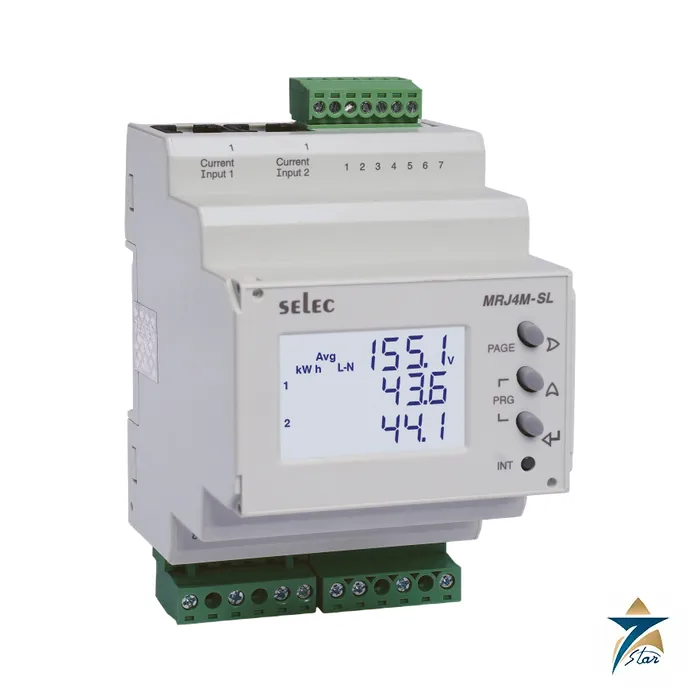
The Selec MRJ4M-SL measures more than one load with a single voltage connection. Fed from one 3-phase 4-wire (or single-phase) supply, it takes current from two separate CT groups through plug-in RJ45 inputs and reports each load on its own, so one meter can do the job of two on a split-load board.
The manual describes two selectable modes: 3-phase with 2 channels (Load 1 and Load 2) or single-phase with 6 channels. It reports active and reactive energy per load as well as in total, plus voltage, current, frequency, power factor and maximum demand, on a three-row backlit LCD. The meter is self-powered from the measured voltage.
Datasheet features
- Plug-n-Wire RJ45 connectors for the current inputs
- Two pulse outputs and RS485 Modbus RTU
- Self powered (60 to 300 V AC); programmable CT primary and PT ratios; maximum demand of power
Technical specification
Measurement
| Parameter |
Specification |
| Connection |
3-phase 4-wire or 1-phase 2-wire |
| Voltage input |
60 to 300 V AC L-N; 104 to 520 V AC L-L; frequency 45 to 65 Hz |
| Display |
3-row backlit LCD (1 x 4 digits, 2 x 7 digits); energy resolution 0.01k to 0.1M; PF resolution 0.01; auto/manual scrolling |
| Accuracy |
Voltage and current 0.5% of F.S.; PF 0.01; frequency 0.1%; power 1; energy 1 (as printed) |
| Settable parameters |
CT primary 1 and 2: 5 A to 10 kA; CT secondary 330 mV; PT primary 100 V to 10 kV; PT secondary 100 to 500 V AC (L-L) |
| Measured values |
Voltage L-L/L-N, current per channel, frequency, PF, active/reactive/apparent power, active and reactive energy per load and total, demand (max active, max apparent) |
| Memory retention |
10 years (energy) |
Outputs and mechanical
| Parameter |
Specification |
| Pulse outputs |
24 V DC max, 100 mA; duration 0.1 to 2.0 s; weight 0.01 to 9.99 kWh |
| RS485 |
Modbus RTU, half duplex, 500 m, address 1 to 255, 300 to 19200 bps, parity none/odd/even, 1 or 2 stop bits, 100 ms response |
| Supply / consumption |
60 to 300 V AC, 50/60 Hz (+/-5%), self supplied (V1, N); 8 VA max |
| Mounting and weight |
DIN rail (70 mm series per datasheet); 200 g |
| Environment |
-10 to +55 degC operating; -20 to +75 degC storage; up to 85% RH non-condensing |
| EMC printed |
IEC 61326-1; ESD IEC 61000-4-2 level IV (15 kV air); surge 2 kV L-G, 1 kV L-L; EFT 2 kV |
Order code and channel modes
The datasheet lists a single code, MRJ4M-SL, with self-supplied 60 to 300 V AC, pulse output and RS485. Channel assignment follows the manual: in 3-phase mode Load 1 uses channels 1 to 3 and Load 2 uses channels 4 to 6; in single-phase mode all six channels are separate circuits.
Wiring and use of the RJ45 current inputs
Current is not wired to screw terminals on the meter body: each load group plugs in through an RJ45 connector (Current Input 1 and Current Input 2), so the CT leads are terminated at the CT end. The manual shows a line-and-load diagram and notes fuses of 0.5 A class CC fast acting 600 V as examples.
- Switch off supplies before wiring and use lugged terminals; cable 0.5 to 2.5 mm2.
- The meter returns to the first page after 60 s with no key pressed.
- A circuit breaker or mains switch should be installed near the operator.
Where split-load metering saves hardware
Typical cases are a distribution board feeding two tenants, a pump station with duty and standby motors, or a building riser serving two floors. Each load gets its own kWh and kVArh register while the installer buys, mounts and wires one DIN-rail device. For Gulf commercial buildings this keeps tenant sub-billing neat inside a compact enclosure. Record which CT group feeds Load 1 and which feeds Load 2 on the panel drawing, because the meter reports totals for each separately as well as a combined figure, and the demand registers (maximum active and maximum apparent power) are listed on the datasheet for planning feeder capacity.
Selection and installation notes
A panel energy meter or instrument is selected from the wiring system, the current range and the outputs needed. Check whether it is direct-connected or CT-operated, set the CT ratio before reading, connect the voltage inputs through suitable fuses, respect the phase order and the polarity of the CTs and set the communication parameters when it is read by a BMS or energy system. Compare the first readings with a reference meter and fit it in a panel with the cut-out size on the data sheet.
Information needed for a quotation
Send the full model code, the quantity, the delivery location in Oman or the GCC, the intended use and any accessories needed, so that the complete package can be quoted together.
Documents and supply information
The manufacturer data sheet is attached to this page and should be read together with the project specification and the site risk assessment before a purchase is confirmed. Ratings, standards and dimensions are quoted as printed on that sheet. Lead time, stock position and certificates available with the shipment are confirmed in the quotation, and we supply to Oman and the wider GCC region for industrial, utility and building services projects.
Related items
The RJ45 inputs expect CTs terminated with the matching connector and a 330 mV secondary according to the settable-parameter list; confirm the CT type against the manual before ordering. RS485 gateways and terminators are separate.
Frequently asked questions
What does SL stand for?
The product is a split-load version of the MRJ4M family, listed as a dual-channel DIN-rail multifunction meter.
How are the CTs connected?
Through two RJ45 plug-in current inputs, one per load group.
How many loads can it meter?
Two three-phase loads or six single-phase channels, per the manual.
Does it need an auxiliary supply?
No. It is self supplied from 60 to 300 V AC (V1, N).
Which outputs are available?
Two pulse outputs and RS485 Modbus RTU.
Documents and quotation
The hosted PDF is the Selec MRJ4M-SL datasheet. Tell us the CT type and channel mode when requesting a price. Please verify approvals, delivery time and accessories before ordering. Seven Star LLC works as an independent supplier in Muscat. More products in this range are listed under Metering Systems.








Reviews
There are no reviews yet.