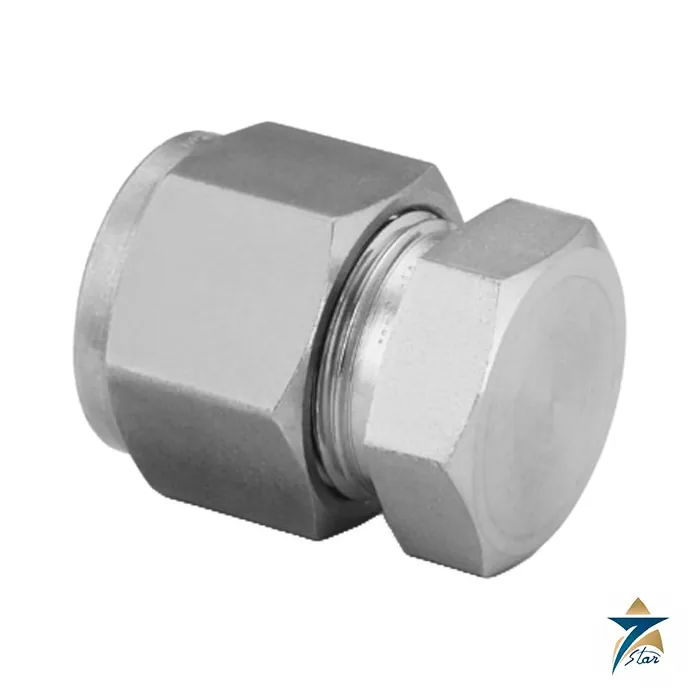
Every open tube end on an instrument or sample system needs a safe stop. The Swagelok SS-810-C is a 316 stainless steel cap that closes the end of 1/2 in. OD tubing: slide the nut and ferrules onto a cut tube, seat the tube end against the cap shoulder and the line is blanked with the same leak-tight seal as any other Swagelok connection.
Technical specifications
| Parameter |
Specification |
| Part number |
SS-810-C |
| Description |
Cap for 1/2 in. OD tubing, nut with ferrules and closed body |
| Material |
316 stainless steel |
| Tube OD |
1/2 in. |
| Dimension A (overall length) |
1.21 in. |
| Dimension D (nut size) |
0.90 in. |
| Cleaning |
Standard cleaning and packaging SC-10 |
| Installation |
As a Swagelok tube fitting: one and one-quarter turns from finger-tight |
| Reference |
Catalog MS-01-140, caps and plugs section |
Caps for tubing, plugs for fittings
The catalog treats caps and plugs side by side but they close different things. A cap is a closed fitting body that receives tubing: the tube is part of the assembly, and the pair is a normal tube connection. A plug, such as SS-810-P in the same size range, instead blanks the open nut end of a fitting or valve port. SS-810-C is therefore the correct part for a spare tube branch, a dead-end test point or a stub awaiting a future instrument, while a plug is used to close a fitting port.
The cap is compact: 1.21 in. overall for the 1/2 in. size with a 0.90 in. nut dimension, shorter than a union or an elbow.
Ordering and variants
SS-810-C decodes as 316 stainless, 1/2 in. tube, C for cap. The cap exists for every size block from 1/16 in. up, so 400-C is the 1/4 in. cap and 12M0-C the 12 mm version. Brass and other material prefixes are available. CP gives individual bagging and BQ the oxygen-oriented cleaning and packaging described in the catalog, with silver-plated front ferrule and nut lubricant.
As a dead-end, a cap holds the full line pressure. Because it is a Swagelok tube connection, its limit is the working pressure of the tubing used, not a separate cap rating.
Fitting and reuse
Cut the tube square, deburr it and wipe it clean, then seat it fully. Take the nut to finger-tight, mark it if you wish, and rotate it one and one-quarter turns. A gap gauge sized for the tube confirms the result, and the system must be depressurised before the nut is touched. The catalog notes that connections can be disconnected and retightened, which makes caps convenient for temporary blanking during commissioning or leak testing: after the first make-up, a cap is remade by snugging the nut by hand and then tightening it slightly with a wrench.
Never bleed pressure by loosening a cap or plug; use a vent or bleed valve on the system instead.
Selection checks before specifying the cap
Start with the tubing itself. The SS-810-C is intended for 1/2 in. OD tubing, so confirm the tube is inch-sized and not a metric size that looks similar, since mixing inch and metric components is a common cause of leaks. Check that the tube material, hardness and wall thickness suit Swagelok tube fittings as described in the catalog, and that the pressure rating of that tubing covers the maximum system pressure, including test pressure.
Consider the process fluid and the temperature at the dead end as well. A capped branch can trap liquid that stagnates, so check whether the medium can freeze, polymerise, deposit solids or become corrosive when it is not flowing. Where the branch is only temporary, note it on the drawings and in the maintenance system so that it is not forgotten after commissioning.
Commissioning and leak testing a capped line
Include every cap in the pressure and leak test of the system, not just the main run. After the test pressure has been applied and held, check each capped end with a suitable leak detection fluid or with the method required by the site procedure. Mark caps that have been made up and tested so that the commissioning team can see at a glance which ends have been completed.
When a cap is removed to connect an instrument later, depressurise and isolate the line first, confirm it is drained and vented, and follow the reassembly method from the catalog when the new connection is made.
Corrosion and environment in Oman and the GCC
316 stainless steel is widely used in Gulf process plants, but on coastal and offshore sites in Oman and the wider GCC, hot, humid, salt-laden air can still cause surface staining and pitting on tubing and fittings, especially where deposits collect and stay damp. Instrument tubing near the sea, cooling towers or desalination units should be inspected more often, and surface deposits washed off with fresh water during routine maintenance.
Dust and sand in the air can also enter open tube ends during construction. Keep tube ends protected until the cap or final connection is made, and blow lines clear with clean, dry air or nitrogen before fitting caps, as particles trapped in the line can later damage valves and instruments downstream.
Inspection during plant maintenance
During routine walk-downs, look at capped branches for signs of leakage, staining or mechanical damage from nearby work. Confirm that each cap is still needed and that it is shown on the current drawings. Branches that are no longer required can be reviewed with the process engineer to decide whether they should be removed to reduce dead legs in the system.
Documents and quotation
The reference for this page is Swagelok catalog MS-01-140, Gaugeable Tube Fittings and Adapter Fittings. It holds the ordering numbers, dimension tables, pressure ratings and installation steps summarised above, and is attached for download. Send SS-810-C with the quantity and any cleaning or packaging option and we will quote.
Related items: product category.






Reviews
There are no reviews yet.