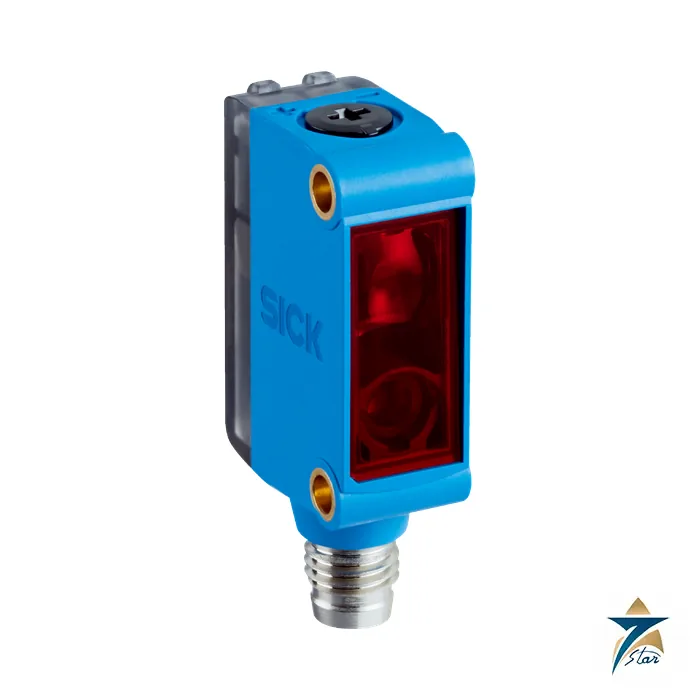
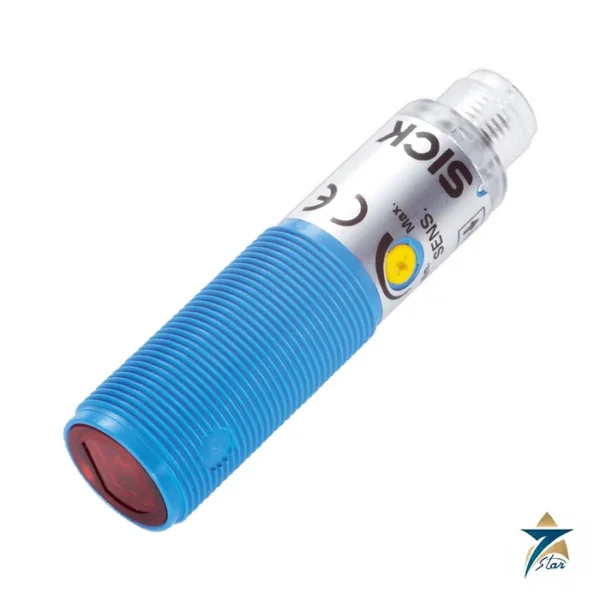
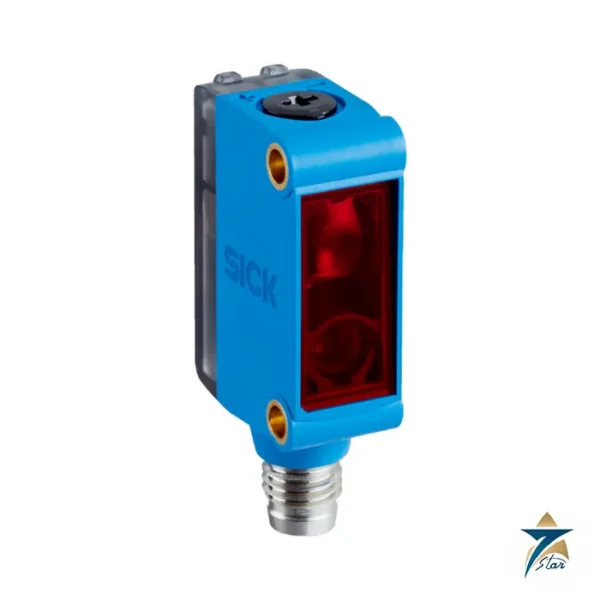
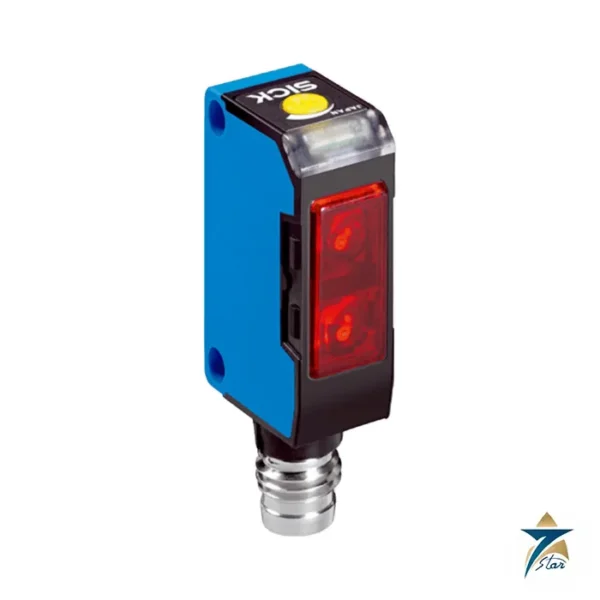
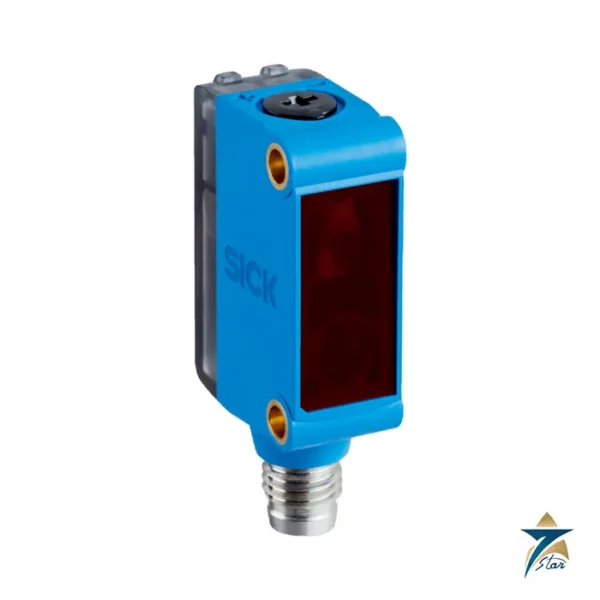
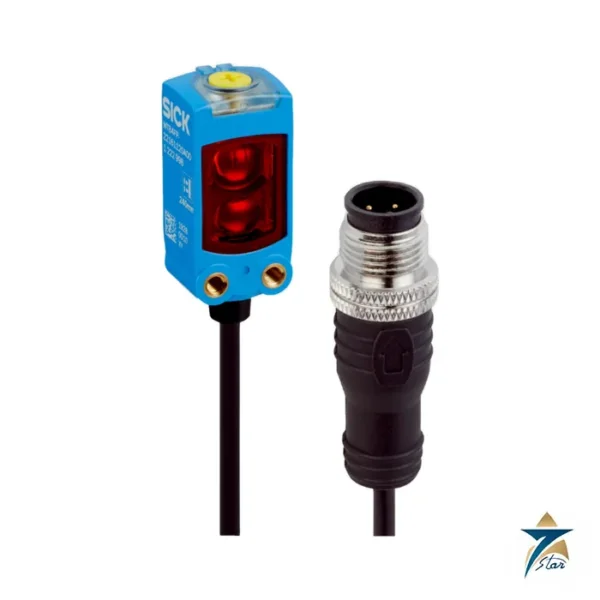
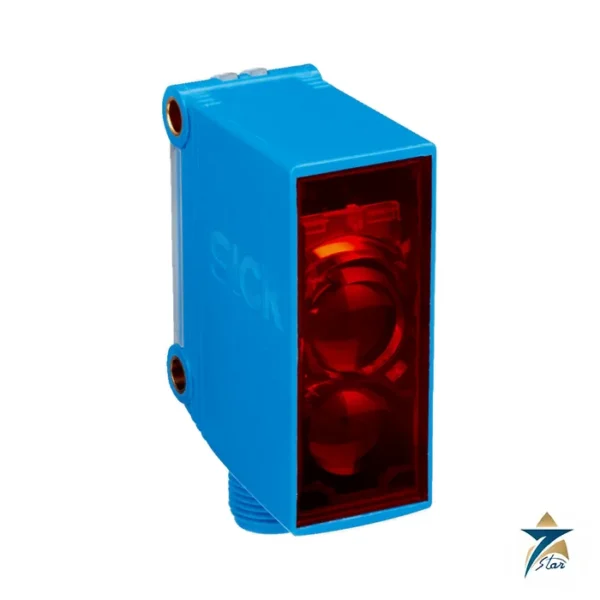
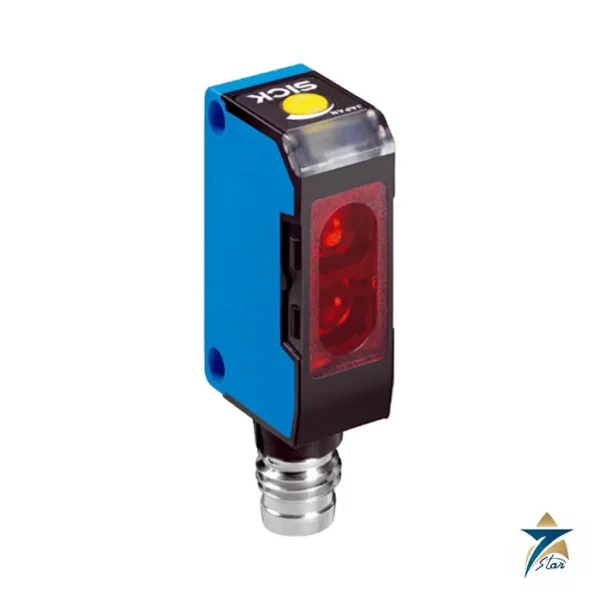
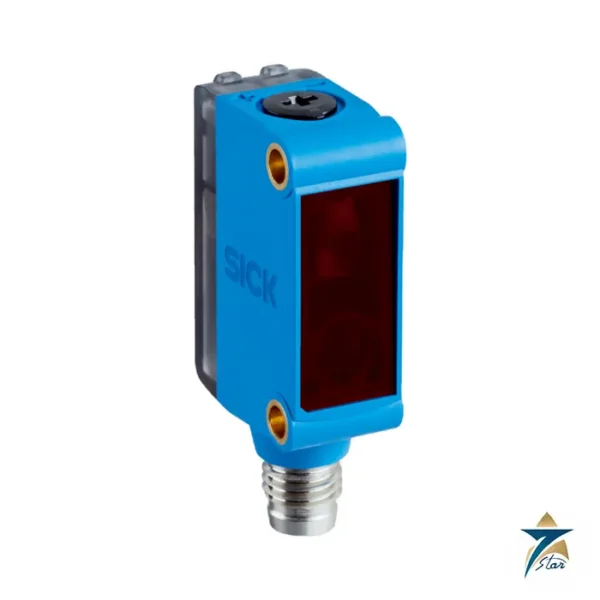
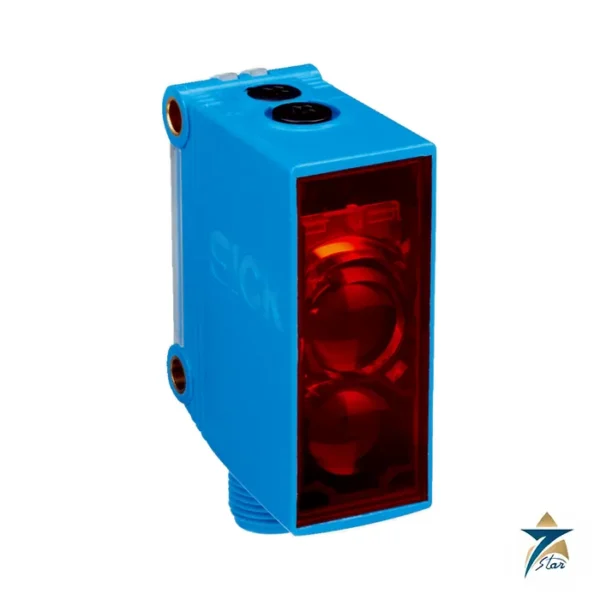
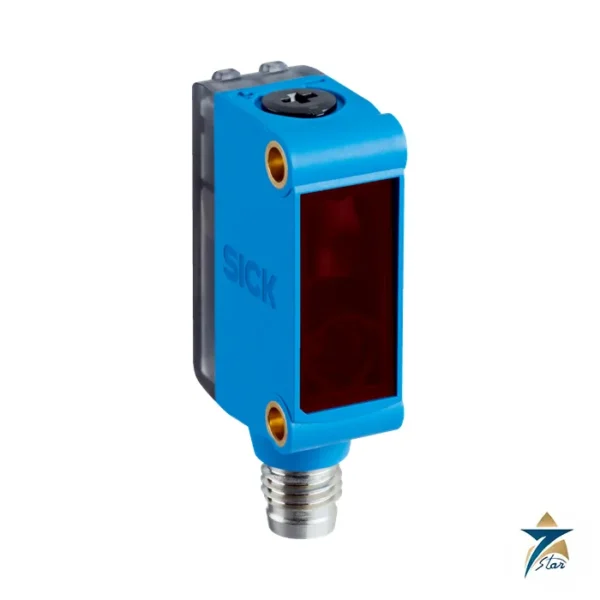
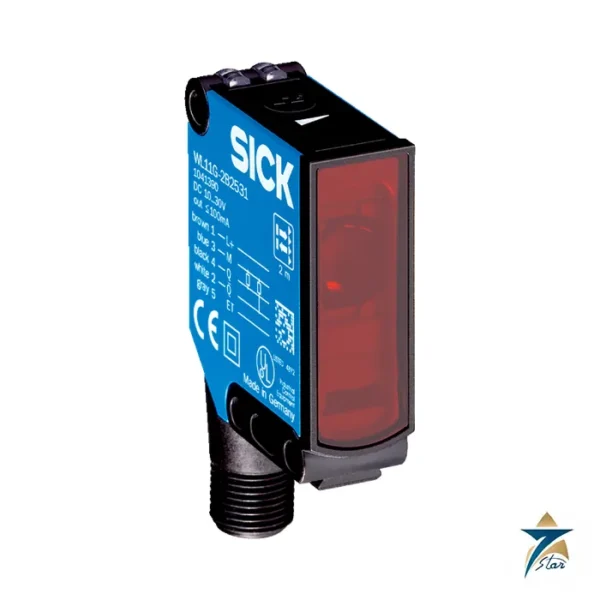
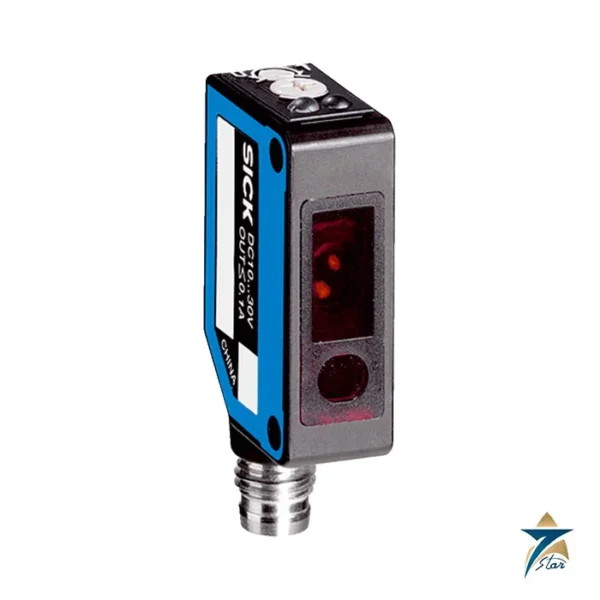
Part number 1059632 identifies the GL6G-P4211, a G6 photoelectric sensor that works with a reflector. It needs wiring on one side only and detects anything that breaks the light path between sensor and reflector. The sensing range maximum is 0.03 m … 6 m (sensing range value 0.07 m … 5 m). Output: PNP, light/dark switching; connection: Male connector M8, 4-pin.
Retro-reflective sensing with the GL6G-P4211
The data sheet describes a dual-lens system with a minimum distance to the reflector. Place the reflector beyond that minimum distance; closer than that the beam geometry no longer works as intended, and the sensing range figures only apply from there outwards. A polarisation filter is fitted: it passes only light that the reflector has rotated, so shiny objects are less likely to be mistaken for the reflector. Range figures are quoted against a reference reflector. A smaller or dirty reflector gives less operating reserve, so leave margin instead of using the full range. Align by sweeping the sensor across the reflector until the received-light indicator is steady, then lock the mounting and check again after the first vibration-heavy start-up.
Light source: PinPoint LED, visible red light, light spot Ø 8 mm (350 mm). Adjustment: potentiometer, 270°. The data sheet lists this special application: detecting transparent objects. Response time < 625 µs.
Technical specifications
| Parameter |
Specification |
| Type code |
GL6G-P4211 |
| Part number |
1059632 |
| EAN |
4047084239137 |
| Product family |
G6 |
| Functional principle |
Photoelectric retro-reflective sensor |
| Functional principle detail |
With minimum distance to reflector (dual lens system) |
| Sensing range max. |
0.03 m … 6 m |
| Sensing range |
0.07 m … 5 m |
| Polarisation filter |
Yes |
| Emitted beam: Light source |
PinPoint LED |
| Emitted beam: Type of light |
Visible red light |
| Emitted beam: Light spot size (distance) |
Ø 8 mm (350 mm) |
| Key LED figures: Wave length |
650 nm |
| Adjustment |
Potentiometer, 270° |
| Special applications |
Detecting transparent objects |
| MTTFD |
1,895 years |
| DCavg |
0 % |
| Supply voltage UB |
10 V DC … 30 V DC |
| Ripple |
± 10 % |
| Current consumption |
30 mA |
| Protection class |
III |
| Digital output: Type |
PNP |
| Digital output: Switching mode |
Light/dark switching |
| Digital output: Switching mode selector |
Selectable via light/dark selector |
| Digital output: Signal voltage PNP HIGH/LOW |
VS – (≤ 3 V) / approx. 0 V |
| Digital output: Output current Imax. |
≤ 100 mA |
| Digital output: Response time |
< 625 µs |
| Digital output: Switching frequency |
1,000 Hz |
| Attenuation along light beam |
> 20 % |
| Circuit protection |
A ; B ; D |
| Special feature |
Detecting transparent objects |
| Housing |
Rectangular |
| Dimensions (W x H x D) |
12 mm x 31.5 mm x 21 mm |
| Connection |
Male connector M8, 4-pin |
| Material: Housing |
Plastic, ABS/PC |
| Material: Front screen |
Plastic, PMMA |
| Weight |
20 g |
| Enclosure rating |
IP67 |
| Ambient operating temperature |
–25 °C … +55 °C |
| Ambient temperature, storage |
–40 °C … +70 °C |
| Declarations and certificates in the data sheet |
EU declaration of conformity; UK declaration of conformity; ACMA declaration of conformity; Moroccan declaration of conformity; China RoHS; China Compulsory Product Certification (CCC) exempt; cULus certificate; Photobiological safety (DIN EN 62471) certificate |
Type code GL6G-P4211 and part number 1059632
Retro-reflective types of one family often differ only in connector, output or range, so SICK numbers each separately. Quote 1059632 together with GL6G-P4211; if the old label is unreadable, send us the application and we will compare the neighbouring variants.
Related catalogue entries in the same family, each ordered under a different number:
- GL6G-P4212 (part no. 1060810)
- GL6G-P4211S71 (part no. 1084967)
- GL6G-P4211S73 (part no. 1086956)
- GL6G-P4211S97 (part no. 1104671)
- GL6L-P4211 (part no. 1105822) – Light source: Laser
Mounting, wiring and alignment notes
Plan for 10 V DC … 30 V DC at the terminals, IP67 enclosure protection and an operating ambient of –25 °C … +55 °C. The body measures 12 mm x 31.5 mm x 21 mm and weighs 20 g. No reflector is listed as supplied, so add a suitable reflector to the order and check the operating reserve against the distance you need. Choose a reflector that suits the distance and the dirt level; a larger reflector gives more operating reserve in dusty areas.
Commissioning the sensor on the line
Once the GL6G-P4211 and its reflector are mounted, connect the M8 cable and apply supply within the 10 V DC … 30 V DC range. Decide whether the PLC input should be active when the beam is clear or when it is interrupted, and set the light/dark selector accordingly before tuning anything else. Then run real product through the beam, not only a hand or a test card: transparent bottles, film and trays behave differently from opaque cartons, and the sensor is specified for detecting transparent objects precisely because those targets weaken the beam only partly.
Use the 270° potentiometer to set sensitivity so that the output switches reliably for the faintest object you need to see while staying stable when the beam is clear. Check the switching with the slowest and fastest line speeds; the response time below 625 µs and the 1,000 Hz switching frequency allow fast lines, but gaps between products must still be long enough for the output to change state.
Selection checks for the application
Confirm that the reflector distance falls between the minimum distance of the dual-lens system and the usable sensing range, with operating reserve left for dirt. Make sure the PNP output and its 100 mA limit suit the controller input or relay being driven, and that the 4-pin M8 connection matches the cable already used on the machine. Where a laser light source is preferred for long, narrow beam paths, the GL6L-P4211 listed above is the related type to compare.
Dust, heat and humidity in Gulf plants
Packaging halls, cement and aggregate plants and warehouses in Oman often have airborne dust that settles on both the PMMA front screen and the reflector. Even with IP67 protection keeping dust out of the housing, a coated lens or reflector reduces the light returned and can cause false switching. Include the sensor and reflector in daily or weekly cleaning, using a soft cloth and a cleaner that is safe for plastic optics.
The ambient operating limit is +55 °C. Avoid mounting the sensor where it receives direct sunlight through doors or skylights, or next to ovens, shrink tunnels and hot motors, since the housing temperature can rise above the surrounding air. Strong sunlight shining straight into the optics can also disturb detection, so angle the beam away from bright openings. In humid, air-conditioned plants, allow equipment brought in from outside to settle before switching on to avoid condensation on the optics.
Maintenance and replacement
After any mechanical impact or line changeover, re-check alignment and the potentiometer setting. When replacing a unit, compare the type code and part number on the old label with 1059632 and GL6G-P4211, set the light/dark selector to match the old sensor, and repeat the commissioning test with real product.
Documents and quotation
We attach SICK’s own data sheet for part no. 1059632 (GL6G-P4211) as an unaltered PDF; use it to compare dimensions, connections and ratings with the device on your machine. Send the type code and part number with quantity and delivery location through the RFQ form and we will quote. Related items are listed under Sensors & Transmitters. Please verify the variant against the nameplate of the device you are replacing, since similar types differ in small details. The data sheet is the authority.


Reviews
There are no reviews yet.