Pressure-based mass flow control that ignores inlet and outlet pressure swings
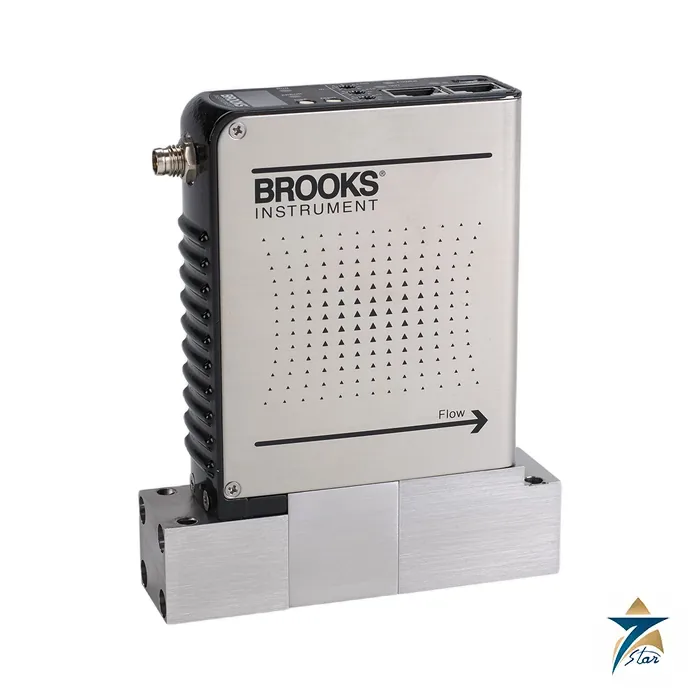
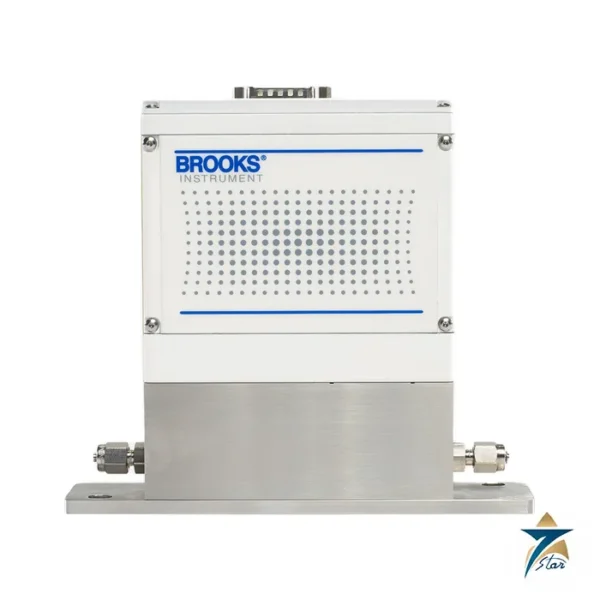
The GP200 is a metal-sealed, digital, ultra-high-purity pressure-based mass flow controller (P-MFC) for gases. Brooks describes it as the first inlet and outlet pressure insensitive P-MFC and designed it specifically for semiconductor applications, so it is a specialist component for gas panels in that field rather than a general industrial flow controller. A patented differential pressure sensor and a downstream valve architecture are intended to remove the limits of earlier pressure-based designs.
The MultiFlo gas model is embedded in each unit, allowing gas and range to be reconfigured on the fly. During supply disruptions of up to 40 psi per second the flow is held within 1 percent of setpoint, and the downstream valve can deliver flow into outlet pressures up to 1200 Torr. A low-pressure option serves etch gases such as SiCl4, BCl3 and C4F6.
Technical specifications
| Parameter |
Specification |
| Full-scale range |
3 sccm to 50,000 sccm N2 equivalent; nine standard bins |
| Process gas accuracy, zero-leak valve |
Under +/-1% of setpoint (5 to 100% FS); under +/-0.05% FS (0.5 to 5% FS) |
| Process gas accuracy, metal-seal valve |
Under +/-1% of setpoint (5 to 100% FS); under +/-0.05% FS (2 to 5% FS) |
| Control range |
0.5 to 100% FS (zero-leak valve); 2 to 100% FS (metal-seal valve) |
| Repeatability and reproducibility |
+/-0.15% of setpoint (5 to 100%); +/-0.015% FS (0.5 or 2 to 5%) |
| Transient response |
280 +/-20 ms matched transient response for ascending or descending non-zero setpoints |
| Valve leak-by |
Zero-leak valve under 0.005% FS of bin (bins 42-46), under 0.02% (bins 40-41); metal-seal valve under 0.15% FS of bin at 45 psia to vacuum |
| Supply pressure insensitivity |
Under +/-1% of setpoint up to 40 psi/sec inlet spike |
| Dynamic back-pressure insensitivity |
Maintains accuracy for vacuum to 1200 Torr disturbance over 1 second |
| Zero stability |
Under +/-0.15% FS per year |
| Temperature coefficient |
Zero 0.005% FS per C; span 0.05% of setpoint per C |
| Operating temperature |
10 to 60 C |
| Operating inlet pressure |
Under 15 psia for low-pressure bins; 15 to 30, 25 to 40, 35 to 50 or 45 to 60 psia |
| Differential pressure |
7 psid typical minimum, up to 50 psid maximum |
| Pressure ratings |
Proof 100 psia (CT bins) or 45 psia (LP bins); design 150 psia; burst 1000 psia |
| External leak integrity |
1×10⁻¹⁰ atm cc/sec He |
| Valve type |
Normally closed |
| Wetted materials |
316L, Hastelloy C-22, 316/316L and 304 stainless steel, KM-45, PCTFE; 5 micro-inch Ra average |
| Display |
Top-mounted rotatable LCD showing flow, temperature and pressure |
| Interfaces |
DeviceNet, EtherCAT, RS485/analog 0-5 V; micro-USB RS485 diagnostic port |
| Compliance |
EMC 2014/30/EU EN 61326-1, RoHS 2011/65/EU and 2015/863/EU, REACH EC 1907/2006 |
Understanding the bins and ordering code
The ordering code starts with GP200 and a valve choice: P for a positive shut-off, zero leak-by valve or C for a normally closed valve with a metal seat. The gas and range field holds a Brooks gas code and a full scale, for example the standard bins from 10 sccm (CT40) up to 45,000 sccm (CT48) at 35 psia inlet and vacuum outlet. A bin type selects the standard (CT) or low-pressure (LP) family, the latter in bins 40 to 46. Fitting options are 1-1/8 inch body width with C-seal, W-seal, C-seal with poka-yoke or a 124 mm male 1/4 inch VCR version. The base I/O codes are G1 for analog with RS485, TX for analog only, E0 for EtherCAT and DX for DeviceNet.
What to confirm before ordering
Provide the gas, flow and bin, inlet pressure window and outlet condition, fitting footprint, I/O type and whether zero leak-by is required. The datasheet advises using the Brooks Configurator and bin tables for gas-specific inlet pressure options, and says the lowest controllable setpoint for the smallest bins is about 1 percent of the bin at 35 psia, which is 0.1 sccm nitrogen. The device should be zeroed at ambient operating temperature.
How the Brooks GP200 works
A differential pressure sensor measures the pressure drop across a restriction and a downstream valve sets the flow. The embedded gas model converts the reading into mass flow for the selected gas. The result is a controller that does not react to supply or outlet pressure changes.
Where the GP200 is used
- Semiconductor process gas panels
- Etch process tools
- Deposition tools
- Ultra-high-purity gas delivery
- Multi-gas process chambers
Selection checklist for the GP200
- Process gas
- Full-scale range bin
- Valve type
- Inlet pressure range
- Outlet pressure
- Differential pressure available
- Communication interface
- Seal material
Installation, commissioning and maintenance notes for the GP200
Install the controller on a clean, purged gas panel with the base mounting face flat. Leak-check the connections. Confirm the gas and range in the embedded gas model and check the zero before first use. Keep the inlet gas clean and dry.
Requesting a quotation for the Brooks GP200
Please send the gas, the flow range, the valve type and the inlet and outlet pressures. Seven Star LLC serves industrial customers in Oman and the GCC and replies with a quotation based on the information provided.
GP200 controller type
It is a metal-sealed, digital, ultra-high-purity pressure-based mass flow controller.
GP200 target field
Brooks designed it specifically for semiconductor applications.
GP200 pressure insensitivity
Brooks describes it as the first inlet and outlet pressure insensitive pressure-based mass flow controller.
GP200 sensor
A patented differential pressure sensor is used.
GP200 valve architecture
The valve is mounted downstream of the sensor.
GP200 gas model
The MultiFlo gas model is embedded in each unit.
GP200 reconfiguration
Gas and range can be reconfigured on the fly.
GP200 supply disruptions
Flow is held during supply disruptions of up to 40 psi per second.
GP200 outlet pressure
The downstream valve can deliver flow into outlet pressures up to 1200 Torr.
GP200 low pressure option
A low-pressure option serves etch gases such as SiCl4, BCl3 and C4F6.
GP200 full-scale range
The range is 3 sccm to 50,000 sccm nitrogen equivalent.
GP200 range bins
There are nine standard bins.
GP200 valve options
A zero-leak valve and a metal-seal valve are offered.
GP200 zero-leak control range
With the zero-leak valve the control range is 0.5 to 100 percent of full scale.
GP200 metal-seal control range
With the metal-seal valve the control range is 2 to 100 percent of full scale.
GP200 transient response
The matched transient response is about 280 ms for ascending or descending non-zero setpoints.
GP200 back pressure
It maintains control through a vacuum to 1200 Torr disturbance over 1 second.
GP200 operating temperature
The operating temperature is 10 to 60 degrees C.
GP200 low pressure bins
Low-pressure bins operate at an inlet pressure under 15 psia.
GP200 inlet pressure ranges
Other ranges are 15 to 30, 25 to 40, 35 to 50 and 45 to 60 psia.
GP200 differential pressure
A typical minimum of 7 psid is needed, up to a maximum of 50 psid.
GP200 temperature effect
The zero temperature coefficient is 0.005 percent of full scale per degree C.
GP200 span temperature effect
The span temperature coefficient is 0.05 percent of setpoint per degree C.
Controller records for the GP200
Record the gas, the range bin, the valve type and the date of each zero check.
Choosing the right GP200 valve
Choose the valve from the leak-by and control range your process needs.
Documents and quotation
The manufacturer datasheet is attached to this page as a download. For a quotation, send the full model code and the process data to Seven Star LLC in Muscat; browse more instruments in the Flowmeters category. We supply this item as an independent supplier, so please confirm availability and delivery with us.









Reviews
There are no reviews yet.