- Automation & ControlView all 1,983 products
- AC Drives
- PLC & I/O Cards
- Industrial Communications
- Automation Accessories
- Vibration Monitoring
- Controllers & Data Acquisition
- Isolator & Barrier
- CCTV & Security
- Safety Switches & Guard Locking
- Encoders
- HMI Displays
- Motor Soft Starters
- Industrial Computers
- Pneumatic Cylinders
- Servo Drives
- Machine Vision
- Automation Software
- Robotics
















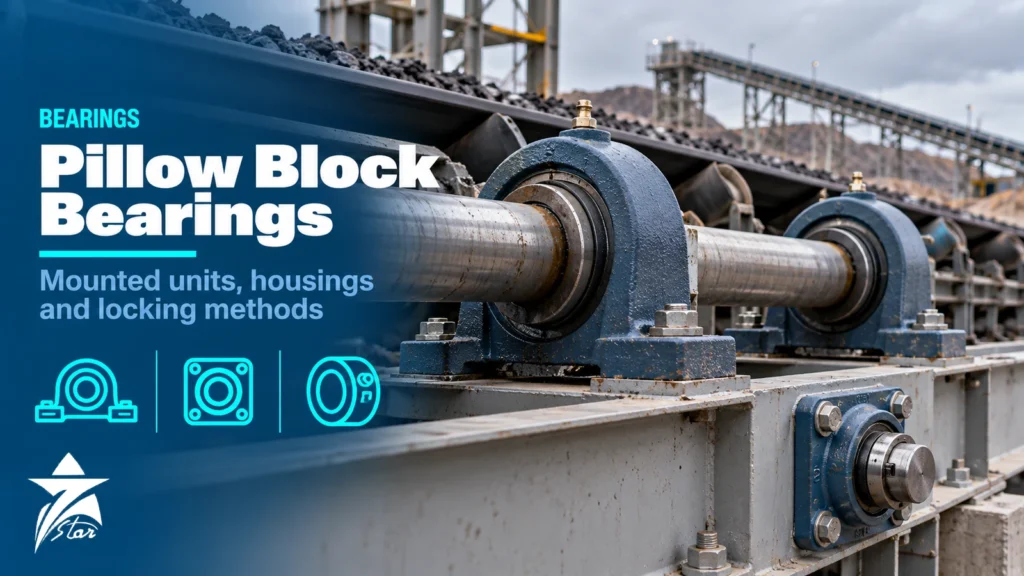
Conveyors, fans, agitators, screens and line shafts rarely have a machine frame with a bored bearing seat, so the bearing comes in its own housing that bolts to the structure. Choosing the right mounted unit, and the right way to lock it to the shaft, decides whether it runs for years or works loose within weeks. This guide explains pillow block bearings and the wider family of mounted units: insert bearing units, flange and take-up housings, split plummer blocks, locking methods, seals, locating and floating arrangements, and the mounting practices that prevent early failures.
Two Families: Insert Bearing Units and Split Housings
Mounted bearings fall into two broad groups. Insert bearing units, commonly called pillow block or Y-bearing units, combine a deep groove ball bearing with an extended inner ring and a spherical outer surface, fitted into a one-piece cast iron, pressed steel, stainless or polymer housing. They arrive ready to slide onto the shaft and lock in place. Split plummer block housings have a separate cap and base and take a standard bearing, usually a self-aligning ball or spherical roller bearing on an adapter sleeve, chosen and assembled on site. Housings for insert bearings are covered by ISO 3228, while insert bearing dimensions follow ISO 9628. Our mounted bearings and housings category shows both families.
Housing Styles Compared
| Housing style | Mounting | Typical uses | Points to check |
|---|---|---|---|
| Pillow block (two-bolt) | Base bolted parallel to shaft | Conveyors, fans, line shafts | Shaft height, bolt spacing, slotted holes |
| Four-bolt flange (square) | Bolted to a wall or frame face perpendicular to shaft | Machine frames, agitators, drives | Bolt circle, pilot spigot, wall thickness |
| Two-bolt flange (oval) | Narrow frame face | Light machinery, agricultural and packaging equipment | Load direction relative to bolts |
| Three-bolt or round flange | Circular cut-out with spigot | Precise radial location | Spigot diameter and tolerance |
| Take-up unit | Slides in a frame to tension a belt or chain | Conveyor tail pulleys, elevators | Travel length, screw adjuster |
| Hanger unit | Suspended from above | Screw conveyors | Clearance to flights |
| Split plummer block | Two- or four-bolt base, separate cap | Heavy fans, crushers, large conveyors | Sleeve size, seal type, locating ring |
The usual housing material is grey cast iron, with ductile iron or cast steel for shock loads, pressed steel for light duties, and stainless steel or thermoplastic for food, washdown and corrosive areas.
How Insert Bearings Self-Align
The insert’s spherical outer ring sits in a matching spherical bore in the housing. When the housing is bolted down slightly out of line with the shaft, the insert swivels to follow the shaft. This tolerance for initial misalignment is a major reason insert units are popular on fabricated steel frames, which are rarely perfectly true. It is not a licence for running misalignment: a shaft that wobbles in operation will fret the outer ring in its seat and wear the seals. Many units have a lubrication hole in the outer ring with a grease fitting in the housing, and some designs include an anti-rotation pin.
Locking Methods for Insert Bearings
Insert bearings are normally fitted on shafts with a loose fit, so the locking method carries all the responsibility for preventing the inner ring from creeping on the shaft.
- Set screw (grub screw) locking: two screws in the extended inner ring, typically 120° apart, clamp directly onto the shaft. Simple and suitable for both rotation directions, but the screws mark the shaft and can loosen under vibration if not tightened to the specified torque.
- Eccentric locking collar: the collar is turned on an eccentric on the inner ring until it binds, then locked with one set screw. Good for one rotation direction; tighten in the direction of shaft rotation.
- Concentric collar: a collar clamps the slotted inner ring to the shaft evenly, reducing shaft damage and running more smoothly at higher speeds.
- Adapter sleeve: a tapered sleeve and lock nut give a tight, concentric fit on a standard drawn shaft, suited to higher speeds, vibration and heavier loads.
- Taper lock and other clamping systems from individual manufacturers that spread the clamping force around the shaft.
Shaft tolerance matters: insert bearings typically need a shaft within the manufacturer’s stated tolerance, often in the h6 to h9 range depending on speed and load. An undersized or worn shaft will let the inner ring slip regardless of how well the screws are tightened.
Split Plummer Blocks and Bearing Arrangements
A split plummer block takes a standard bearing, so the full catalogue of self-aligning ball bearings and spherical roller bearings is available. A typical arrangement on a fan or conveyor pulley uses a tapered bore spherical roller bearing, such as a 222xx K series bearing, mounted on an adapter sleeve in a housing of the corresponding size. Bearings on cylindrical seats with lock nuts and spacer rings are used where a shoulder is available.
One housing on each shaft must locate the shaft axially, and the other must allow it to float as it grows with temperature. This is done with locating rings fitted on both sides of the outer ring in the locating housing and none in the non-locating housing, where the outer ring can slide. Fitting rings in both housings, or none at all, is a common error that leads to overloaded bearings or a shaft that wanders axially. Cap and base are machined together and must not be swapped between housings.
Seals for Mounted Bearings
Seals decide the life of mounted units in most industrial plants because contamination, rather than fatigue, is the usual end of a bearing in dirty duties.
- Contact lip seals in insert bearings: good general protection; extra flingers or covers help in dusty and wet duties.
- Felt seals: traditional, low cost, suited to grease lubrication in clean, moderate speed duties.
- Double lip seals: better contamination protection at moderate speeds.
- Labyrinth seals: non-contacting, suitable for higher speeds and higher temperatures, often packed with grease.
- Taconite or multi-stage seals: labyrinth plus contact seal with a grease purge path, for heavy dust such as mining, cement and quarry plants.
- End covers: closed covers on shaft ends protect people and keep dirt out.
Seal temperature limits depend on the material, so check the catalogue rating for hot fan and oven applications.
Selecting a Mounted Unit
Gather the following before selecting or requesting a mounted unit:
- Shaft diameter, metric or inch, and actual shaft tolerance.
- Radial and axial loads, including belt pull, pulley weight and shock.
- Speed and duty cycle.
- Housing style, shaft centre height and bolt hole spacing to suit the existing frame.
- Locking method and whether the shaft must locate or float.
- Operating temperature, contamination, washdown or chemical exposure.
- Lubrication: sealed for life or relubricatable.
- Existing designation from the housing and insert, if replacing.
Calculate bearing life with the same methods used for other rolling bearings, but remember that the housing, bolts and base also need to carry the load. Pillow block housings are generally strongest when the load acts down into the base; loads pulling the cap upward or acting parallel to the base may need checking against the manufacturer’s permissible load data.
Mounting Best Practice
- Check the shaft: clean, straight, within tolerance and free of burrs at the bearing seat.
- Slide the unit on by pushing on the inner ring, never by hammering the housing.
- Bolt the housings loosely, rotate the shaft and let the inserts align.
- Tighten the base bolts to the specified torque, with shims if the base is uneven.
- Lock the inner ring: set screws to the specified torque, collars in the rotation direction, sleeves to the specified drive-up.
- Check that the shaft turns freely and that the floating bearing can move axially.
- Grease relubricatable units with a small quantity after installation if required by the manufacturer.
Common Mistakes and Failure Signs
- Set screws not tightened to torque, causing the inner ring to creep and wear the shaft.
- Insert units fitted on worn or undersized shafts.
- Both bearings locating, so the shaft cannot expand.
- Over-greasing that pushes seals out and lets dirt in.
- Mixing caps and bases between split housings.
- Mounting on uneven or flexible steelwork, distorting the housing bore.
Signs of trouble include noise, rising temperature, shiny marks on the shaft beside the inner ring, grease leaking or dried around the seals and visible movement of the housing. Bearing condition can be monitored with portable vibration and temperature instruments.
GCC Conditions: Dust, Heat and Washdown
Mounted units are often outdoors on conveyors, cooling tower fans, quarry plants and desalination intakes, where fine dust, sand and humidity are constant. Multi-stage or taconite seals and closed end covers are worth considering on dusty duties, and grease with good water resistance helps near the coast. Direct sun can raise housing temperatures well above the ambient air, so check grease and seal temperature ratings for exposed units. Stainless or coated housings and stainless inserts are common choices in seawater spray and food plants.
Pillow Block Bearings Checklist
- Shaft diameter and tolerance measured.
- Housing style, centre height and bolt spacing matched to the frame.
- Locking method suited to speed, vibration and rotation direction.
- Locating and floating housing defined.
- Seals suited to dust, water and temperature.
- Lubrication plan and grease type defined.
- Mounting torques for bolts and set screws available.
- Old designations recorded before replacement.
Mounted Bearings and Tools We Supply
These examples cover mounted units and maintenance tools.
| Product | Type | Where it fits |
|---|---|---|
| Dodge 300-Series Mounted Ball Bearing Pillow Block | Mounted ball bearing pillow block | Conveyors, fans and shafts. |
| Timken Corrosion-Resistant Mounted Ball Bearings Stainless and Polymer Housings | Corrosion-resistant mounted bearings | Wash-down and wet areas. |
| SKF LGMT 2 General Purpose Industrial Bearing Grease | General purpose grease | Mounted bearing relubrication. |
| SKF TLSD SYSTEM 24 Single Point Automatic Lubricator | Automatic lubricator | Mounted bearings that are hard to reach. |
Send the shaft size, housing type and bearing designation through our quote request form.
Sourcing Pillow Block Bearings Through Seven Star LLC
Seven Star LLC supplies insert bearing units, flange units, take-up units, split plummer block housings, adapter sleeves and seals from established manufacturers on request, along with lubrication and maintenance items from our lubrication and bearing maintenance range. We help with selection and with cross-checking housing and insert part numbers between manufacturers, and availability and lead time are confirmed at quotation.
Send us the housing and insert markings, shaft diameter and a photo of the existing unit, or your RFQ list, and we will respond with matching options in our quotation.
Frequently asked questions
What is the difference between a pillow block and a plummer block?
In everyday use the terms overlap, and both describe a housing bolted to a flat surface parallel to the shaft. Pillow block usually refers to a ready-to-mount unit with an insert bearing in a one-piece cast or pressed housing. Plummer block usually refers to a split housing, with separate cap and base, that takes a standard self-aligning ball or spherical roller bearing, often on an adapter sleeve.
How does a set screw insert bearing differ from an eccentric collar type?
A set screw insert has two grub screws in the extended inner ring, usually 120° apart, that clamp directly onto the shaft. An eccentric locking collar is turned onto a matching eccentric on the inner ring until it binds, then secured with a single set screw. Set screw locking suits both rotation directions, while eccentric collars are normally tightened in the direction of rotation and are better suited to one-way running.
Can insert bearing units accept shaft misalignment?
Yes. The insert has a spherical outer ring seated in a matching spherical bore in the housing, so the unit can align itself to the shaft during installation. This initial alignment capacity is not intended to accommodate continuous wobbling or dynamic misalignment, and the limit is given in the manufacturer's catalogue.
When should I use a split plummer block instead of a pillow block unit?
Split plummer blocks are normally chosen for heavier loads, larger shafts and critical drives such as large fans, conveyors and crushers. They take standard spherical roller bearings with high load ratings, allow inspection and bearing replacement without removing the shaft from the housing base, and offer a wide range of seals. Insert bearing units are compact, quick to fit and suit light to medium loads.
What is a locating ring in a plummer block?
A locating ring, also called a stabilising ring, is fitted beside the bearing outer ring to fix it axially in one housing. The other housing on the same shaft is fitted without rings so its bearing can float and accommodate thermal expansion of the shaft. Fitting rings in both housings locks the shaft and induces axial loads as it heats.
Do sealed insert bearings need regreasing?
Many insert bearings are factory-greased and can run for long periods without relubrication in clean, cool and moderate speed duties. Units with grease fittings should be relubricated where contamination, moisture, high temperature or continuous duty shorten grease life. Add small quantities slowly while the shaft turns, as excess grease can damage the seals.
Was this guide helpful?One click helps us write better guides for engineers.
Thank you! Glad it helped. Need this equipment for your project? Request a quotation
Thank you. We will use this to improve the guide.