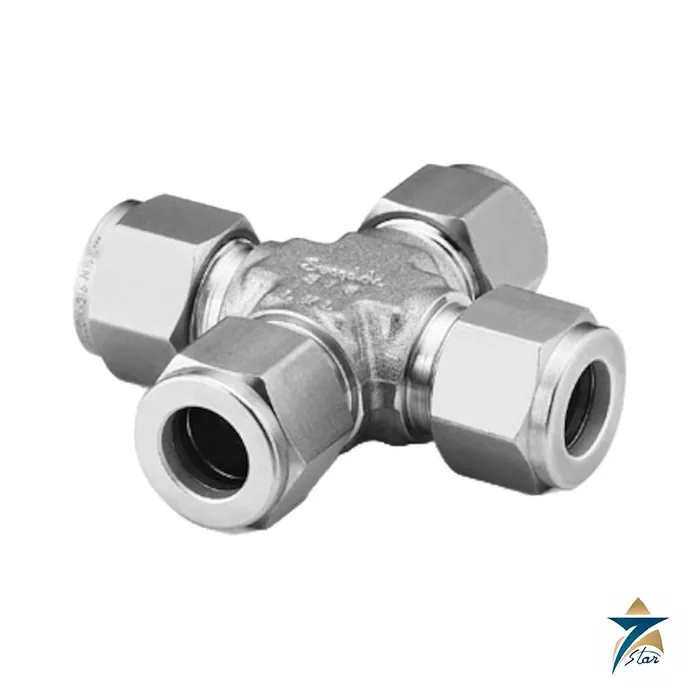
A cross is the least common of the tube-fitting shapes and the most useful on a crowded panel. The Swagelok SS-810-4 puts four 1/2 in. tube-fitting ends on one 316 stainless steel forging, so a single body can take a supply, two outlets and a gauge or vent, with one set of ferrules per port and no intermediate joints.
Technical specifications
| Parameter |
Specification |
| Part number |
SS-810-4 |
| Description |
Union cross, four 1/2 in. Swagelok tube-fitting ends |
| Body material |
316 stainless steel (forged shape) |
| Tube OD (all ports) |
1/2 in. |
| Dimension A (port to opposite port) |
2.84 in. |
| Dimension D (nut size) |
0.90 in. |
| Dimension E (nominal opening) |
0.41 in. |
| Hex flat F |
13/16 in. |
| Pressure basis |
Working pressure of the tubing used (Tubing Data MS-01-107) |
| Cleaning |
Standard cleaning and packaging SC-10 |
Why choose a cross
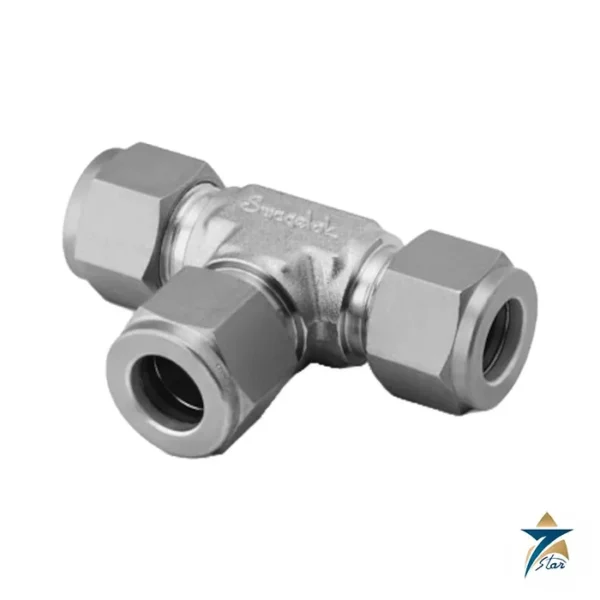
Replacing a cross with two tees means an extra joint and an extra length of tube. In the 1/2 in. size the cross measures 2.84 in. from port to port, the same run length as the union tee SS-810-3, so it occupies no more room along the line than a tee while adding the fourth branch. Typical uses are a manifold where a pressure transmitter, a test point and a vent share a line, or a sample junction that feeds two analysers from one header.
Because four nuts meet around one body, check wrench access before committing to the layout: each nut hex is 13/16 in. across flats at the body and the nuts are 0.90 in. in the D dimension.
Selection and ordering
The code reads SS for 316 stainless, 810 for 1/2 in. tube and 4 for union cross. The catalog lists the cross for tube sizes from 1/8 in. upward, with matching metric 12M0-4 for 12 mm tubing. Crosses are forged, so the body uses ASTM A182 stock, and the nominal opening E is 0.41 in. Other materials such as brass or alloy 400 are available under their own prefixes; confirm the material you need and quote the whole number.
Do not use a cross where a pulsating or vibrating line meets a rigid body without tubing support, because four connections concentrate stress at the forging. Brace tubes close to the cross and keep bends away from the nuts.
Installation reminders
Cut the tube square, deburr it and wipe it clean, then seat it fully. Take the nut to finger-tight, mark it if you wish, and rotate it one and one-quarter turns. A gap gauge sized for the tube confirms the result, and the system must be depressurised before the nut is touched.
The catalog stresses that installation advantages come from the live-loaded ferrule design: no torque reaches the tubing, and a leak-tight connection can be disconnected and retightened. Swagelok advises against mixing its parts with components of other manufacturers because no industry design standard exists for two-ferrule tube fittings.
Key features of the SS-810-4
- Four identical 1/2 in. Swagelok tube-fitting ends on a single forged 316 stainless steel body.
- Two-ferrule design on each port: the front ferrule seals against the body and tube, and the back ferrule grips the tube.
- Port-to-opposite-port dimension A of 2.84 in., equal to the run length of the matching union tee.
- Pressure capability governed by the tubing wall thickness and material, per the Swagelok tubing data reference.
- Supplied with nuts and ferrules assembled, cleaned and packaged to the SC-10 standard.
Matching tubing to the fitting
Because the fitting rating follows the tube, the tube selection deserves as much attention as the cross itself. Use fully annealed seamless or welded-and-drawn 316 stainless tubing of 1/2 in. outside diameter, with a hardness and wall thickness inside the range that Swagelok lists for this size. Tube that is too hard or too thin may not take a proper ferrule grip, while very heavy wall tube raises the pressure rating but also the make-up effort. Avoid mixing fitting materials across a system; the same alloy for tube, body and ferrules prevents galvanic issues and keeps the ferrule hardness relationship that the design relies on. Components from different tube-fitting manufacturers should not be interchanged on the same joint.
Assembly and remake
- Cut the tube square and deburr inside and outside; a burr can damage the ferrule seal.
- Insert the tube until it bottoms firmly on the shoulder inside the body, then tighten the nut finger-tight.
- Mark the nut and follow the turns from finger-tight specified by Swagelok for 1/2 in. size, using an inspection gauge to confirm adequate make-up.
- When remaking a joint, return the nut to its previous position and then tighten slightly; do not over-torque.
- Support the four branches with clamps so that line vibration and thermal movement do not load the cross.
Applications in Oman and the GCC
Union crosses turn up on analyser shelters, chemical injection skids, instrument manifolds and hydraulic test benches in oil and gas, petrochemical and power facilities. 316 stainless steel is the usual material for these panels because it resists general corrosion from humid coastal air, although in hot, chloride-laden environments tubing and fittings can still suffer pitting or staining over time. Keeping fittings clean, avoiding contact with carbon steel debris, and using tube clamps with suitable inserts all help. For more aggressive service, the same cross geometry is offered in higher alloys under different prefixes, and the decision should follow the project’s material selection report.
What to include in your RFQ
- Exact part number SS-810-4, or the alloy prefix and size if a different material is needed.
- Quantity and any requirement for a single heat lot or material test reports.
- Tubing specification (OD, wall, material) if tubing is quoted with the fittings.
- Any special cleaning, such as oxygen service, beyond the standard SC-10 cleaning.
- Delivery site and required timeline.
Documents and quotation
The Swagelok catalog MS-01-140 is the source for the tables and rules on this page and is attached for download. For a quotation please give us the full part number SS-810-4, the quantity and any packaging requirement.
Related items: product category.






Reviews
There are no reviews yet.