A 16 bar electronic switch with a rotatable display and analogue output
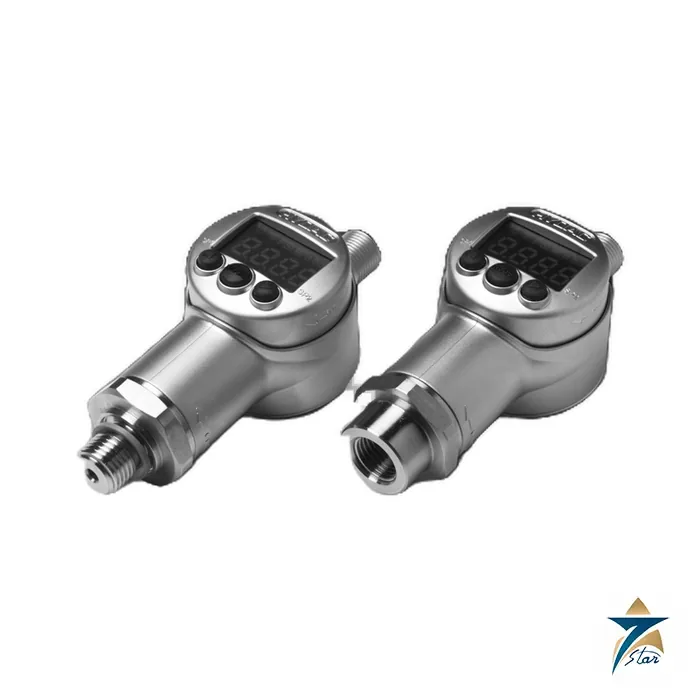
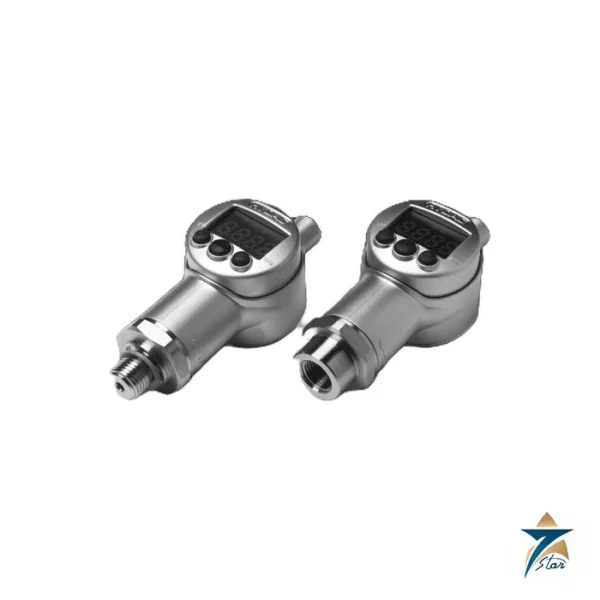
The Hydac EDS 3316-3-0016-000-F1 (HYDAC part number 908729) is an electronic pressure switch from the EDS 3300 family for low-pressure ranges. It has a ceramic measuring cell, a 4-digit LED display, one PNP transistor switching output and a switchable analogue output of 4 to 20 mA or 0 to 10 V. That combination lets one device both switch a pump or valve and feed a pressure value to a controller.
A characteristic feature of the EDS 3300 is that the display housing can be turned in two axes, so the reading can be aligned to the mounting position without a mechanical adapter.
Technical specifications
| Parameter |
Specification |
| HYDAC part number |
908729 |
| Model code |
EDS 3316-3-0016-000-F1 |
| Measuring range |
0 to 16 bar |
| Overload pressure |
48 bar |
| Burst pressure |
80 bar |
| Mechanical connection |
G1/2 B DIN EN 837, male; 45 N·m |
| Sensor cell |
Ceramic |
| Wetted parts |
Stainless steel connection, copper and FKM seals |
| Switching outputs |
1 PNP transistor output plus 1 analogue output |
| Switching current |
1.2 A max. per output; more than 100 million cycles |
| Switch point range |
0.25 to 16 bar, increment 0.05 bar |
| Hysteresis range |
0.1 to 15.8 bar |
| Analogue signal |
4 to 20 mA (load max. 500 ohm) or 0 to 10 V (load min. 1 kohm), selectable |
| Accuracy (DIN 16086) |
0.5 % FS typical, 1 % FS maximum (display, analogue output) |
| Repeatability |
0.25 % FS max. |
| Display |
4-digit red LED, 7 mm digits; bar, psi or MPa |
| Supply voltage |
18 to 35 V DC with analogue output (datasheet) |
| Electrical connection |
Male M12x1, 4-pole |
| Operating temperature |
-25 to +80 °C (-25 to +60 °C to UL specification) |
| Fluid temperature |
-25 to +80 °C |
| Protection class |
IP 67 with mating connector |
| Vibration / shock |
10 g / 50 g |
| Weight |
Approx. 120 g |
| Approvals as printed |
CE (EN 61000-6-1/2/3/4); cUL, certificate no. E318391 |
Setting and functions
The switch point, switch-back hysteresis and window function are set from the front keys in two menus, with a programming lock against tampering. The output can run as a switching-point function or as a window function with N/C or N/O direction, with switch-on and switch-off delays of 0.00 to 99.99 seconds. When you change the display unit between bar, psi and MPa, the instrument converts all the stored switching points automatically.
Order code
The datasheet pattern is EDS 3 3 X X – X – XXXX – 400 – X 1. In this code the output digit 3 means one switching output and one analogue output, the electrical digit 6 is the four-pole M12x1 plug, F stands for an FKM seal (E would be EPDM for water or refrigerants) and 1 for stainless steel. The thread and range digits shown in the catalogue entry here are G1/2 B and 16 bar; the datasheet attached is the HYDAC USA edition with psi ranges and NPT, so use it for series features and settings and verify the thread on your drawing.
Tighten the G1/2 B connection to 45 N·m using the sealing ring specified for that thread, and do not apply a spanner to the display housing. For a PLC input, set the analogue output and check the supply voltage against the 18 V minimum.
Selection checks before ordering the EDS 3316
Start with the pressure profile of the circuit rather than the nominal system pressure. The 0 to 16 bar range suits low-pressure duties such as lubrication, cooling, filtration and return lines, but pressure peaks from valve switching or pump start-up should stay below the overload rating listed above. If the circuit sees regular spikes, consider damping at the measuring point or a different range after discussing the application.
Check fluid compatibility against the FKM seal and stainless steel connection, and confirm that the fluid temperature stays within the stated range. Then compare the electrical side with your controller: supply voltage, whether the PLC input card expects current or voltage for the analogue signal, and whether a PNP switching output fits the input logic.
Installation and commissioning on hydraulic skids
Mount the switch at a point where it sees representative pressure, away from locations where air collects and, where practical, not directly at a pump outlet where pulsation is strongest. Use the specified sealing ring and tightening torque, and route the M12 cable with a drip loop so water cannot run along it toward the connector.
At commissioning, compare the display reading with a calibrated test gauge at two or three pressures across the working band. Set the switch point and hysteresis with the actual process behaviour in view: too narrow a hysteresis can make a pump or valve chatter, while too wide a band lets pressure wander before the output reacts. Record the final settings, enable the programming lock, and note the chosen analogue mode on the loop drawing so maintenance staff know what the controller should expect.
Using the delays and window function
The adjustable switch-on and switch-off delays help filter short transients that would otherwise trip an alarm. A window function is useful for supervising a filter or lubrication circuit where both low and high pressure indicate a fault. Test each alarm by raising and lowering pressure in a controlled way before handing the skid over.
Operating in GCC heat, dust and humidity
Hydraulic power units in Omani plants, quarries and ports often sit outdoors or in hot enclosures. Keep the instrument within its operating temperature range by shading it from direct sun and by not mounting it on hot pipework or close to heat sources. The IP 67 rating applies only with a correctly fitted mating connector, so check that connectors are fully seated and that unused cable entries in junction boxes are sealed against fine dust and condensation.
Humidity and temperature swings between day and night can draw moisture into poorly sealed connections. During routine maintenance, inspect the cable and connector, wipe dust off the display so readings stay legible, and verify the reading against a reference gauge at an interval suited to how critical the measurement is. If the reading drifts or the output behaves erratically, replace the unit rather than adjusting around the fault.
Documents and quotation
The EDS 3300 datasheet is attached. Send the full code and application. See also our pressure instrumentation range.










Reviews
There are no reviews yet.