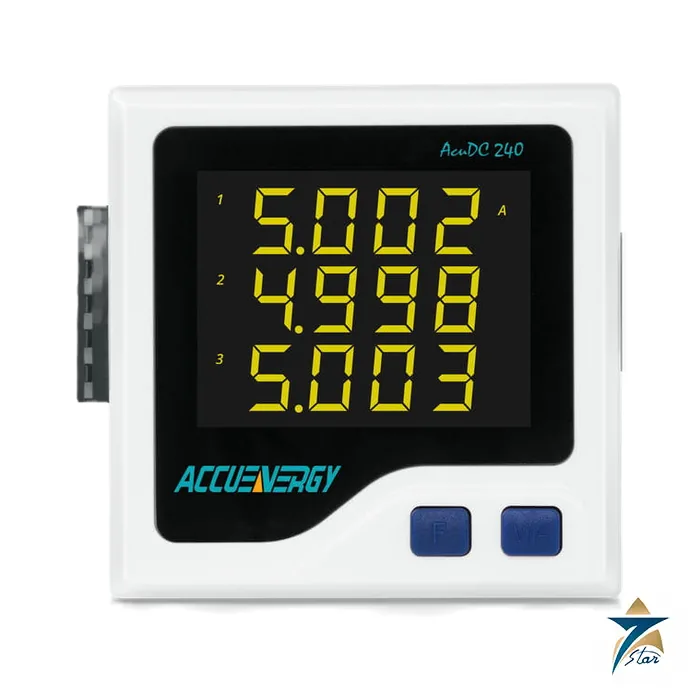
AcuDC 243 is the multifunction model of the Accuenergy AcuDC 240 series, a 72 mm x 72 mm DC power and energy meter for systems up to 1000 Vdc. It measures voltage, current, power, energy and ampere-hours with 0.2 percent accuracy on voltage and current, accepts shunts, Hall effect sensors or direct current input, and communicates by RS485 Modbus RTU.
A DC meter for solar, EV charging, telecom and plating plants
Alternating-current meters cannot read direct-current systems, so DC plants need a dedicated instrument. The AcuDC 243 reads voltage up to 1000 V directly (or up to 9999 V through a voltage Hall effect sensor) and current up to 50000 A through a shunt of 50 to 100 mV or a Hall effect sensor, or up to 10 A directly.
The 240 series adds cable loss compensation for long cable runs between meter and load, a note that matters for EV charging posts and remote DC loads. The datasheet also lists a new high-accuracy shunt model and an EV charger application order option with shunts from 50 A to 1000 A.
Features stated in the datasheet
- 0.2 % accuracy on voltage and current, 0.5 % on power and energy (0.2 % on power and energy available on request).
- Energy resolution of 0.1 Wh; ampere-hour measurement.
- Three configurable log files; 1-minute logging for up to four months.
- Optional I/O modules with analogue input and output, relay, digital output and a plus/minus 15 Vdc Hall sensor supply.
Technical specification
Metering (datasheet)
| Parameter |
Specification |
| Voltage |
0.2 %; 0.001 V; 0 – 9999 V |
| Current |
0.2 %; 0.001 A; 0 to ± 50000 A |
| Power |
0.5 %; 0.001 kW; 0 to ± 60000 kW |
| Energy |
0.5 %; 0.0001 kWh; 0 – 9999999.99 kWh |
| Drift and stability |
Below 100 ppm per C; 0.5 % per year |
Inputs, outputs and environment
| Parameter |
Specification |
| Current input |
Direct 0 – ±10 A; shunt 50 – 100 mV; Hall sensor 0 – ±5 V / 0 – ±4 V or 4 – 20 mA / 12 mA ± 8 mA |
| Voltage input |
Direct 0 – 1000 V; via Hall effect sensor 0 – 9999 V; impedance 2 Mohm; accuracy 0.2 % |
| Digital input |
Dry, 20 – 160 Vac/dc; 2 ms SOE; 100 Hz maximum; isolation 2500 Vac |
| Digital output (Photo-MOS) |
0 – 250 Vac/dc, 100 mA maximum, 25 Hz |
| Relay output |
Form A, 250 Vac / 30 Vdc, 5 A resistive, 2 A inductive; 10 ms set time |
| Analogue output |
0 – 5 V / 1 – 5 V or 0 – 20 mA / 4 – 20 mA; accuracy 0.5 %; 500 Vdc isolation |
| Control power |
P1: 100 – 240 Vac 50/60 Hz or 100 – 300 Vdc; P2: 20 – 60 Vdc; about 3 W typical |
| Communication |
RS-485 half duplex, optically isolated, 1200 – 38400 bps, Modbus RTU |
| Operating / storage temperature |
-25 to 70 C / -40 to 85 C; humidity 5 – 95 % non-condensing |
| Dimensions |
72.0 x 72.0 x 64.5 mm; panel cut-out 68.0 x 68.0 mm |
| Standards |
IEC 61010-1; EMC IEC 55011, IEC 61000-6-2, IEC 61000-3-2, IEC 61000-3-3 |
Ordering code
The code reads Meter Model – Voltage Option – Current Option – Power Supply – I/O Option – Communication – Datalogging. Voltage options are 1000V, 600V, 300V, 60V or 5V (via Hall sensor); current options A0 (0 – 10 A direct), A1 (shunt 50 – 100 mV), A2 (Hall effect 4 – 20 mA) and A3 (Hall effect 0 – 5 V / 0 – 4 V); power supply P1 or P2; I/O modules X1 (2DI+2AO current), X2 (2DI+2AO voltage), X3 (2DI+2RO), X4 (2DI+2DO), X5 (2DI±15 Vdc); communication C; datalogging D.
Examples printed: AcuDC 243-300V-A1-P1-X1-C-D and AcuDC 243-1000V-A1-P2-C-D. The EV charger version appends U and an optional shunt rating, for example AcuDC 243-1000V-A1-P2-C-U-1000A.
Grounding limits and installation
The datasheet warns that an AcuDC 243 with Hall effect current input and direct voltage input supports only negative grounding systems. For positive, ungrounded or centre-tap systems an external voltage Hall effect sensor must be used, otherwise damage or unsafe operation may occur.
Accessories are a DIN rail mounting adapter (DC-DIN) and a USB-RS485 converter. When the voltage exceeds 1000 V or an isolation sensor is required, choose the Hall effect voltage input with a 0 – 5 V output.
Applications
Listed uses include DC energy management, renewable energy, metallurgy and electroplating, light rail transit, EV charging, data centres and cellular tower monitoring. General engineering note: telecom towers in remote Gulf locations often run on DC plant with solar or generator supply, where per-site DC kWh is hard to obtain without a DC meter.
Related Accuenergy items
For revenue-grade dual-channel DC billing see the AcuDC-262, and for EV charging transactions the AcuDC-301. See the power meters category.
Commissioning and enquiry notes
DC metering is increasingly needed in the region for solar PV plants, battery storage, telecom sites and EV charging. Select the current sensor type and range to match the system, and follow the grounding limits in the datasheet. In outdoor combiner boxes and solar sites, check the enclosure temperature in summer against the meter rating.
Information to send with an enquiry
- System voltage and current range
- Sensor type: shunt, Hall effect or direct input
- Quantity
Frequently asked questions
What is the maximum DC voltage?
1000 V direct, or up to 9999 V when a voltage Hall effect sensor is used, according to the datasheet.
How is current measured?
Directly up to 10 A, or through a 50 – 100 mV shunt or a Hall effect sensor for up to 50000 A, programmable.
Does it keep logs?
Yes with the D option: three configurable log files, one-minute interval, about four months of records for voltage, current, power, energy, ampere-hour and DI count.
Can it be used on positively grounded systems?
Only with an external voltage Hall effect sensor; the direct voltage input supports negative grounding systems only when used with Hall effect current input.
Is Seven Star LLC an Accuenergy distributor?
No, we are an independent supplier in Muscat and supply Accuenergy items on request rather than acting for Accuenergy.
Documents and quotation
For quotation, send your required quantity and destination. The Accuenergy datasheet and user manual for AcuDC 243 are provided below the description on this page. Seven Star LLC works as an independent supplier from Muscat. Please compare code, ratings and options with the documents before you place an order; see also the category listing.








Reviews
There are no reviews yet.