Turning a girder through 90 degrees with one clamp on the flange
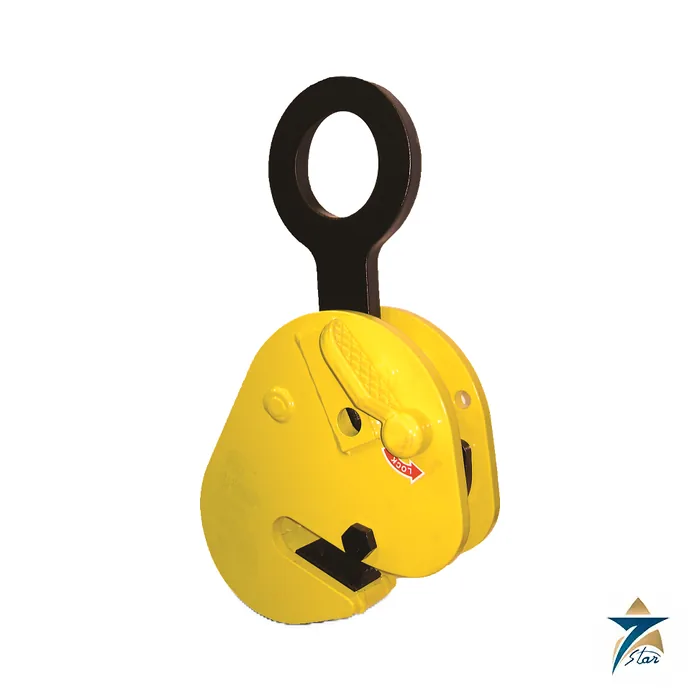
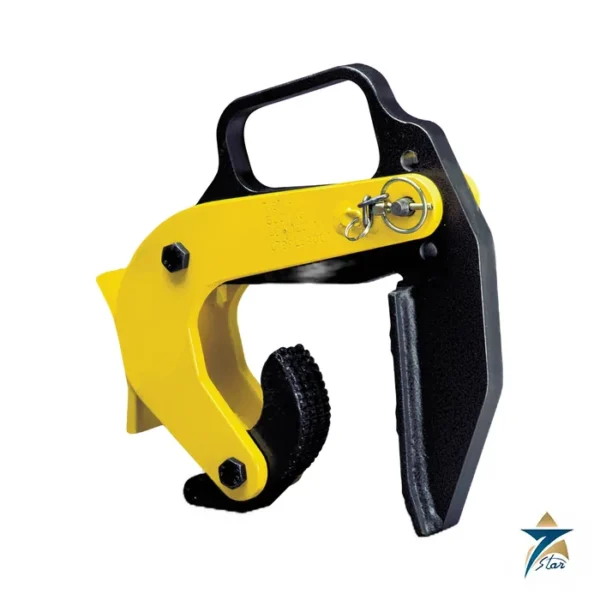
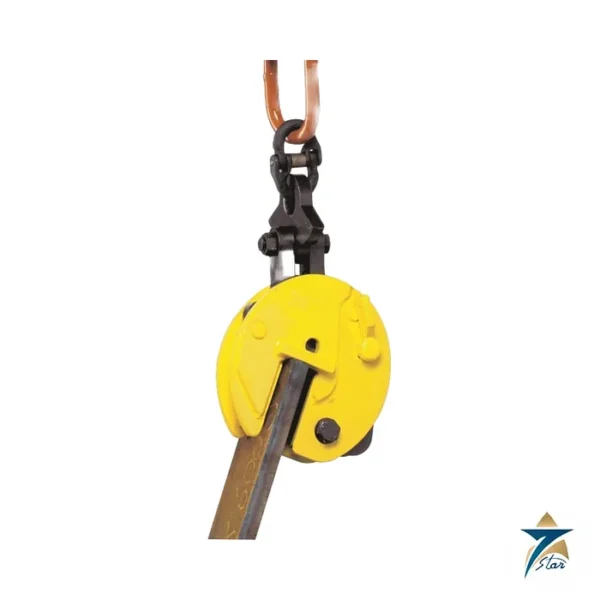
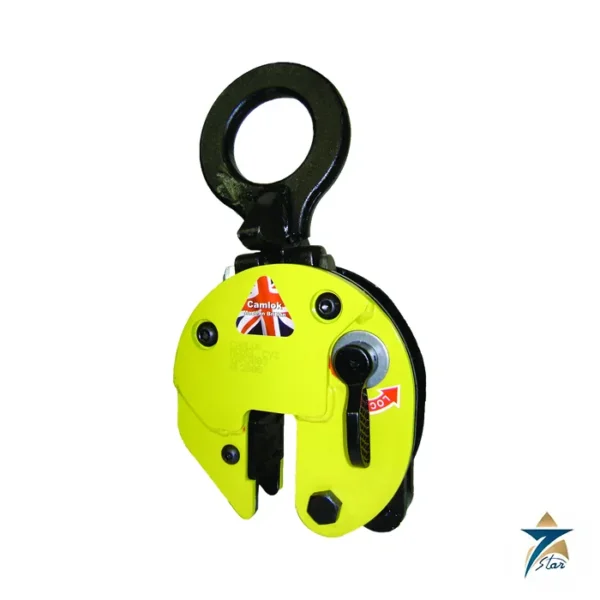
The Camlok CG is a girder turning clamp for lifting and turning steel girders (RSJ) through 90 degrees, from horizontal to vertical and back. It attaches to the horizontal flange of the girder and locks in place with the jaw locking lever; once lifted, the girder turns through 90 degrees. A cam and spring operated lock holds the clamp on before the lift begins, so the operator can step clear.
Two sizes are listed: the CG1 with a working load limit of 100 to 1000 kg and a jaw of 0 to 16 mm, and the CG2 with 200 to 2000 kg and a jaw of 0 to 32 mm. The clamp can be used singly or in pairs with a spreader beam for longer sections.
CG characteristics
- Girder turning through 90 degrees (H to I and back)
- Cam and spring operated lock that grips before the lift
- Lever-operated jaw with a lock-open feature
- Rolled steel joists, beams and fabrications up to 300 Brinell
- A load of maximum WLL can be turned 180 degrees in the plane of the clamp (manual)
- Design factor 4:1; product group I2
Technical specification
CG ratings
| Model |
Art.-No. |
WLL, kg |
Jaw capacity Z, mm |
Weight, kg |
| CG1 |
N4300000036 |
100 – 1000 |
0 – 16 |
6 |
| CG2 |
N4300000037 |
200 – 2000 |
0 – 32 |
14 |
CG dimensions, mm
| Dimension |
CG1 |
CG2 |
| A |
211 |
290 |
| B |
90 |
140 |
| C |
50 |
80 |
| D |
13 |
20 |
| E |
43 |
60 |
| F |
263 |
317 |
| G |
64 |
100 |
| H |
350 |
465 |
| I |
337 |
435 |
Material and handling limits
| Parameter |
Specification |
| Hardness of material |
Not above HRC 30 / 300 Brinell |
| Minimum load |
Marked on the side of the clamp |
| Long girders |
Two clamps and a lifting beam may be required |
| Wear width allowed on teeth |
CG1 0.6 – 0.8 mm; CG2 0.8 – 1.0 mm |
| Large hook |
Use a master link and drop chain on a clamp with a chain link (manual) |
| Technical drawings |
Available from the maker on request |
CG1 or CG2
The only choices are the CG1 and CG2. The CG1 clamps a flange up to 16 mm thick and the CG2 up to 32 mm, so measure the girder flange before anything else. The weight is also different, 6 kg against 14 kg per clamp, which matters for manual handling at height. In the model table the CG1 range starts at 100 kg, so it can be used on a light section; the CG2 starts at 200 kg.
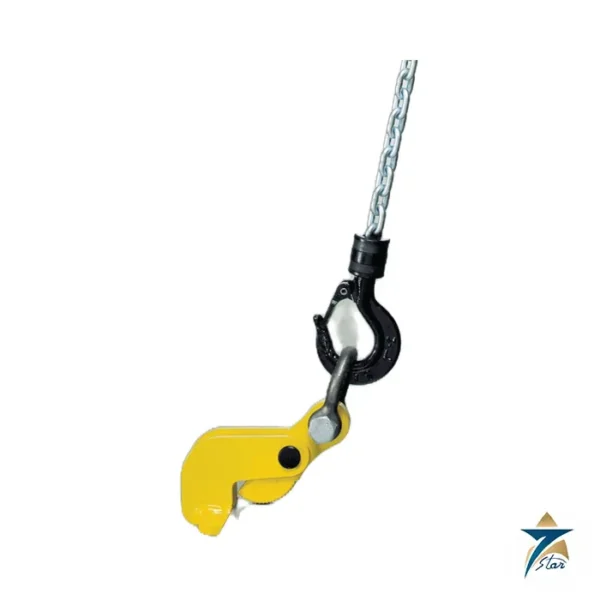
If the crane hook is too large for the clamp, the manual suggests a master link and a drop chain fitted to a clamp that has a chain link. For long girders, plan two clamps and a lifting beam and select the beam separately. The product page states the minimum load is marked on the side of the clamp, so verify it against the lightest girder to be lifted.
Fitting and turning a girder
Girder surfaces must be free of grease, standing water, oil, scale and paint. Turn the lever clockwise to hold the jaws open while the sling is slack, bring the clamp onto the girder flange over the centre of gravity and fully into the mouth, then seat the fixed jaw and turn the lever anticlockwise to LOCK. Make sure the chain is not twisted and the position is right before lifting.
One girder at a time is the rule. Lift slowly with vertical slings, because the girder can kick or swing as it clears the floor; keep the danger zone clear and carry it low. When lowering, set it down gently, keep the lever in LOCK until unloaded, then slacken the sling so the hook ring can withdraw and push it into the shell while turning the lever. The check list covers smooth action, weld cracks, shell plate distortion, teeth, lubrication, fasteners, jaw bolt, internal links and spring, jaw and pad wear, the cam handle and spring tension.
Beam handling in steel stores and workshops
CG clamps suit steel stockholders and fabricators who rotate a beam from flat to upright for loading, cutting or fit-up, and site crews handling rolled steel joists. They are not for people and not for material above 300 Brinell. The manual says to consult the supplier for high humidity, salt, caustic or alkaline exposure or extreme temperatures, which is relevant to coastal steel yards.
Selection and installation notes
Lifting clamps and grabs must be selected from the working load limit, the thickness and size of the load and the lifting angle, and used only by trained people under the site lifting procedure. Check the working load limit and the range on the marking, inspect the clamp before each use, never exceed the rated load or the stated angle, keep people away from the load and follow the periodic examination rules of the country where it is used. Damaged or worn clamps are taken out of service.
Information needed for a quotation
Send the full model code, the quantity, the delivery location in Oman or the GCC, the intended use and any accessories needed, so that the complete package can be quoted together.
Documents and supply information
The manufacturer data sheet is attached to this page and should be read together with the project specification and the site risk assessment before a purchase is confirmed. Ratings, standards and dimensions are quoted as printed on that sheet. Lead time, stock position and certificates available with the shipment are confirmed in the quotation, and we supply to Oman and the wider GCC region for industrial, utility and building services projects.
Related clamps
The product page links the CX heavy-duty hinged vertical clamp and the TTR girder stacking clamp for other beam and plate handling. A lifting beam and chain sling are separate items. For stacking girders flat, the TTR clamp is the alternative.
Frequently asked questions
How far does the CG turn a girder?
Through 90 degrees, from horizontal to vertical and back, according to the datasheet.
What flange thickness does the CG take?
0 to 16 mm for the CG1 and 0 to 32 mm for the CG2.
What hardness limit applies?
The material must not exceed HRC 30 or 300 Brinell.
Can one clamp lift a long girder?
For longer girders the datasheet says to use two clamps and a lifting beam.
What is the weight of each model?
6 kg for the CG1 and 14 kg for the CG2 per clamp.
Documents and quotation
The catalogue sheet and the CG manual are hosted here. The headline range differs between the catalogue sheet and the product page, so the model table figures are quoted and the marking on the clamp should be confirmed before ordering. Seven Star LLC is an independent supplier in Muscat.



Reviews
There are no reviews yet.