Y-type bronze strainer with pressure-drop test points
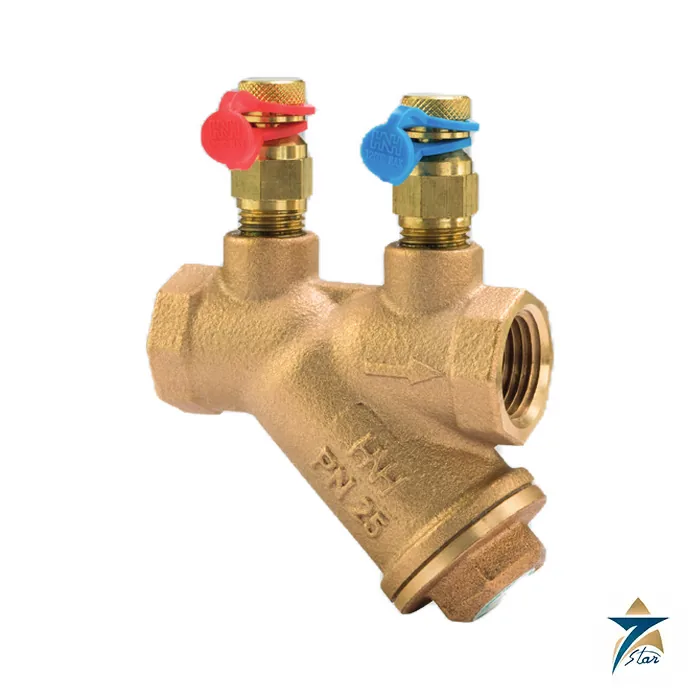
The Hattersley Fig. 907 is a bronze Y-type strainer rated PN25. Its job is to remove foreign matter from piping systems before it reaches pumps, control valves, meters and heat exchangers. A perforated stainless steel screen with 0.75 mm diameter holes catches the debris, and the data sheet states that the design gives low flow resistance. The strainer is WRAS approved for use on hot and cold water systems up to 85 C, according to the maker.
A feature that sets the 907 apart is that it is supplied with two Fig. 631 test points, fitted to the body, so that the pressure drop across the strainer can be measured in service. A rising pressure drop is the standard indicator that the screen needs cleaning.
Key features
- Perforated stainless steel (type 304) screen, 0.75 mm holes
- WRAS approved for hot and cold water systems up to 85 C
- Two Fig. 631 test points to measure pressure drop
- Bronze body and cap, BS EN 1982 CC491K
- Taper threaded to BS EN 10226-2 (UK) or ANSI B1.20.1 (US)
- Not suitable for group 1 or group 2 gases or unstable fluids (PED 2014/68/EU)
Technical specification
| Parameter |
Specification |
| Valve type |
Y-type strainer, screwed ends |
| Pressure rating |
PN25 |
| Pressure / temperature |
25 bar from -10 to 100 C; 23.4 bar at 110 C; 21.8 bar at 120 C |
| Screen |
Stainless steel type 304, perforated, 0.75 mm holes |
| Body and cap |
Bronze, BS EN 1982 CC491K |
| Gasket |
Klingersil C4430 |
| Test points |
Fig. 631, DZR brass, BS EN 12165 CW602N (two supplied) |
| ID plate |
Anodised aluminium |
| End connection, UK |
Taper threaded to BS EN 10226-2 |
| End connection, US |
ANSI B1.20.1 |
| Approval printed |
WRAS approved, hot and cold water, up to 85 C |
| Fluid limits |
Not for group 1 gases, group 2 gases or unstable fluids |
Dimensions and weights
| Size (in) |
1/2 |
3/4 |
1 |
1 1/4 |
1 1/2 |
2 |
| A mm |
71 |
86 |
101 |
134 |
148 |
176 |
| B mm |
29 |
35 |
45 |
54 |
63 |
77 |
| C mm |
42 |
51 |
55 |
80 |
87 |
97 |
| D mm |
49 |
60 |
67 |
93 |
103 |
119 |
| E mm |
100 |
114 |
127 |
157 |
171 |
194 |
| F mm |
27 |
35 |
42 |
50 |
58 |
71 |
| G mm |
35 |
44 |
54 |
63 |
73 |
93 |
| H mm (withdraw) |
144 |
176 |
202 |
294 |
322 |
367 |
| Weight kg |
0.27 |
0.44 |
0.78 |
1.30 |
1.81 |
3.10 |
Dimension H is the withdraw distance, the clearance needed to remove the screen, so leave at least that much space below the cap when planning pipe routes.
Selection and ordering guide
Select by line size. A strainer is normally the same size as the line; reducing the size raises velocity and pressure drop. The 0.75 mm perforation is fine, so it is suited to protecting small control valves and heat-exchanger plates, but fine screens clog sooner on dirty systems, which makes the supplied test points useful. Hattersley lists a separate bronze Y-type strainer, Fig. 807, with a PN32 rating, for higher pressure duty. Note the pressure rating of 25 bar at up to 100 C, falling to 21.8 bar at 120 C.
Installation and maintenance
General practice: fit the strainer with flow in the direction of the arrow on the body and the cap pointing downwards or at an angle so that the screen can be withdrawn. Leave the withdrawal clearance H. Connect a differential pressure gauge to the two test points to read pressure drop, and clean the screen when the reading rises above the value set at commissioning; the sheet does not state a cleaning limit. Shut off and relieve pressure before opening the cap.
Applications
Strainers are standard protection ahead of pumps, balancing valves and meters in chilled water, heating and domestic hot water systems. In Gulf building services they are installed on pump suctions in district cooling and plant rooms where scale and construction debris collect after commissioning.
Understanding the strainer ratings and fluid limits
The data sheet gives a temperature-dependent rating table: 25 bar from -10 to 100 C, 23.4 bar at 110 C and 21.8 bar at 120 C. The WRAS approval is stated separately and only for hot and cold water up to 85 C, so a system at 110 C may use the pressure rating but not the water-fittings approval. The sheet also warns that the strainer is not suitable for group 1 gases, group 2 gases or unstable fluids under the Pressure Equipment Directive, which limits it to liquids of the appropriate group.
The materials are specified by European standard: bronze to BS EN 1982 CC491K, stainless steel strainer mesh type 304 and a Klingersil C4430 gasket on the cap. These are the names to quote when a project material approval list is checked.
Specification checklist before ordering
Confirm the size and thread (BS EN 10226-2 for the UK pattern or ANSI B1.20.1 for the US pattern), the working pressure of 25 bar from -10 to 100 C, the fluid and the screen opening. The sheet states that the strainer is not suitable for group 1 or group 2 gases or unstable fluids, so confirm the medium. The 0.75 mm perforated screen suits general water duty; finer screens must be checked with the manufacturer.
Using the test points
The two Fig. 631 test points allow a differential pressure gauge to be connected across the strainer. Record the clean pressure drop at commissioning, and clean the screen when the reading rises noticeably. Fit isolation valves each side so that the cap can be removed without draining the system.
Information needed for a quotation
Send the figure number, size, thread, quantity, delivery location in Oman or the GCC and the medium and temperature.
Related products
See Fig. 5N and Fig. 13 for downstream control, the Fig. 1013 check valve and the Globe Valves category.
Frequently asked questions
What is the screen perforation?
0.75 mm diameter holes in a stainless steel screen.
What approval does the sheet print?
WRAS approved for hot and cold water systems up to 85 C.
What are the test points for?
Two Fig. 631 test points are supplied to measure pressure drop across the strainer.
What is the rating?
PN25: 25 bar from -10 to 100 C, 23.4 bar at 110 C, 21.8 bar at 120 C.
Can it be used with gas?
No. The sheet says it is not suitable for group 1 or group 2 gases or unstable fluids.
Documents and quotation
Download the official data sheet from this page. Size and thread form (BS or NPT) are the details we need for a quotation. Seven Star LLC is an independent supplier in Muscat.









Reviews
There are no reviews yet.