A stainless steel housing for hazardous gases and ATEX zones 1 and 2
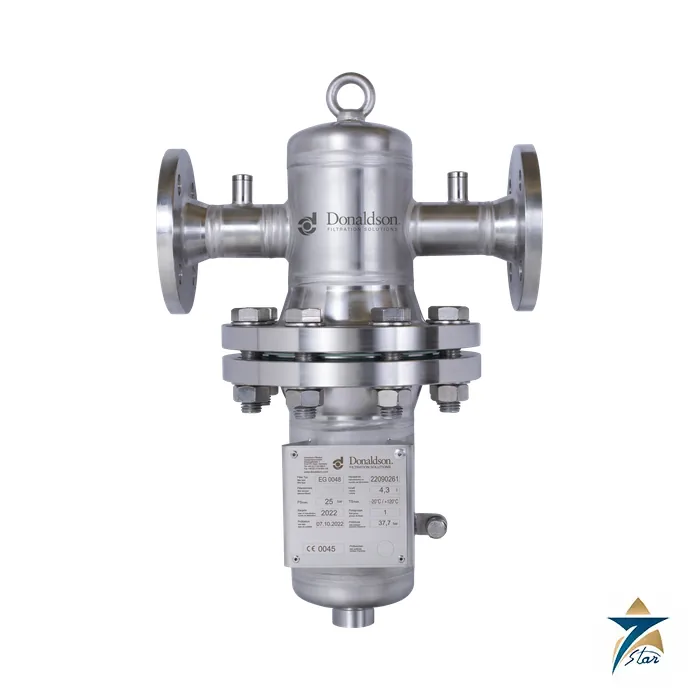
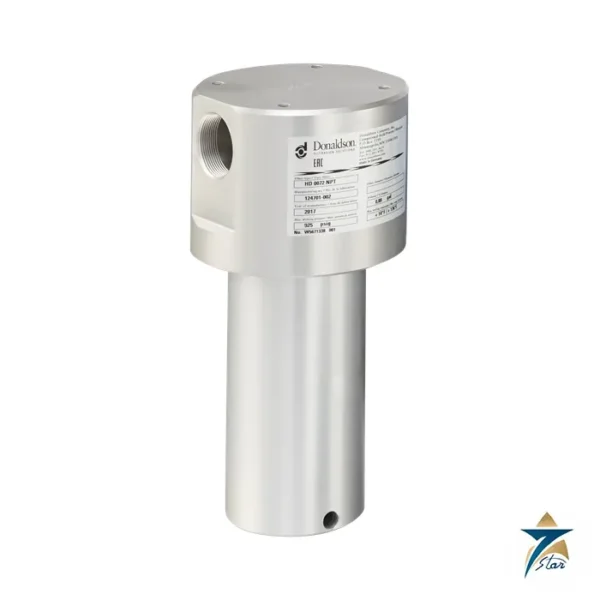
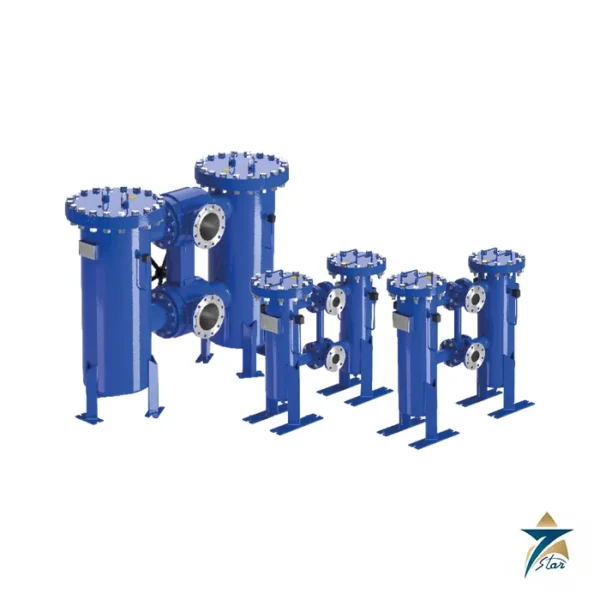
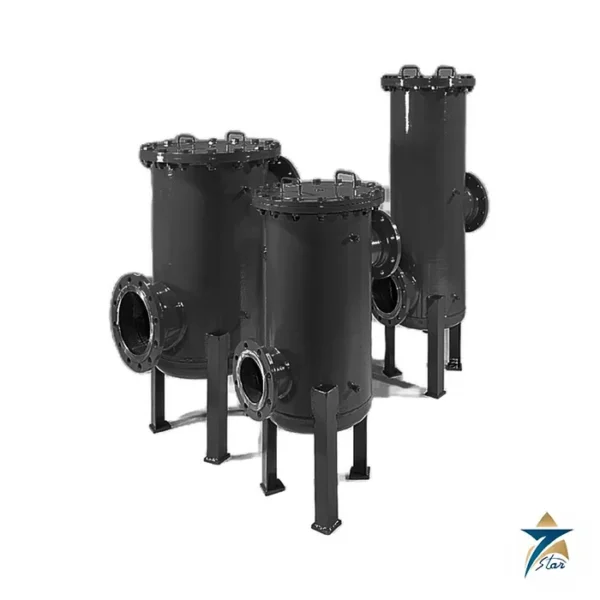
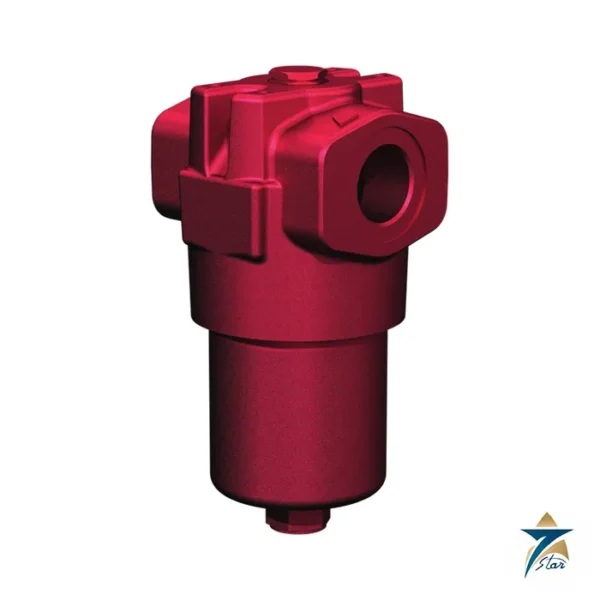
The Donaldson EG 0048-0768 is a flanged stainless steel filter housing for gases classed as media group 1 (hazardous) under the Pressure Equipment Directive. It is marked II 2G IIC T4 Gb and built for explosion hazard zones 1 and 2, with earthing connections and conductive materials, which is why Donaldson names bio-methane, natural gas, hydrogen and wet carbon dioxide as typical applications.
The housing is designed for 25 bar and for -20 C to +120 C, so it can stand outdoors on a gas skid as well as indoors. Nine sizes from EG 0048 to EG 0768 take one to four elements, and a full portfolio of coalescing, particulate and activated carbon elements, including conductive grades, goes inside.
Technical specifications
| Parameter |
Specification |
| Series / sizes |
EG 0048, 0072, 0108, 0144, 0192, 0288, 0432, 0576, 0768 |
| Allowable operating pressure |
25 bar (test pressure 37.7 bar) |
| Allowable temperature |
-20 C to +120 C |
| Housing material |
1.4301 / 1.4541 stainless steel; accessory parts 1.4301 |
| Surface treatment |
Pickled and passivated |
| Fluid group |
Group 1 under the Pressure Equipment Directive |
| ATEX marking |
II 2G IIC T4 Gb, zones 1 and 2 |
| Connections |
Flanges DN 40 to DN 150, PN 40, on inlet, outlet, head and bowl |
| Element fixing |
Donaldson Ultrafilter thread (0048-0072); push-in with tie rod from size 0108 |
| Sockets |
Condensate drain; condensate level control from size 0108; differential pressure measurement |
| Included |
Earthing point and connectors, flat seal with soft sealing |
| Applications |
Coalescing and particulate filtration, oil vapour adsorption on activated carbon |
Sizes, elements and flanges
- 0048: Element 07/30; Volume l 4.3; Flange DN 40 / PN 40
- 0072: Element 10/30; Volume l 5.4; Flange DN 50 / PN 40
- 0108: Element 15/30; Volume l 7.5; Flange DN 50 / PN 40
- 0144: Element 20/30; Volume l 9.3; Flange DN 65 / PN 40
- 0192: Element 30/30; Volume l 18.1; Flange DN 80 / PN 40
- 0288: Element 30/50; Volume l 25.7; Flange DN 80 / PN 40
- 0432: Element 3 x 20/30; Volume l 36.6; Flange DN 100 / PN 40
- 0576: Element 3 x 30/30; Volume l 45.5; Flange DN 100 / PN 40
- 0768: Element 4 x 30/30; Volume l 81; Flange DN 150 / PN 40
The data sheet adds the housing height, bowl diameter and overall dimensions for each size.
Why the design suits gas service
Flange connections on the head and bowl as well as on the pipe ports are chosen to avoid gas leakage, and a flat soft seal replaces the O-ring of the standard compressed-air housings. The earthing point and connectors are already fitted, so the earthing demanded in an ATEX area is a matter of connecting a cable, not of modifying the vessel.
Sockets for the condensate drain are fitted on all sizes, and the level control socket is added from EG 0108, which lets a drain or alarm be fitted without welding. The sheet lists oil and gas, chemical, energy and power generation and industrial gas producers among the industries, which matches the typical gas treatment skid in a processing plant. Check the element grade for conductivity if the gas may form an explosive atmosphere: Donaldson offers conductive elements for exactly this purpose.
Installation on a gas skid or pipeline
Install the housing in the orientation and flow direction given in the Donaldson documentation, and support the pipework so that no piping loads are carried by the flanges. Use flange gaskets and bolting suitable for the gas, the PN 40 rating and the design temperature, and tighten the bolts in a cross pattern to the values set by the piping specification. Leave enough clearance below the bowl to remove it and change elements without dismantling adjacent pipework.
Connect the earthing point to the plant earthing system before the housing is put into service, and check continuity across the flanges as required by the site hazardous area procedure. Route the condensate drain to a safe collection point suitable for the gas and any liquids it may carry, and fit the differential pressure measurement so that it can be read without opening the housing.
Commissioning steps
Pressure-test and leak-test the installation in line with the site procedure and the pressure equipment documentation. Purge air from the system according to the gas operator’s purging procedure before introducing flammable gas. Record the initial differential pressure across the clean element at normal flow, because this value is the baseline for deciding later when an element change is due.
Selection checks before ordering
Choose the housing size from the required gas flow at operating pressure, using the Donaldson sizing data, and check that the flange size fits the line. Select the element grade for the task, whether coalescing, particulate or activated carbon, and confirm that a conductive element is used where the hazardous area assessment calls for one. Confirm that the gas composition, including any moisture, carbon dioxide or hydrogen content, is compatible with the housing materials and seals, and that the ATEX marking on this page matches the zone and gas group of the installation.
Operating environment in Oman and the GCC
Gas installations in Oman and the GCC are frequently outdoors in strong sun, with large daily temperature swings, wind-borne sand and, on coastal sites, salt-laden humid air. Check that the metal temperature of the housing in direct sun stays inside the allowable temperature range, and consider shading on exposed skids. The pickled and passivated stainless steel resists corrosion, but salt and sand deposits should still be washed off during routine inspections, especially around flanges and bolting. Daily temperature swings can cause condensation inside the gas line, so check the condensate drain more often during cooler months and humid periods.
Maintenance and element changes
Change elements when the differential pressure reaches the limit given by Donaldson or the site procedure, or at the interval set for activated carbon elements, which are not indicated by differential pressure. Depressurise and purge the housing before opening it, follow the hot-work and gas-free procedures of the site, and replace the soft seal whenever the bowl is opened.
Documents and quotation
EG 0048-0768 is quoted to order. Download Donaldson EG filter housing for special gases data sheet (F119213, 01/2026) from this page, check the gas composition, ATEX zone and element grade, then send the quantity you need. More products: Filter Housings.

Reviews
There are no reviews yet.