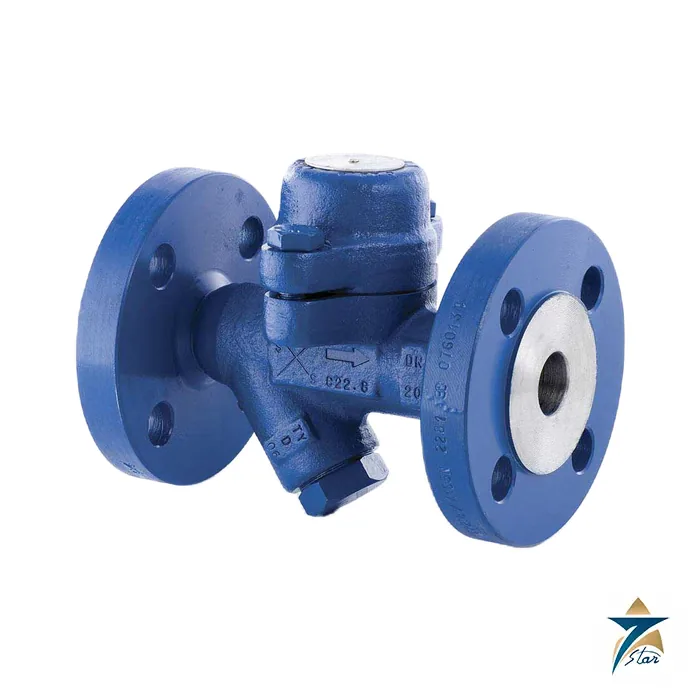
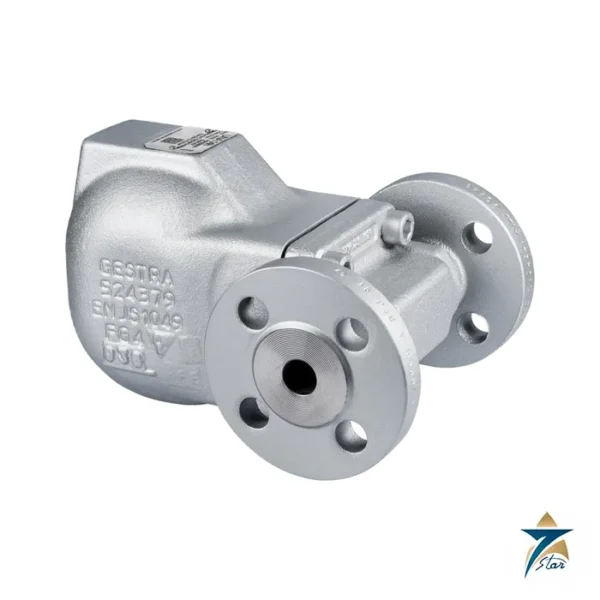
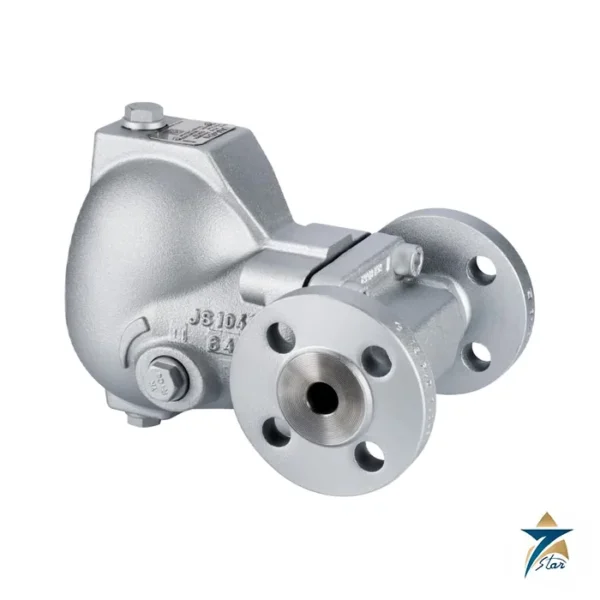
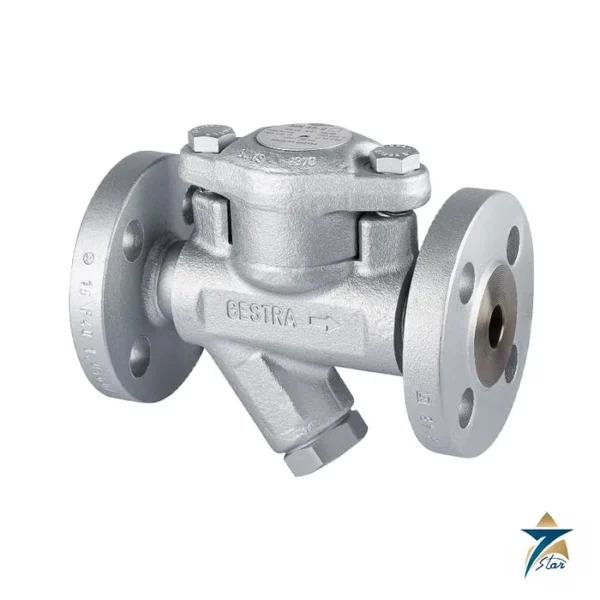
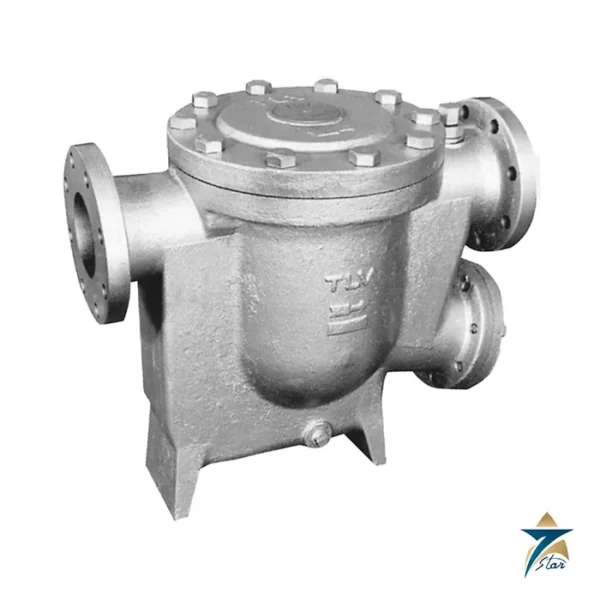
The Spirax Sarco BPC32YF is a maintainable balanced pressure thermostatic steam trap with integral flanges and a built-in cylindrical Y-type strainer. A stainless steel capsule opens and closes the valve according to condensate temperature, so the trap discharges condensate just below steam temperature and holds back live steam. It is made in carbon steel for saturated steam up to 32 bar g and is intended for steam tracing, drip legs, heating coils and other lines that carry air and sub-cooled condensate.
Technical specifications
| Parameter |
Specification |
| Model |
BPC32YF (BPC32F has a flat strainer screen; CVF versions add a check valve) |
| Type |
Balanced pressure thermostatic, maintainable |
| Body / cover |
Carbon steel 1.0619+N / ASTM A216 WCB body; ASTM A105N cover |
| Capsule and seat |
Stainless steel capsule; BS 970 431 S29 seat |
| Strainer |
Integral cylindrical Y type, AISI 304 screen |
| Sizes |
DN15, DN20, DN25 |
| Flanges |
EN 1092 PN40, ASME B16.5 Class 150 or 300 |
| PMA (ASME 300) |
50 bar g at 50 C |
| TMA |
400 C at 35 bar g; minimum allowable -60 C |
| PMO (saturated steam) |
32 bar g at 281 C |
| Minimum operating temperature |
0 C |
| Cold hydraulic test |
75 bar g |
| Dimensions (DN15 / DN20 / DN25) |
A 150 / 150 / 160 mm; B 94 mm; C 64 mm; Y screen F 55 / 56 / 58 mm |
| Weight (DN15 / DN20 / DN25) |
3.1 / 3.7 / 4.4 kg |
| Certification |
EN 10204 3.1 available; PED 2014/68/EU |
How the capsule decides
A balanced pressure thermostatic trap contains a sealed capsule filled with a liquid whose boiling curve is close to that of water. When cold condensate or air surrounds the capsule it contracts and the valve is open; when steam arrives the fill boils, the capsule expands and the valve closes. The standard STD capsule works about 12 C below steam saturation temperature; an optional SUB capsule works about 24 C below, which suits tracing and tracer lines where sub-cooled discharge is acceptable, and an NTS capsule works about 6 C below for near-to-steam discharge. The data sheet says to state the capsule fill with every order.
Because the balanced capsule follows the saturation curve at any pressure, the trap clears air quickly on start-up and is described as unaffected by waterhammer.
Limits, materials and dimensions
The data sheet limits the trap to 32 bar g saturated steam service (281 C), within an allowable pressure of 50 bar g for the ASME 300 flange at 50 C, and a 75 bar g cold hydraulic test. Flange class limits the usable region on the pressure-temperature chart: PN40, ASME 150 and ASME 300 follow different curves, so check the flange chosen. At DN15 the face-to-face dimension A is 150 mm and the weight is 3.1 kg; the Y strainer adds a 55 mm clearance F for screen removal and 37 mm withdrawal distance E for the cover.
The BPC32 and BPC32Y ranges are verified as safe for full vacuum with integral and welded flanged connections.
Installing and maintaining the trap
Spirax Sarco states that the trap can be installed in any position, horizontal or vertical. It recommends a non-return valve where discharge goes into a return line that may have back pressure (the BPC32YCVF has one built in), a diffuser when discharging to atmosphere, and isolation valves upstream and downstream so the cover can be removed under pressure control. Spare parts are the capsule and seat assembly set (items 2, 3, 17 and 18), the strainer screen and gasket, and cover and strainer-cap gasket packs.
Choose the trap for the duty: balanced pressure traps are not the right choice where condensate must be held to steam temperature for process heating; a float or thermodynamic trap suits that duty. Confirm the capsule fill, flange standard and size before ordering.
Selecting size and capsule for the duty
Steam traps are chosen on condensate load and pressure difference rather than on the pipe size of the line they drain. Work out the condensate the trap must handle at start-up, when the line is cold and condensing quickly, as well as at normal running, and then read the capacity charts in TI-P005-10 at the actual differential pressure between steam inlet and condensate outlet. Back pressure from a lifted or pressurised return line reduces that differential, so include it in the calculation. Only once the capacity is confirmed should you decide between DN15, DN20 and DN25.
The capsule fill is the second decision. For steam tracing of fuel, bitumen or sulphur lines where some sub-cooling is acceptable and saves flash steam, the SUB capsule is often the logical choice. For drip legs on steam mains, where condensate should leave promptly to keep the main dry, the STD or NTS capsule is closer to the need. Write the chosen fill on the order, as the data sheet requires.
Checklist for the enquiry
- Steam pressure and maximum operating temperature at the trap location.
- Flange standard and class: EN 1092 PN40, ASME 150 or ASME 300, matched to the piping specification.
- Capsule fill: STD, SUB or NTS.
- Whether a built-in check valve (CVF version) is needed for discharge into a return line.
- Material certification requirements such as EN 10204 3.1.
Commissioning and troubleshooting
Before fitting the trap, blow the line through so welding debris and scale do not end up in the strainer on the first start. Open the upstream isolation valve slowly to warm the line, and watch the discharge: at first the trap should pass air and cold condensate freely, then cycle once the line reaches temperature. If a trap blows steam continuously, the usual causes are dirt holding the valve off its seat or a worn capsule and seat; isolate it, clean the strainer screen and inspect the internals, fitting the capsule and seat set if needed. A trap that stays cold is often blocked by a clogged strainer or has isolation valves left closed. Checking traps on a regular survey route, with a record of each tag number, prevents losses from going unnoticed.
Steam systems in Oman and the GCC
Refineries, petrochemical plants and food factories in the region often run long tracing circuits outdoors, exposed to heat, wind-blown sand and, near the coast, salty humid air. Keep insulation on trap sets in good condition, clean strainers more often after shutdowns when sand and scale enter the lines, and inspect carbon steel bodies and flange bolting for external corrosion during routine rounds. Fitting the isolation valves recommended by Spirax Sarco makes this maintenance possible without shutting down the whole tracing system.
Documents and quotation
The official Spirax Sarco technical information sheet TI-P005-10 is attached to this page; it carries the pressure-temperature limits, materials list, dimensions, capacity charts and spares used above. Seven Star LLC is an independent supplier in Muscat. To request a quotation for BPC32YF, send the model, size, end connection, any certification you need under EN 10204 and the quantity so the request can be matched to the data sheet before we reply.
Related items: product category.







Reviews
There are no reviews yet.