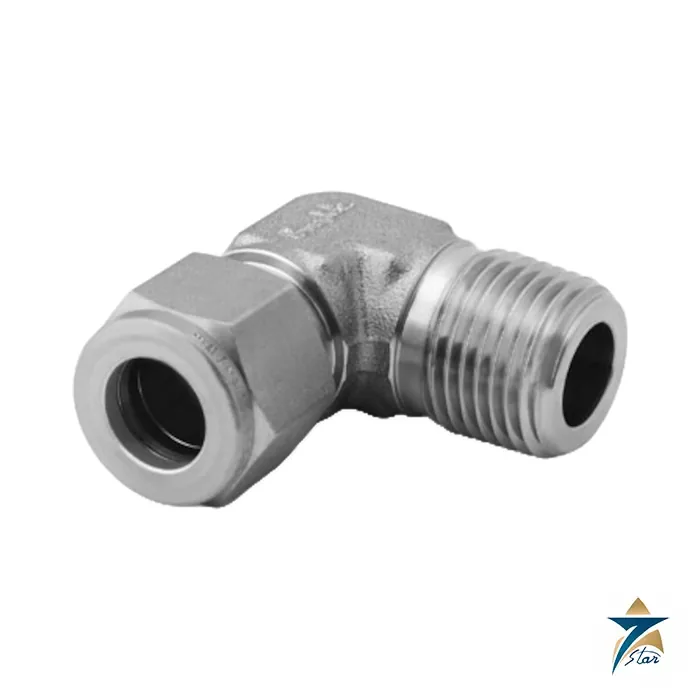
Where tubing has to leave a threaded port at right angles, the Swagelok SS-810-2-8 saves a bend and a clamp. It is a 90 degree male elbow in 316 stainless steel with a 1/2 in. tube-fitting end on one leg and a 1/2 in. male NPT thread on the other, so it screws into a pump casing, instrument port or manifold and turns the tube run sideways within a very short envelope.
Technical specifications
| Parameter |
Specification |
| Part number |
SS-810-2-8 |
| Description |
90 degree male elbow, 1/2 in. tube fitting x 1/2 in. male NPT |
| Body material |
316 stainless steel (forged shape) |
| Connection 1 |
Swagelok tube fitting, 1/2 in. tube OD |
| Connection 2 |
Male NPT, 1/2 in. |
| Bored through |
No |
| Flow restrictor |
No |
| Dimension A (centre-line to end) |
1.42 in. |
| Dimension D (nut size) |
0.90 in. |
| Dimension E (nominal opening) |
0.41 in. |
| Hex flat F |
13/16 in. |
| Cleaning |
Standard cleaning and packaging SC-10 |
What the elbow gives you
Elbows, tees and crosses in this catalog are made from forgings (ASTM A182 for 316 stainless), while straight fittings are cut from bar (ASTM A276 or A479). Shape pieces like this suit compact manifold and gauge-panel layouts. The overall dimension A of 1.42 in. is measured to the tube end, so it is short enough to fit between a port and an adjacent component where a union and separate bend would not.
The 90 degree geometry also helps with strain. Tubing that exits a threaded port in a straight line can be levered by vibration or by a technician leaning on it; turning the line at the port with an elbow lets you route the tube along a support rail instead.
Decoding SS-810-2-8
SS is 316 stainless steel, 810 is the 1/2 in. tube size, 2 is the catalog code for a 90 degree male elbow and 8 is the pipe size in eighths of an inch (1/2 in. NPT). Change the last block and the thread changes: SS-810-2-4 is the same elbow on a 1/4 in. NPT port, and SS-810-2-12 uses 3/4 in. NPT. The shape is not interchangeable with the 45 degree male elbow, which carries code 5, or with the union elbow SS-810-9, which has tube ends only.
The tapered NPT thread follows ASME B1.20.1 and must be sealed with a suitable thread sealant. The catalog rates 316 stainless male NPT ends at 7700 psig (530 bar) at ambient temperature for the 1/2 in. size, while the tube end is rated to the tubing you use. The lower of the two governs, and temperature derating applies.
Installation notes
For the tube end, bottom the tube against the shoulder, run the nut up finger-tight and add one and one-quarter turns, then verify pull-up with the Swagelok gap gauge for the size. Only the nut should rotate during make-up; isolate and vent the line before any adjustment. Run the threaded end into the port first, sealing the tapered thread, and position the elbow so the tube leg points where the run needs to go before final tightening; the thread, not the nut, sets the final orientation. Over-tightening to correct orientation is a common cause of leaks, so choose a positionable (PR or ST) elbow from the catalog if the angle has to be adjustable.
Key features
- Forged 316 stainless body: good general corrosion resistance for instrument, process and utility lines.
- Swagelok two-ferrule tube fitting end: the front ferrule seals against the tube and fitting body while the back ferrule grips the tube, giving a gas-tight seal and resistance to vibration.
- Compact 90° turn: removes the need for a tube bend right at the port, saving space on panels and skids.
- Standard 1/2 in. NPT thread: fits common pump, valve, manifold and instrument ports.
Sealing the NPT end
Tapered pipe threads seal on the thread flanks, so a sealant is required. Use PTFE tape or a suitable thread sealant compatible with the process fluid, keep it off the first thread to avoid it entering the system, and do not over-tighten, which can crack cast ports or gall stainless threads. Because the elbow must finish pointing in a set direction, assemble the NPT end first and orient it before making up the tube end. Backing off a tapered thread to align it can create a leak path, so tighten forward to the orientation needed rather than reversing.
Making up the tube fitting end
Follow Swagelok installation instructions for 1/2 in. tube: insert the tube until it bottoms in the fitting, tighten the nut finger tight, mark the nut, and turn it the specified amount with a wrench while holding the body. Check the result with a Swagelok gap inspection gauge where available. Use tubing of the correct hardness and wall thickness for the pressure duty, and cut it square and deburred. Mixing components from different tube fitting manufacturers is not recommended, because ferrule geometry and tolerances differ.
Material considerations in the Gulf
316 stainless is widely used on offshore platforms, coastal plants and desalination sites in Oman and the GCC because of its molybdenum content. Even so, hot, chloride-laden coastal air can cause tea staining or pitting on exposed fittings over time. Keep tubing and fittings clean, avoid trapping salt deposits in crevices, and consider higher alloy materials for very aggressive marine or sour service. For sour oil and gas duty, check the project’s material requirements before selecting the fitting.
Typical applications
- Instrument connections to pressure transmitters, gauges and analysers.
- Impulse lines and sample lines on process skids.
- Hydraulic, pneumatic and chemical injection tubing on oil and gas facilities.
- Utility air and nitrogen distribution on gauge panels.
Inspection and maintenance
Check fittings during routine rounds for leaks, corrosion and vibration damage. Re-tighten disassembled tube fittings according to the reassembly instructions rather than over-tightening. Replace any fitting with damaged threads or a deformed body.
What to include in an RFQ
Quote the part number SS-810-2-8 and quantity. If you need other configurations, such as female NPT elbows, other tube sizes or alternative materials, list them with part numbers so they can be quoted together, and mention any material certificates required by your project.
Documents and quotation
Attached for download is the official Swagelok catalog MS-01-140, which carries the dimension and pressure-rating tables behind this page. Quote requests are handled against the exact code, so list SS-810-2-8, the quantity and your cleaning or packaging needs.
Confirm the full order code, including any suffix, with your piping drawing before you order; similar codes are easy to mix up. Related items: product category.






Reviews
There are no reviews yet.