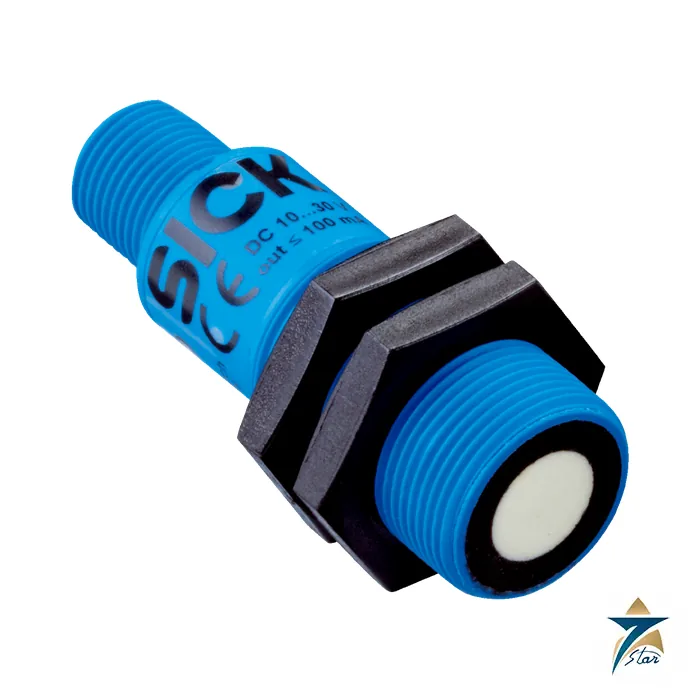
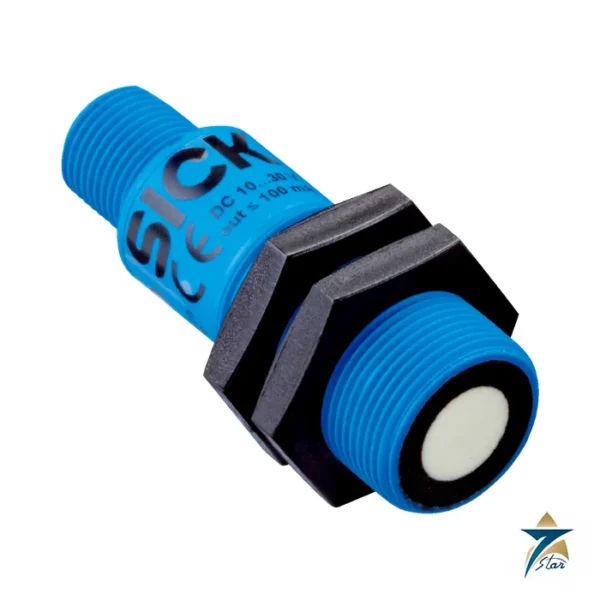
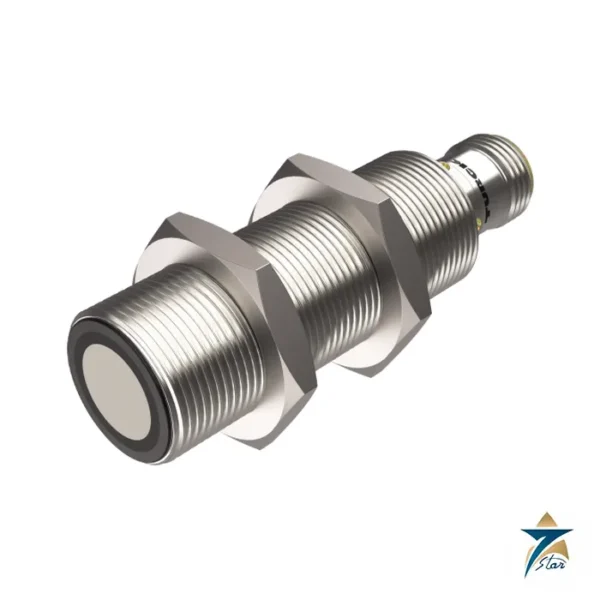
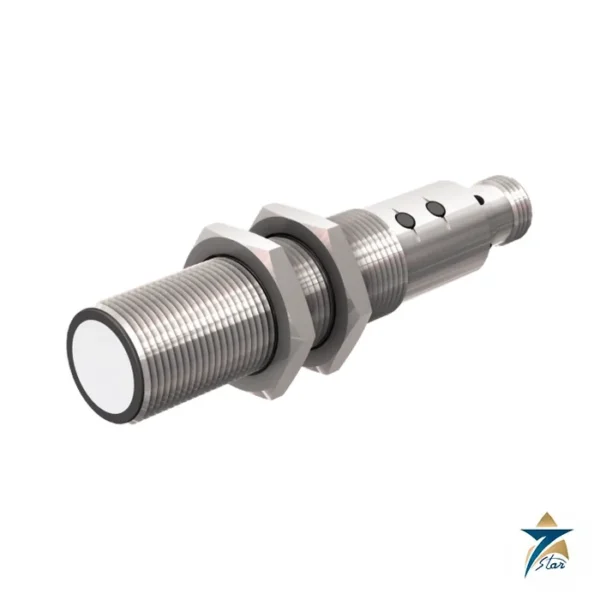
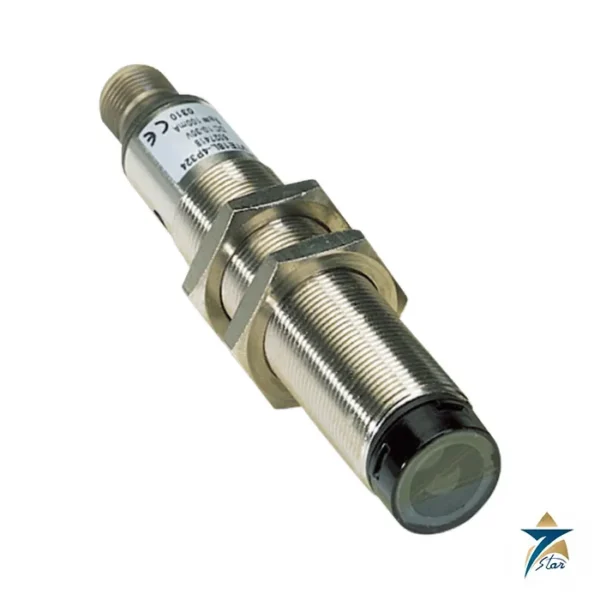
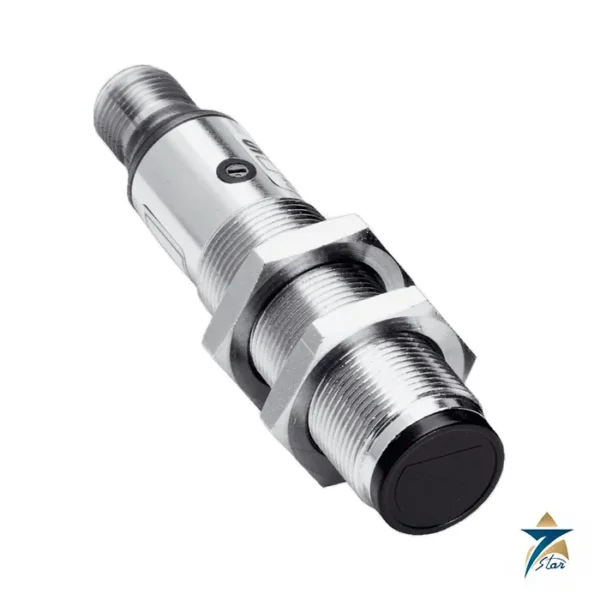
UM18-218166101 is a SICK UM18 ultrasonic distance sensor (part no. 6072883). It measures the distance to an object from the travel time of a sound pulse and reports it as current output (4 mA … 20 mA, ≤ 500 Ω). Operating range, limiting range: 120 mm … 1,000 mm, 1,300 mm; response time 80 ms; connection Male connector, M12, 4-pin.
Distance measurement with the UM18-218166101
Soft, strongly angled or very small targets reflect poorly, and foam, cloth or loose granules can absorb the pulse, so test the real target before committing. There is a blind zone in front of the transducer, below the operating range, in which the sensor cannot measure; mount it so the target never enters that zone. The sound cone widens with distance, so fixed objects such as brackets, pipes or tank walls near the beam can cause false echoes; see the detection-area diagram in the data sheet. This type lists a temperature drift of 0.17 % / K.
On the UM18-218166101 the resolution is ≥ 0.2 mm, repeatability ± 0.15 %, accuracy ± 1 % and the output time is 20 ms. The ultrasonic frequency is typically 200 kHz. Configurable functions: teach-in of analog output; Invertable analog output; Reset to factory default.
Technical specifications
| Parameter |
Specification |
| Type code |
UM18-218166101 |
| Part number |
6072883 |
| Product family |
UM18 |
| Operating range, limiting range |
120 mm … 1,000 mm, 1,300 mm |
| Resolution |
≥ 0.2 mm |
| Repeatability |
± 0.15 % |
| Measurement accuracy |
± 1 % |
| Response time |
80 ms |
| Output time |
20 ms |
| Ultrasonic frequency (typical) |
200 kHz |
| Detection area (typical) |
See diagrams |
| Additional function |
Teach-in of analog output; Invertable analog output; Reset to factory default |
| Safety-related parameters: MTTFD |
101 years |
| Safety-related parameters: DCavg |
0% |
| Analog output: Number |
1 |
| Analog output: Type |
Current output |
| Analog output: Current |
4 mA … 20 mA, ≤ 500 Ω |
| Analog output: Resolution |
12 bit |
| Supply voltage UB |
DC 10 V … 30 V |
| Power consumption |
≤ 1.2 W |
| Initialization time |
< 300 ms |
| Display |
2 x LED |
| Enclosure rating |
IP65 / IP67 |
| Protection class |
III |
| Dimensions (W x H x D) |
18 mm x 18 mm x 52.7 mm |
| Design |
Cylindrical |
| Sending axis |
Straight |
| Housing material |
Plastic (PBT, ultrasonic transducer: polyurethane foam, glass epoxy resin) |
| Weight |
15 g |
| Thread size |
M18 x 1 |
| Connection type |
Male connector, M12, 4-pin |
| Ambient temperature, operation |
–25 °C … +70 °C |
| Ambient temperature, storage |
–40 °C … +85 °C |
| Temperature drift |
0.17 % / K |
| Declarations and certificates in the data sheet |
EU declaration of conformity; UK declaration of conformity; ACMA declaration of conformity; Moroccan declaration of conformity; China RoHS; China Compulsory Product Certification (CCC) exempt; cULus certificate |
Type code UM18-218166101 and part number 6072883
UM18-218166101 belongs to the UM18 family. Within one family SICK lists versions with other ranges, outputs and plug types, each under its own part number. For an exact replacement quote 6072883, and tell us the output your controller expects.
Neighbouring versions of this family that SICK lists as active, with their part numbers:
- UM18-218166102 (part no. 6072884)
- UM18-218161101 (part no. 6048420)
- UM18-218161102 (part no. 6048421)
- UM18-218167101 (part no. 6072885)
- UM18-212166102 (part no. 6072880)
Mounting, wiring and set-up notes
Electrical supply: DC 10 V … 30 V. Environmental limits: IP65 / IP67 and –25 °C … +70 °C ambient in operation. The body measures 18 mm x 18 mm x 52.7 mm and weighs 15 g. Current draw is ≤ 1.2 W. Indication: 2 x LED. After teaching, move the target through its full travel and confirm the analog signal follows the expected scale. Allow for the sound cone: keep fixed brackets and pipes outside it, or mask them in the controller where the sensor allows it.
Selecting an ultrasonic sensor for the task
Ultrasonic measurement works well where optical sensors struggle: transparent bottles and films, dark or glossy surfaces, liquids in small tanks and bulk materials on a belt are all detected by their echo rather than by colour or reflectivity. Before choosing the UM18-218166101, confirm that the whole travel of the target lies inside the stated operating range and outside the blind zone, that the target surface faces the sensor reasonably square, and that the controller input accepts a 4–20 mA signal within the stated load. If the application needs a switching output, a different range or another plug, look at the neighbouring versions of the family listed above instead of adapting this one.
Think also about what else is in the path of the sound. Mist, steam, strong air currents and temperature layers near hot surfaces can bend or weaken the pulse, and two sensors facing the same area can hear each other. Spacing and aiming the sensors carefully, and testing them together, avoids most of these problems.
Installation and commissioning practice
Use the M18 thread to fix the sensor in a rigid bracket so that its aim does not change when the machine vibrates or is cleaned, and do not overtighten the fixing on the plastic housing. Route the M12 cable away from motor and drive cables, provide strain relief, and keep the connector out of standing water. After power-up, wait for the initialization time before reading the signal. Teach the analog output at the near and far ends of the real application range, invert it if the controller logic needs rising level to give falling distance, and then run the target through its full movement while watching the signal in the PLC. Note the taught values in the machine documentation so a replacement can be set up the same way.
Operation and maintenance
The transducer face should be kept free of dust cake, product splashes and condensation, because a coating changes the echo and can shift the reading. Clean it gently with a soft cloth and a mild cleaner suited to the housing materials; avoid sharp tools and solvents. If readings become unstable, check first for new objects in the sound cone, loose brackets and cable damage before replacing the sensor. A reset to factory default followed by a fresh teach-in is a quick way to rule out wrong settings.
Ultrasonic sensing in GCC plants
Packaging lines, water tanks and material handling systems in Oman and the GCC see high ambient heat, airborne dust and humid coastal air. Keep the sensor out of direct sun and away from hot pipework where possible, since the speed of sound and the stated temperature drift both depend on temperature, and allow time for the sensor to reach a stable temperature before final teach-in. Fine dust settling on the transducer is a common cause of drift, so add the face to the routine cleaning list. For an RFQ, include the part number, the quantity, the target material and distance range, the controller input type and any notes on the installation environment.
Documents and quotation
Download the SICK data sheet for UM18-218166101 from this page. It is the manufacturer’s PDF for part no. 6072883, unchanged, and it carries the drawings and the full parameter list. Quote the part number in the RFQ form together with the quantity and delivery location, and our team will respond with pricing. Related items are listed under Sensors & Transmitters. Compare the connection, the output and the ratings with your existing installation first; the PDF governs if it differs from this text.




Reviews
There are no reviews yet.