A steam-tight handheld Pt100 probe for cooking and sterilizing
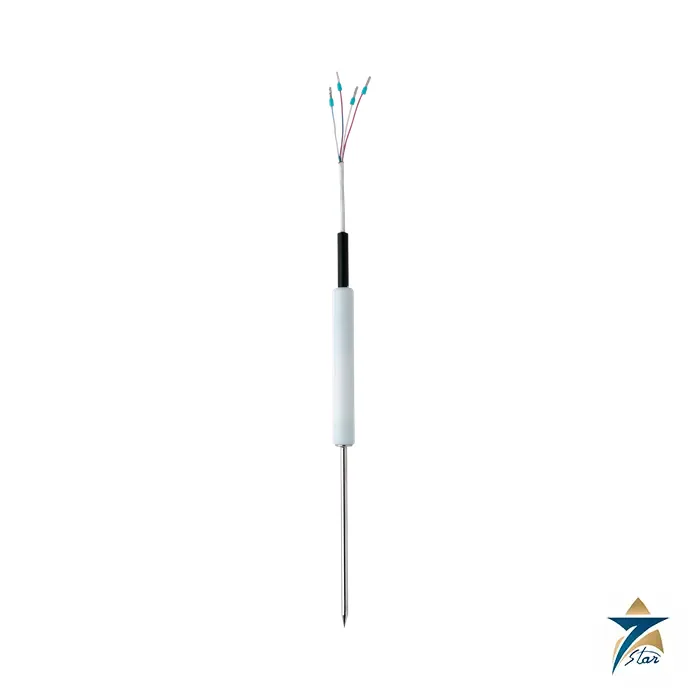
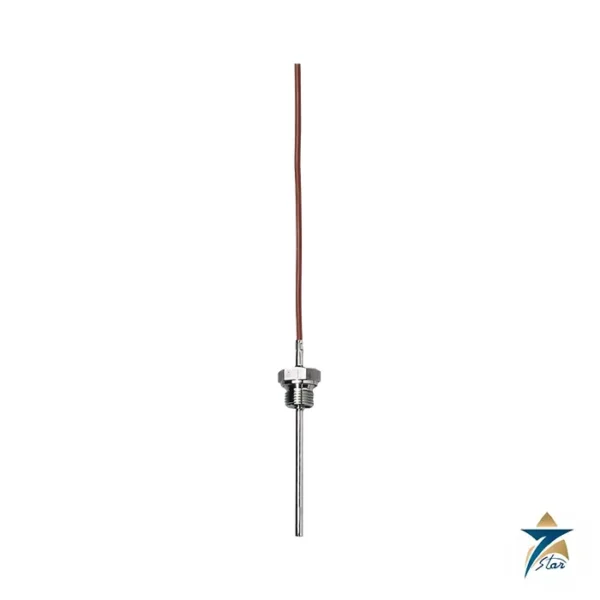
The JUMO FOODtemp (type 902350) is an insertion RTD temperature probe for temperatures between -50 and +260 degC. Its construction is steam-tight and pressure-resistant, with high mechanical strength, so it is especially suited to cooking, boiling and baking processes throughout food processing and preservation. JUMO names autoclaves and sterilizers as further areas. Several measuring points can be built into one probe.
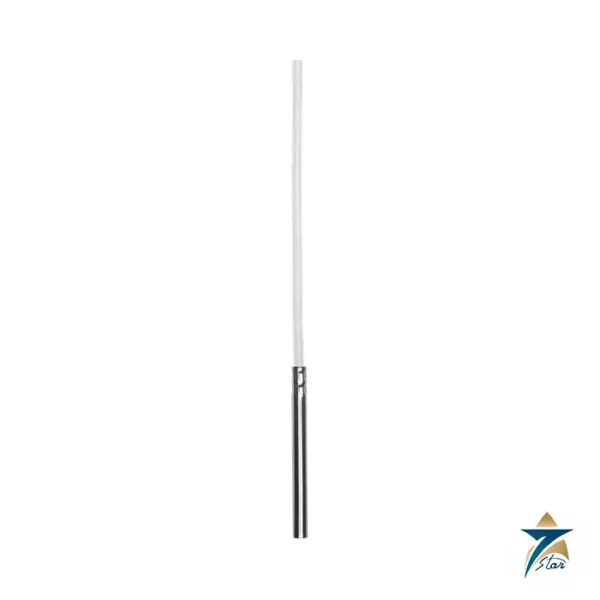
The probe tube is stainless steel 1.4571 with a diameter of 4 or 4.5 mm and a concentric or oblique tip (about 25 degrees or 45 degrees), which pierces food products more easily. All versions are highly vibration-resistant, and the handles are oil-resistant and acid-proof. Handle materials include silicone, PTFE, FPM, PPS plastic and PEEK, with ambient limits of +200 degC for PPS, silicone and FPM and +260 degC for PTFE and PEEK. The standard measuring insert is a Pt100 to DIN EN 60751, class B, in 2-wire or 3-wire circuit, and the protection type is IP67.
Technical specifications
| Parameter |
Specification |
| Basic types |
902350/22 silicone handle 10 mm, silicone cable; /23 silicone handle, PTFE cable; /33 PTFE handle 12 mm; /63 PTFE handle 15 mm; /37, /38 miniature, FPM handle 6.5 mm; /43 PPS handle 20 mm; /83, /84 PEEK handle |
| Operating temperature |
-50 to +200 degC (380); -50 to +260 degC (386) |
| Measuring insert |
1 x Pt100 in 2-, 3- or 4-wire; 2 x Pt100 in 2- or 3-wire (not with silicone cable and 4 mm tube for 3-wire) |
| Tolerance class |
Class B (standard) or Class A to DIN EN 60751 |
| Probe tube |
Stainless steel 1.4571, 4 mm or 4.5 mm; miniature type 4 mm stepped to 2.5 mm |
| Tip |
Concentric or oblique (about 25 or 45 degrees) |
| Insertion length EL |
100, 150, 200 mm; miniature 30, 50, 80, 100 mm |
| Handle materials, ambient limit |
PPS, silicone, FPM max. +200 degC; PTFE, PEEK max. +260 degC |
| Connecting cable |
Silicone -50 to +180 degC; PTFE -50 to +260 degC; shielded option (317) |
| Cable end |
Bare ends, ferrules, plug-in sleeves or multi-pole plug connector |
| Cable length AL |
4000 mm standard; 500 to 500,000 mm in 500 mm steps |
| Protection type |
IP67 |
| Stock part numbers |
Include 00338150, 00085418, 00083365, 00325270, 00523228, 00523235 |
Choosing the FOODtemp handle, cable and tip
The order code reads basic type – operating temperature – measuring insert – tolerance class – tube diameter – insertion length – tip – cable end – cable length / extra code. The example is 902350/22 – 380 – 1003 – 1 – 4 – 100 – 3 – 11 – 4000 / 000, a silicone-handle probe with 4 mm oblique tip and ferrules. Operating-temperature code 380 corresponds to silicone and 386 to PTFE cable. The datasheet notes that double Pt100 in 3-wire circuit (2001) is not available with silicone cables and a 4 mm tube.
| Basic type |
Handle |
Cable |
| 902350/22 |
Silicone, 10 mm |
Silicone |
| 902350/23 |
Silicone, 10 mm |
PTFE |
| 902350/33, /63 |
PTFE, 12 mm / 15 mm |
PTFE |
| 902350/37, /38 |
FPM, 6.5 mm |
Silicone / shielded PTFE |
| 902350/43 |
PPS plastic, 20 mm |
PTFE |
| 902350/83, /84 |
PEEK |
PTFE |
Extra code 317 supplies a shielded connecting cable. Stock versions include 902350/22-380-1003-1-4-100-3-11-4000/000 (00338150) and 902350/43-380-1003-1-4-100-3-11-4000/000 (00083365).
Using insertion probes safely in food and sterilizer duty
Pick the handle by the hottest surface it will meet: silicone, FPM and PPS up to +200 degC, PTFE and PEEK up to +260 degC. An oblique tip pierces meat, dough and packaged goods more easily than a concentric tip, while the miniature types with the 2.5 mm tip are meant for thin products or small test points. Because the tube and handle are sealed, the probe withstands steam and pressure during cooking or sterilizing cycles, but cable ends must be kept outside the steam.
For process validation, connect the probe to a calibrated controller or recorder and consider tolerance class A or a calibration certificate. A 3-wire or 4-wire circuit removes the cable resistance from the reading, which matters when the cable is several metres long. Typical locations are cooking kettles, smokehouses, autoclaves, retorts, ovens and chillers in catering and food factories. Clean the handle with agents suited to its material; the datasheet only states that the handles are oil-resistant and acid-proof.
Spare handles and cable differ in how they are cleaned and sterilized. PEEK and PTFE handles tolerate up to +260 degC, whereas silicone, FPM and PPS tolerate up to +200 degC, so autoclave duty should use the former. The miniature types 902350/37 and /38 have a 6.5 mm FPM handle, a tube stepped from 4 mm to 2.5 mm and insertion lengths of 30, 50, 80 or 100 mm, which suit small samples. Connection cable end 80 provides a multi-pole plug connector in a type written in plain text, convenient where the probe must be unplugged for cleaning.
Documents and quotation
The JUMO data sheet 902350 (dated 2014-05-19) can be downloaded below. Seven Star LLC supplies JUMO probes from Muscat; send the basic type, temperature code, element, tube, tip and cable length and we will quote. More temperature sensors are listed under https://omansevenstar.com/product-category/sensors-transmitters/temperature/.





Reviews
There are no reviews yet.