A serial-to-Ethernet bridge for legacy RS-232, RS-422 and RS-485 devices
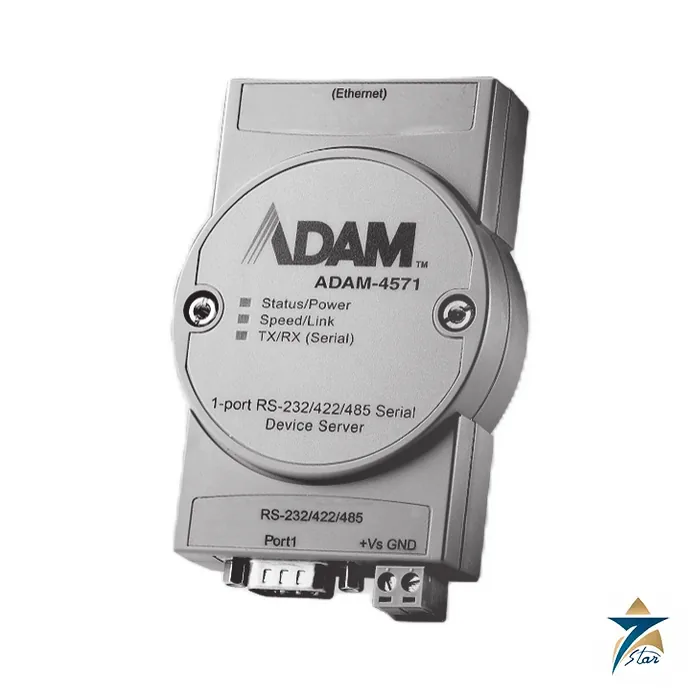
The Advantech ADAM-4571 is a one-port serial device server. It connects a single serial instrument, meter, PLC port or controller to a 10/100 Mbps Ethernet network so that software on a PC or server can talk to it over TCP/IP. The serial port is software selectable between RS-232, RS-422 and RS-485 and uses a DB9 male connector, which suits most older field devices.
Operation modes listed in the datasheet are COM port redirection (virtual COM), TCP and UDP server mode for polling, TCP and UDP client mode for event handling, and pair connection for peer-to-peer links between two servers. Configuration is done from the Advantech EKI Device Configuration Utility, a Telnet console or a web browser.
The same sheet covers the RS-232-only ADAM-4571L and the two-port ADAM-4570 and ADAM-4570L.
Technical specifications
| Parameter |
Specification |
| Ethernet |
IEEE 802.3 and 802.3u; 10/100 Mbps; 1 x 8-pin RJ45; 1.5 kV magnetic isolation |
| Serial port |
1 port, software selectable RS-232/422/485 (ADAM-4571L: RS-232 only); DB9 male |
| Baud rate |
50 bps to 921.6 kbps, any baud rate setting |
| Data bits / stop bits |
5, 6, 7, 8 / 1, 1.5, 2 |
| Parity / flow control |
None, odd, even, space, mark / XON-XOFF and RTS-CTS |
| Serial protection |
15 kV ESD protection on all signals |
| Operation modes |
COM port redirection, TCP/UDP server, TCP/UDP client, pair connection |
| Network protocols |
ARP, ICMP, IP, TCP, UDP, BOOTP, DHCP client, Auto IP, Telnet, SNMP, HTTP, DNS, SMTP |
| Operating systems |
32/64-bit Windows XP, Vista, 7, 8, Windows Server 2003/2008/2008 R2/2012, Windows CE 5.0 and Linux |
| Power input / consumption |
10 to 30 VDC on a terminal block; 2.5 W |
| Enclosure / mounting |
ABS plus PC; DIN-rail, stack or wall mounting |
| Dimensions (W x H x D) |
70 x 130 x 30 mm |
| Weight |
135 g (ADAM-4571/4571L) |
| Operating temperature |
-10 to 60 degrees C (14 to 140 degrees F) |
| Storage temperature / humidity |
-20 to 80 degrees C; operating humidity 5 to 95% RH |
| Approvals |
CE; FCC Part 15 Subpart B Class A |
| Reboot protection |
Built-in watchdog timer |
Ordering codes in the datasheet
The four codes are ADAM-4571-CE (1-port RS-232/422/485), ADAM-4571L-DE (1-port RS-232), ADAM-4570-CE (2-port RS-232/422/485) and ADAM-4570L-DE (2-port RS-232). The 2-port units include two 1 m RJ48-to-DB9 male cables.
Pick the ADAM-4571 when a single instrument needs a network link and the interface may be RS-422 or RS-485 as well as RS-232. Pick the two-port ADAM-4570 when two serial devices sit in the same cabinet. Where a remote I/O module is needed instead of a serial bridge, see the ADAM-4017+ analog input module already listed on this site.
What to confirm before ordering
Check the serial standard, connector gender and baud rate of the device, the operating system of the host that will use the virtual COM driver, and the available supply between 10 and 30 VDC. The listed Windows versions are older ones, so confirm driver availability for the version you run.
How the Advantech ADAM-4571 works
Many instruments, meters and controllers only have a serial port. A serial device server puts that port on the Ethernet network, so that software on a PC or a server can talk to it by TCP/IP. The ADAM-4571 has one serial port that is selected by software as RS-232, RS-422 or RS-485, with a DB9 male connector, and one RJ45 port for 10/100 Mbps Ethernet. In COM port redirection mode the software sees a virtual COM port, so older programs run unchanged.
Where the ADAM-4571 is used
- Connecting a serial instrument to a network.
- Meters and controllers with an RS-485 port.
- PLC serial ports that need remote access.
- Legacy equipment in plants that are being modernised.
- Data collection by SCADA systems from remote serial devices.
Selection checklist for the ADAM-4571
- One port, RS-232/422/485 by software.
- Baud rate of 50 bps to 921.6 kbps.
- Data bits of 5 to 8 and stop bits of 1, 1.5 or 2.
- Parity: none, odd, even, space or mark.
- Flow control: XON-XOFF and RTS-CTS.
- 15 kV ESD protection on the serial signals.
- Operation modes: COM redirection, TCP/UDP server, TCP/UDP client and pair connection.
- Power of 10 to 30 VDC, 2.5 W.
- Operating range of -10 to 60 degrees C.
- Size of 70 x 130 x 30 mm and weight of 135 g.
Installation, commissioning and maintenance notes
Mount the unit on a DIN rail, on a wall or in a stack, and supply it with 10 to 30 VDC. Connect the serial device with the right cable for RS-232, RS-422 or RS-485, and connect the Ethernet port to the network. Use the EKI Device Configuration Utility, a Telnet console or a web browser to set the IP address, the serial parameters and the mode. Test the link with the real software, and record the IP address and the serial settings for the site documents.
Requesting a quotation for the Advantech ADAM-4571
Send the number of serial devices and the interface that they use. Seven Star LLC serves industrial customers in Oman and the GCC and replies with a quotation based on the information provided.
Operation modes
TCP and UDP server mode is for polling, client mode is for event handling, and pair connection links two servers peer to peer.
Related models
The same datasheet covers the RS-232-only ADAM-4571L and the two-port ADAM-4570 and ADAM-4570L.
Network protocols
The unit supports ARP, ICMP, IP, TCP, UDP, DHCP client, Telnet, SNMP, HTTP and DNS, and it has a built-in watchdog timer for reboot protection.
Device server records
Record the IP address, the serial settings and the connected device of each unit.
Choosing the serial interface
Check whether the serial device uses RS-232 for a point-to-point cable, or RS-422 or RS-485 for longer runs and multi-drop lines. The mode is set in software, so one model covers all three, but the wiring on the DB9 connector must match the chosen interface.
Network planning
Give each unit a fixed IP address or a DHCP reservation, so that the software always finds it. Keep the unit on a protected network segment, because serial devices often have no security of their own.
Documents and quotation
The attached datasheet is the Advantech ADAM-4570/L and ADAM-4571/L sheet of February 2024. Send the quantity and port count to Seven Star LLC for a quotation. Other gateways and switches are grouped in Industrial Communications.










Reviews
There are no reviews yet.