Three-phase RMS sensing for PMG-excited alternators
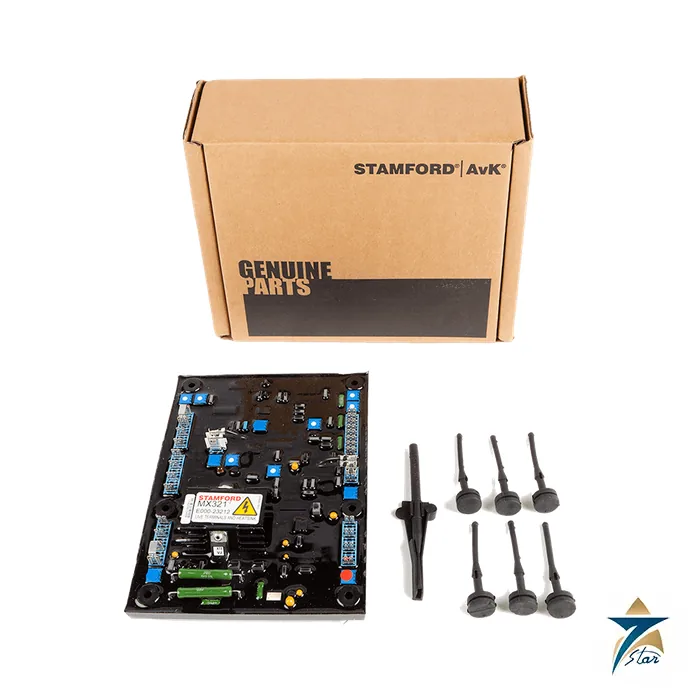
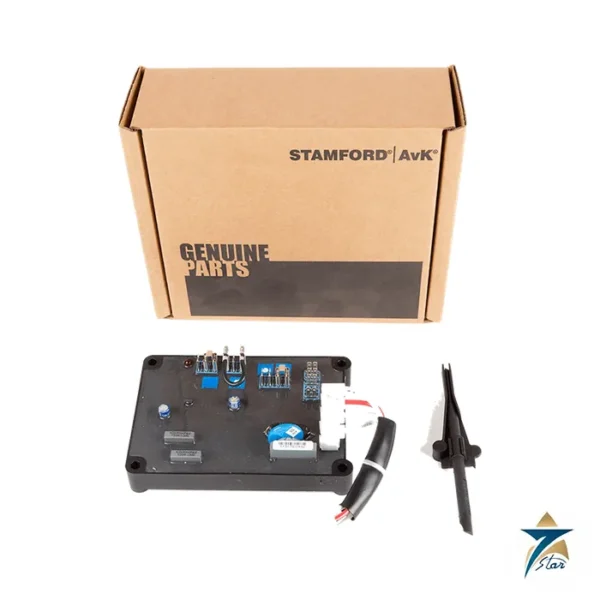
The STAMFORD MX321 is a three-phase sensed automatic voltage regulator for brushless generators. Its excitation power comes from a three-phase permanent magnet generator (PMG), which isolates the AVR control circuits from non-linear load effects, reduces radio-frequency interference on the generator terminals and gives sustained short-circuit current. It is the regulator named for the PMG excitation system on several STAMFORD frames.
Three-phase RMS sensing gives better regulation than single-phase average sensing: +/-0.5 percent RMS with 4 percent engine governing. Adjustable soft start brings the voltage up smoothly, and an under-frequency circuit with adjustable volts-per-hertz slope, dip and dwell helps turbocharged engines recover after load steps.
Technical specifications
| Parameter |
Specification |
| Part number (UC manual service parts) |
E000-23212/1P |
| Sensing input |
190-264 V ac max, 2 or 3 phase, 50-60 Hz |
| Power input (PMG) |
170-220 V ac max, 3 phase, 3 wire, 3 A/phase, 100-120 Hz |
| Output |
Max 120 V dc; 3.7 A continuous (derate from 3.7 A at 50 C to 2.7 A at 70 C); 6 A intermittent for 10 s |
| Exciter field resistance |
15 ohms minimum |
| Regulation |
+/-0.5% RMS with 4% engine governing |
| Thermal drift |
0.02% per degree C (after 10 minutes) |
| Soft start ramp time |
0.4-4 seconds |
| System response |
AVR 10 ms; field current to 90% 80 ms; machine volts to 97% 300 ms |
| External voltage adjustment |
+/-10% with 5 k ohm, 1 W trimmer (mod status E onwards) |
| Under-frequency protection |
Set point 95% Hz; slope 100-300% down to 30 Hz; max dwell 20% volts/s recovery |
| Analogue input |
+/-5 V dc max; 1 V for 5% generator volts; 1 k ohm |
| Droop input |
10 ohm burden; 0.22 A for 5% droop at 0 PF; max 0.33 A |
| Current limit input |
10 ohm burden; sensitivity 0.5-1 A |
| Over-voltage detector |
Set point 300 V, 1 s delay; CB trip coil 10-30 V dc, 20-60 ohms |
| Over-excitation protection |
Set point 75 V dc, delay 8-15 s |
| Power dissipation |
18 W maximum |
| Environment |
Operating -40 to +70 C; humidity 95% non-condensing; storage -55 to +80 C |
Controls on the board
Eleven trimmers are listed: VOLTS, STABILITY, UFRO, DROOP, TRIM, EXC, DIP, DWELL, I LIMIT, OVER V and RAMP. A jumper selects the stability setting for generators below 90 kW, between 90 and 550 kW, or above 550 kW. The EXC setting is sealed at the works and should not be altered. Current limiting through an optional CT lets the set manage its sustained short-circuit current, while the over-voltage circuit can trip an optional excitation circuit breaker.
Selection and installation notes
Confirm the sensing connection (two or three phase) and the PMG output voltage on the alternator wiring diagram before fitting. Do not increase voltage above the rating plate figure, and never ground the hand-trimmer terminals, which can be above earth potential. Any device on the analogue input must be fully floating with 500 V ac insulation. Replacement units require the VOLTS control to be turned fully anti-clockwise before the generator runs.
| AVR |
Excitation power |
Sensing |
Max. continuous output |
Regulation |
| SX460 |
From generator terminals |
95-132 or 190-264 V ac, 1 phase |
4 A dc |
+/-1.0% |
| AS440 |
From stator or auxiliary winding |
100-130 or 190-264 V ac, 1 phase |
4 A dc |
+/-1.0% |
| AS480 |
From stator, optional EBS boost |
100-264 V ac, 1 phase |
5 A dc |
+/-1.0% |
| MX341 |
PMG, 3-phase |
190-264 V ac, 1 phase, 2 wire |
2.7 A dc |
+/-1% |
| MX342 |
PMG, 3-phase |
190-264 V ac, 1 phase, 2 wire |
2.7 A dc |
+/-1% average sensing |
| MX321 |
PMG, 3-phase |
190-264 V ac, 2 or 3 phase |
3.7 A dc |
+/-0.5% RMS |
| DM110 |
PMG or other source, digital PWM |
Up to 600 V ac, no PT needed |
7 A dc |
0.5% |
Key features of the MX321
- PMG excitation supply – the regulator draws its power from a separate permanent magnet generator, so excitation does not collapse when the main output voltage dips during motor starting or a fault.
- True RMS three-phase sensing – averages all phases, which keeps the voltage steadier when loads are unbalanced or when non-linear loads distort the waveform.
- Built-in protection functions – under-frequency roll-off, over-excitation shutdown and an over-voltage detector that can trip an excitation breaker.
- Parallel operation support – a droop input from a current transformer allows reactive load sharing between generators.
- External control inputs – a remote trimmer for voltage setting and an analogue input for accessories such as a power factor controller.
Commissioning and adjustment guidance
Commissioning should follow the STAMFORD AVR manual for the specific alternator frame. In general terms, set the stability jumper for the generator output range first, then bring the set to rated speed with the voltage trimmer at a conservative position and adjust upwards. Stability should be adjusted so the voltage recovers quickly after a load step without hunting. The UFRO knee point must match the engine’s nominal frequency (50 Hz or 60 Hz), otherwise the AVR may reduce voltage at normal speed. DIP and DWELL are tuned together with the engine governor so that turbocharged engines are not overloaded after a large block load.
Paralleling and droop
When generators run in parallel, each AVR needs a droop CT in the correct phase and with correct polarity. A reversed CT produces rising instead of falling voltage with reactive load and causes circulating currents between sets. The droop trimmer should be set consistently across sets sharing the same busbar.
Replacing an existing AVR
The MX321 is wired for PMG-excited machines. It is not a direct swap for a self-excited regulator unless the alternator already has a PMG fitted. When replacing a failed unit, record the existing wiring, trimmer positions and jumper setting before removal, check the exciter field resistance and the PMG output, and look for the cause of failure – for example a shorted rotating diode or a damaged exciter – so the new regulator is not damaged straight away. Fit the unit on its anti-vibration mounts where supplied, and keep sensing and PMG wiring separated from power cables.
Operating in Oman and GCC conditions
Standby and prime-power generators in Oman are often installed in desert sites, oil and gas facilities, telecom shelters and coastal plants. High enclosure temperatures are the main concern: the output current derating with ambient temperature shown in the specification table should be checked against the actual temperature inside the terminal box, not the outside air. Dust ingress and salt-laden air near the coast make periodic cleaning of the AVR and its terminals worthwhile, and loose connections caused by vibration and thermal cycling are a common cause of voltage instability. Keeping a spare MX321 on site is a practical step for remote, critical gensets where a regulator failure would otherwise stop the whole installation.
Routine checks
- Inspect and retighten terminal connections during scheduled genset maintenance.
- Check that the AVR is clean and that cooling around the heatsink is not obstructed.
- Confirm voltage stability under a load step during periodic load-bank tests.
- Verify that any external voltage trimmer and accessory wiring is undamaged.
What to include in your RFQ
Quote MX321 and the part number on the existing unit or in the alternator manual, the alternator model and serial number, and the rated voltage and frequency. State whether the request is for a replacement, a spare or a new installation, the quantity, and whether accessories such as a droop CT or remote voltage trimmer are also needed. A photograph of the alternator nameplate and the existing AVR label helps us confirm the correct item.
Documents and quotation
Seven Star LLC supplies STAMFORD MX321 regulators on request. The datasheet is attached. Please send the alternator frame, serial number and the existing AVR code. See Diesel Generator Spare Parts for related components, or the Cummins C1000D5B 1000 kVA diesel generator set for a complete 1 MVA set. Check the modification status against your old unit when ordering a replacement.





Reviews
There are no reviews yet.